[English] 日本語
Yorodumi Papers
- Database of articles cited by EMDB/PDB/SASBDB data -

+
Search query

Keywords
Structure methods
Author
Journal
IF

-
Structure paper

TitleMetabolite-gated vascular contractility switch: OXGR1 activation mechanism enables agonist therapy for rosacea erythema.
Journal, issue, pagesCell, Year 2026
Publish dateMar 5, 2026
AuthorsWenqin Xiao / Yan Zhu / Xinjie Tang / Kongkai Zhu / Weifeng Zhang / Mengting Chen / Kui Cai / San Xu / Zheng Wu / Mei Wang / Jiayi Liu / Linglong Long / Zixin Tan / Aike Wu / Songqi Zhou / Zhixiang Zhao / Yan Tang / Yingxue Huang / Ben Wang / Fangfen Liu / Qian Wang / Fan Yang / Dan Jian / Wei Shi / Hongfu Xie / Xiang Chen / Lulu Guo / Zhili Deng / Jinpeng Sun / Ji Li /
PubMed AbstractRosacea, an inflammatory skin disorder, poses a dilemma owing to limited effectiveness of treatments for pathological vasodilation-mediated erythema. Here, we identify oxoglutaric acid (α-KG) as a ...Rosacea, an inflammatory skin disorder, poses a dilemma owing to limited effectiveness of treatments for pathological vasodilation-mediated erythema. Here, we identify oxoglutaric acid (α-KG) as a rosacea-associated metabolite elevated in patients and correlated with erythema severity. Exogenous α-KG administration ameliorates rosacea-like manifestations in murine models. Mechanistically, α-KG activates OXGR1, a vascular smooth muscle cell (VSMC)-enriched G protein-coupled receptor (GPCR) to induce Gq signaling and enhance MYL9 phosphorylation, promoting VSMC contraction and limiting vasodilation. Cryo-electron microscopy (cryo-EM) structures of OXGR1-Gq complexes bound to α-KG or itaconate reveal a specific bipartite-acid pocket recognizing its endogenous agonist and an activation mechanism distinct from classical GPCRs. Building on these structures, we developed A-1, a synthetic selective OXGR1 agonist that mitigates erythema and inflammation with efficacy comparable to first-line therapy while offering enhanced safety in rosacea-like models. These findings link a metabolite to vascular dysfunction and nominate OXGR1 agonism for precision treatment of erythema and vascular disorders.
External linksCell / PubMed:41791372
MethodsEM (single particle)
Resolution2.4 - 2.7 Å
Structure data

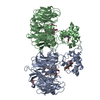
EMDB-65192, PDB-9vmn:
Cryo-EM structure of the a-KG-OXGR1-Gq complex
Method: EM (single particle) / Resolution: 2.6 Å

EMDB-65193, PDB-9vmo:
Cryo-EM structure of the ITA-OXGR1-Gq complex
Method: EM (single particle) / Resolution: 2.4 Å

EMDB-65194, PDB-9vmp:
Cryo-EM structure of the A-1-OXGR1-Gq complex
Method: EM (single particle) / Resolution: 2.5 Å

EMDB-65222, PDB-9vo2:
Cryo-EM structure of the OXGR1(CA)-Gq complex
Method: EM (single particle) / Resolution: 2.7 Å

Chemicals

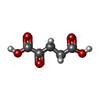
ChemComp-AKG:
2-OXOGLUTARIC ACID

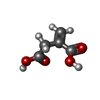
ChemComp-ITN:
2-methylidenebutanedioic acid

PDB-1e2r:
CYTOCHROME CD1 NITRITE REDUCTASE, REDUCED AND CYANIDE BOUND

Source
  • homo sapiens (human)
  • synthetic construct (others)
KeywordsMEMBRANE PROTEIN/IMMUNE SYSTEM / OXGR1 / Gq / a-KG / MEMBRANE PROTEIN / MEMBRANE PROTEIN-IMMUNE SYSTEM complex / ITA / A-1 / constitutive active

+
About Yorodumi Papers

-
News

-
Feb 9, 2022. New format data for meta-information of EMDB entries

New format data for meta-information of EMDB entries

  • Version 3 of the EMDB header file is now the official format.
  • The previous official version 1.9 will be removed from the archive.

Related info.:EMDB header

External links:wwPDB to switch to version 3 of the EMDB data model

-
Aug 12, 2020. Covid-19 info

Covid-19 info

URL: https://pdbj.org/emnavi/covid19.php

New page: Covid-19 featured information page in EM Navigator.

Related info.:Covid-19 info / Mar 5, 2020. Novel coronavirus structure data

+
Mar 5, 2020. Novel coronavirus structure data

Novel coronavirus structure data

Related info.:Yorodumi Speices / Aug 12, 2020. Covid-19 info

External links:COVID-19 featured content - PDBj / Molecule of the Month (242):Coronavirus Proteases

+
Jan 31, 2019. EMDB accession codes are about to change! (news from PDBe EMDB page)

EMDB accession codes are about to change! (news from PDBe EMDB page)

  • The allocation of 4 digits for EMDB accession codes will soon come to an end. Whilst these codes will remain in use, new EMDB accession codes will include an additional digit and will expand incrementally as the available range of codes is exhausted. The current 4-digit format prefixed with “EMD-” (i.e. EMD-XXXX) will advance to a 5-digit format (i.e. EMD-XXXXX), and so on. It is currently estimated that the 4-digit codes will be depleted around Spring 2019, at which point the 5-digit format will come into force.
  • The EM Navigator/Yorodumi systems omit the EMD- prefix.

Related info.:Q: What is EMD? / ID/Accession-code notation in Yorodumi/EM Navigator

External links:EMDB Accession Codes are Changing Soon! / Contact to PDBj

+
Jul 12, 2017. Major update of PDB

Major update of PDB

  • wwPDB released updated PDB data conforming to the new PDBx/mmCIF dictionary.
  • This is a major update changing the version number from 4 to 5, and with Remediation, in which all the entries are updated.
  • In this update, many items about electron microscopy experimental information are reorganized (e.g. em_software).
  • Now, EM Navigator and Yorodumi are based on the updated data.

External links:wwPDB Remediation / Enriched Model Files Conforming to OneDep Data Standards Now Available in the PDB FTP Archive

-
Yorodumi Papers

Database of articles cited by EMDB/PDB/SASBDB data

  • Database of articles cited by EMDB, PDB, and SASBDB entries
  • Using PubMed data

Related info.:EMDB / PDB / SASBDB / Yorodumi / EMN Papers / Changes in new EM Navigator and Yorodumi

Read more