 Movie
Movie Controller


+ Open data

- Basic information
| Entry | Database: PDB / ID: 9vmn | ||||||||||||||||||||||||
|---|---|---|---|---|---|---|---|---|---|---|---|---|---|---|---|---|---|---|---|---|---|---|---|---|---|
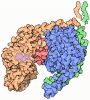
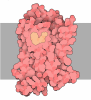
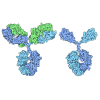
| Title | Cryo-EM structure of the a-KG-OXGR1-Gq complex | ||||||||||||||||||||||||
 Components Components |
| ||||||||||||||||||||||||
 Keywords Keywords | MEMBRANE PROTEIN/IMMUNE SYSTEM / OXGR1 / Gq / a-KG / MEMBRANE PROTEIN / MEMBRANE PROTEIN-IMMUNE SYSTEM complex | ||||||||||||||||||||||||
| Function / homology |  Function and homology information Function and homology informationClass A/1 (Rhodopsin-like receptors) / G protein-coupled receptor activity / Olfactory Signaling Pathway / phospholipase C-activating G protein-coupled receptor signaling pathway / Activation of the phototransduction cascade / G protein-coupled acetylcholine receptor signaling pathway / G beta:gamma signalling through PLC beta / Presynaptic function of Kainate receptors / Thromboxane signalling through TP receptor / Activation of G protein gated Potassium channels ...Class A/1 (Rhodopsin-like receptors) / G protein-coupled receptor activity / Olfactory Signaling Pathway / phospholipase C-activating G protein-coupled receptor signaling pathway / Activation of the phototransduction cascade / G protein-coupled acetylcholine receptor signaling pathway / G beta:gamma signalling through PLC beta / Presynaptic function of Kainate receptors / Thromboxane signalling through TP receptor / Activation of G protein gated Potassium channels / Inhibition of voltage gated Ca2+ channels via Gbeta/gamma subunits / G-protein activation / Glucagon signaling in metabolic regulation / G beta:gamma signalling through CDC42 / Prostacyclin signalling through prostacyclin receptor / Synthesis, secretion, and inactivation of Glucagon-like Peptide-1 (GLP-1) / photoreceptor disc membrane / G beta:gamma signalling through BTK / ADP signalling through P2Y purinoceptor 12 / Sensory perception of sweet, bitter, and umami (glutamate) taste / Glucagon-type ligand receptors / Adrenaline,noradrenaline inhibits insulin secretion / Vasopressin regulates renal water homeostasis via Aquaporins / G alpha (z) signalling events / Glucagon-like Peptide-1 (GLP1) regulates insulin secretion / ADP signalling through P2Y purinoceptor 1 / cellular response to catecholamine stimulus / G beta:gamma signalling through PI3Kgamma / ADORA2B mediated anti-inflammatory cytokines production / adenylate cyclase-activating dopamine receptor signaling pathway / cellular response to prostaglandin E stimulus / Cooperation of PDCL (PhLP1) and TRiC/CCT in G-protein beta folding / GPER1 signaling / heterotrimeric G-protein complex / G alpha (12/13) signalling events / Inactivation, recovery and regulation of the phototransduction cascade / signaling receptor activity / G-protein beta-subunit binding / extracellular vesicle / Thrombin signalling through proteinase activated receptors (PARs) / signaling receptor complex adaptor activity / GTPase binding / Ca2+ pathway / High laminar flow shear stress activates signaling by PIEZO1 and PECAM1:CDH5:KDR in endothelial cells / G alpha (i) signalling events / G alpha (s) signalling events / G alpha (q) signalling events / Ras protein signal transduction / innate immune response / Extra-nuclear estrogen signaling / G protein-coupled receptor signaling pathway / lysosomal membrane / GTPase activity / synapse / protein-containing complex binding / signal transduction / extracellular exosome / membrane / plasma membrane / cytosol Similarity search - Function | ||||||||||||||||||||||||
| Biological species |  Homo sapiens (human) Homo sapiens (human)synthetic construct (others) | ||||||||||||||||||||||||
| Method | ELECTRON MICROSCOPY / single particle reconstruction / cryo EM / Resolution: 2.6 Å | ||||||||||||||||||||||||
 Authors Authors | Tang, X.J. / Sun, J.P. / Guo, L.L. / Li, J. / Deng, Z.L. / Xiao, W.Q. / Zhu, Y. / Zhu, K.K. | ||||||||||||||||||||||||
| Funding support |  China, 1items China, 1items
| ||||||||||||||||||||||||
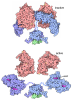
 Citation Citation | Journal: Cell / Year: 2026 Title: Metabolite-gated vascular contractility switch: OXGR1 activation mechanism enables agonist therapy for rosacea erythema. Authors: Wenqin Xiao / Yan Zhu / Xinjie Tang / Kongkai Zhu / Weifeng Zhang / Mengting Chen / Kui Cai / San Xu / Zheng Wu / Mei Wang / Jiayi Liu / Linglong Long / Zixin Tan / Aike Wu / Songqi Zhou / ...Authors: Wenqin Xiao / Yan Zhu / Xinjie Tang / Kongkai Zhu / Weifeng Zhang / Mengting Chen / Kui Cai / San Xu / Zheng Wu / Mei Wang / Jiayi Liu / Linglong Long / Zixin Tan / Aike Wu / Songqi Zhou / Zhixiang Zhao / Yan Tang / Yingxue Huang / Ben Wang / Fangfen Liu / Qian Wang / Fan Yang / Dan Jian / Wei Shi / Hongfu Xie / Xiang Chen / Lulu Guo / Zhili Deng / Jinpeng Sun / Ji Li / Abstract: Rosacea, an inflammatory skin disorder, poses a dilemma owing to limited effectiveness of treatments for pathological vasodilation-mediated erythema. Here, we identify oxoglutaric acid (α-KG) as a ...Rosacea, an inflammatory skin disorder, poses a dilemma owing to limited effectiveness of treatments for pathological vasodilation-mediated erythema. Here, we identify oxoglutaric acid (α-KG) as a rosacea-associated metabolite elevated in patients and correlated with erythema severity. Exogenous α-KG administration ameliorates rosacea-like manifestations in murine models. Mechanistically, α-KG activates OXGR1, a vascular smooth muscle cell (VSMC)-enriched G protein-coupled receptor (GPCR) to induce Gq signaling and enhance MYL9 phosphorylation, promoting VSMC contraction and limiting vasodilation. Cryo-electron microscopy (cryo-EM) structures of OXGR1-Gq complexes bound to α-KG or itaconate reveal a specific bipartite-acid pocket recognizing its endogenous agonist and an activation mechanism distinct from classical GPCRs. Building on these structures, we developed A-1, a synthetic selective OXGR1 agonist that mitigates erythema and inflammation with efficacy comparable to first-line therapy while offering enhanced safety in rosacea-like models. These findings link a metabolite to vascular dysfunction and nominate OXGR1 agonism for precision treatment of erythema and vascular disorders. | ||||||||||||||||||||||||
| History |
|
- Structure visualization
| Structure viewer | Molecule: MolmilJmol/JSmol |
|---|
- Downloads & links
-Download
| PDBx/mmCIF format | 9vmn.cif.gz | 211.5 KB | Display | PDBx/mmCIF format |
|---|---|---|---|---|
| PDB format | pdb9vmn.ent.gz | 161.7 KB | Display | PDB format |
| PDBx/mmJSON format | 9vmn.json.gz | Tree view | PDBx/mmJSON format | |
| Others |  Other downloads Other downloads |
-Validation report
| Arichive directory | https://data.pdbj.org/pub/pdb/validation_reports/vm/9vmnftp://data.pdbj.org/pub/pdb/validation_reports/vm/9vmn | HTTPS FTP |
|---|
-Related structure data
| Related structure data |  65192MC  9vmoC  9vmpC  9vo2C M: map data used to model this data C: citing same article ( |
|---|---|
| Similar structure data |


-Links
 PDBj
PDBj

- Assembly
| Deposited unit | 
|
|---|---|
| 1 |
|
-Components
-Guanine nucleotide-binding protein ... , 3 types, 3 molecules ABG
| #1: Protein | Mass: 41244.766 Da / Num. of mol.: 1 Source method: isolated from a genetically manipulated source Source: (gene. exp.) Homo sapiens (human) / Production host:   Spodoptera frugiperda (fall armyworm) Spodoptera frugiperda (fall armyworm) |
|---|---|
| #2: Protein | Mass: 37198.656 Da / Num. of mol.: 1 Source method: isolated from a genetically manipulated source Source: (gene. exp.) Homo sapiens (human) / Gene: GNB1 / Production host: Spodoptera frugiperda (fall armyworm) / References: UniProt: P62873 |
| #3: Protein | Mass: 5660.541 Da / Num. of mol.: 1 Source method: isolated from a genetically manipulated source Source: (gene. exp.) Homo sapiens (human) / Gene: GNG2 / Production host: Spodoptera frugiperda (fall armyworm) / References: UniProt: P59768 |
-Protein / Antibody / Non-polymers , 3 types, 3 molecules RS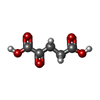
| #4: Protein | Mass: 33758.148 Da / Num. of mol.: 1 Source method: isolated from a genetically manipulated source Source: (gene. exp.) Homo sapiens (human) / Gene: OXGR1, GPR80, GPR99, P2RY15, P2Y15 / Production host: Spodoptera frugiperda (fall armyworm) / References: UniProt: Q96P68 |
|---|---|
| #5: Antibody | Mass: 26277.299 Da / Num. of mol.: 1 Source method: isolated from a genetically manipulated source Source: (gene. exp.) synthetic construct (others) / Production host: Spodoptera frugiperda (fall armyworm) |
| #6: Chemical | ChemComp-AKG / 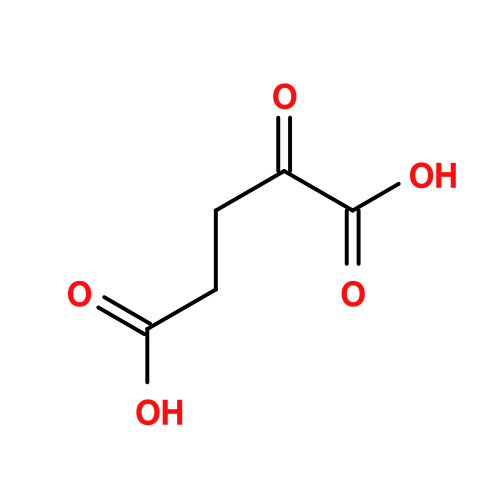 Mass: 146.098 Da / Num. of mol.: 1 / Source method: obtained synthetically / Formula: C5H6O5 / Feature type: SUBJECT OF INVESTIGATION Mass: 146.098 Da / Num. of mol.: 1 / Source method: obtained synthetically / Formula: C5H6O5 / Feature type: SUBJECT OF INVESTIGATION |
-Details
| Has ligand of interest | Y |
|---|---|
| Has protein modification | Y |
-Experimental details
-Experiment
| Experiment | Method: ELECTRON MICROSCOPY |
|---|---|
| EM experiment | Aggregation state: PARTICLE / 3D reconstruction method: single particle reconstruction |
- Sample preparation
| Component | Name: Cryo-EM structure of the AKG-OXGR1-Gq complex / Type: COMPLEX / Entity ID: #1-#5 / Source: MULTIPLE SOURCES |
|---|---|
| Source (natural) | Organism: Homo sapiens (human) |
| Source (recombinant) | Organism: Spodoptera frugiperda (fall armyworm) |
| Buffer solution | pH: 7.4 |
| Specimen | Embedding applied: NO / Shadowing applied: NO / Staining applied: NO / Vitrification applied: YES |
| Vitrification | Cryogen name: ETHANE |
- Electron microscopy imaging
| Experimental equipment |  Model: Titan Krios / Image courtesy: FEI Company |
|---|---|
| Microscopy | Model: TFS KRIOS |
| Electron gun | Electron source:  FIELD EMISSION GUN / Accelerating voltage: 300 kV / Illumination mode: FLOOD BEAM FIELD EMISSION GUN / Accelerating voltage: 300 kV / Illumination mode: FLOOD BEAM |
| Electron lens | Mode: DIFFRACTION / Nominal defocus max: 2000 nm / Nominal defocus min: 1000 nm |
| Image recording | Electron dose: 1.875 e/Å2 / Film or detector model: GATAN K3 (6k x 4k) |
- Processing
| EM software |
| |||||||||
|---|---|---|---|---|---|---|---|---|---|---|
| CTF correction | Type: NONE | |||||||||
| 3D reconstruction | Resolution: 2.6 Å / Resolution method: FSC 0.143 CUT-OFF / Num. of particles: 462777 / Symmetry type: POINT |
