[English] 日本語
Yorodumi Papers
- Database of articles cited by EMDB/PDB/SASBDB data -

+
Search query

Keywords
Structure methods
Author
Journal
IF

-
Structure paper

TitleStructural insight into GPR155-mediated cholesterol sensing and signal transduction.
Journal, issue, pagesSci Bull (Beijing), Vol. 70, Issue 21, Page 3625-3637, Year 2025
Publish dateNov 15, 2025
AuthorsDelin Li / Xiaokang Zhang / Jie Feng / Yufeng Xie / Pu Han / Ming He / Lin Hao / Tianling Guo / Xiaoyi Bai / Kai Yuan / Junqing Sun / Xuefei Pang / Yan Wu / Yingxia Liu / George Fu Gao / Niu Huang / Haixia Xiao / Feng Gao /
PubMed AbstractCholesterol (CHL) serves as a building block for membrane biogenesis and a precursor to oxysterols, steroid hormones, bile acids, and vitamin D. The lysosome serves as a major sorting station for low- ...Cholesterol (CHL) serves as a building block for membrane biogenesis and a precursor to oxysterols, steroid hormones, bile acids, and vitamin D. The lysosome serves as a major sorting station for low-density lipoproteins (LDLs), which carry dietary CHL, and it is also the cellular site where the master growth regulator, the protein kinase mechanistic Target of Rapamycin Complex 1 (mTORC1), is activated. Recently, the lysosomal transmembrane protein GPR155 was reported to signals CHL sufficiency to mTORC1 through sequestration of the GTPase-activating protein towards the Rags 1 (GATOR1). Although the recently reported structures of GPR155 have revealed the CHL binding site, how the signal is transduced from the CHL binding site to the soluble parts of GPR155 and GATOR1 remains unknown. Here, with our three cryo-EM structures of GPR155 captured in different conformations in complex with CHL, complemented by long-time scale molecular dynamics simulations, the dynamic rearrangement of different domains was observed. CHL binding induces a widening of the crevice between the transporter and GPCR domains. The extending helix preceding transmembrane helix (TM) 16, which was unresolved in other structures, acts as a linkage lever that transmits the rotation of the GPCR domain to the soluble parts of GPR155 in response to CHL binding. This work not only answers the question of how CHL is sensed by GPR155, but also addresses a more profound question: how the signal perceived by the TMs regions is transduced to the LED and DEP domains.
External linksSci Bull (Beijing) / PubMed:41058362
MethodsEM (single particle)
Resolution2.79 - 5.62 Å
Structure data

EMDB-63104, PDB-9lhq:
Cryo-EM structure of GPR155 monomer in complex with cholesterol
Method: EM (single particle) / Resolution: 3.46 Å

EMDB-63106, PDB-9lhv:
Cryo-EM structure of GPR155 contracted dimer in complex with cholesterol
Method: EM (single particle) / Resolution: 2.79 Å

EMDB-63107: Cryo-EM map of GPR155 extended dimer
PDB-9lhx: Rigid fitting model of GPR155 extended dimer
Method: EM (single particle) / Resolution: 5.62 Å

Chemicals

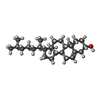
ChemComp-CLR:
CHOLESTEROL

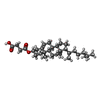
ChemComp-Y01:
CHOLESTEROL HEMISUCCINATE

Source
  • homo sapiens (human)
KeywordsMEMBRANE PROTEIN / cholesterol / mTORC1 regulation / GPCR / transceptor

+
About Yorodumi Papers

-
News

-
Feb 9, 2022. New format data for meta-information of EMDB entries

New format data for meta-information of EMDB entries

  • Version 3 of the EMDB header file is now the official format.
  • The previous official version 1.9 will be removed from the archive.

Related info.:EMDB header

External links:wwPDB to switch to version 3 of the EMDB data model

-
Aug 12, 2020. Covid-19 info

Covid-19 info

URL: https://pdbj.org/emnavi/covid19.php

New page: Covid-19 featured information page in EM Navigator.

Related info.:Covid-19 info / Mar 5, 2020. Novel coronavirus structure data

+
Mar 5, 2020. Novel coronavirus structure data

Novel coronavirus structure data

Related info.:Yorodumi Speices / Aug 12, 2020. Covid-19 info

External links:COVID-19 featured content - PDBj / Molecule of the Month (242):Coronavirus Proteases

+
Jan 31, 2019. EMDB accession codes are about to change! (news from PDBe EMDB page)

EMDB accession codes are about to change! (news from PDBe EMDB page)

  • The allocation of 4 digits for EMDB accession codes will soon come to an end. Whilst these codes will remain in use, new EMDB accession codes will include an additional digit and will expand incrementally as the available range of codes is exhausted. The current 4-digit format prefixed with “EMD-” (i.e. EMD-XXXX) will advance to a 5-digit format (i.e. EMD-XXXXX), and so on. It is currently estimated that the 4-digit codes will be depleted around Spring 2019, at which point the 5-digit format will come into force.
  • The EM Navigator/Yorodumi systems omit the EMD- prefix.

Related info.:Q: What is EMD? / ID/Accession-code notation in Yorodumi/EM Navigator

External links:EMDB Accession Codes are Changing Soon! / Contact to PDBj

+
Jul 12, 2017. Major update of PDB

Major update of PDB

  • wwPDB released updated PDB data conforming to the new PDBx/mmCIF dictionary.
  • This is a major update changing the version number from 4 to 5, and with Remediation, in which all the entries are updated.
  • In this update, many items about electron microscopy experimental information are reorganized (e.g. em_software).
  • Now, EM Navigator and Yorodumi are based on the updated data.

External links:wwPDB Remediation / Enriched Model Files Conforming to OneDep Data Standards Now Available in the PDB FTP Archive

-
Yorodumi Papers

Database of articles cited by EMDB/PDB/SASBDB data

  • Database of articles cited by EMDB, PDB, and SASBDB entries
  • Using PubMed data

Related info.:EMDB / PDB / SASBDB / Yorodumi / EMN Papers / Changes in new EM Navigator and Yorodumi

Read more