 Movie
Movie Controller
 Structure viewers
 About Yorodumi Papers


+Search query
-Structure paper
| Title | Interface swapping orchestrates carbon transfer in the archaeal acetyl-CoA decarbonylase/synthase. |
|---|---|
| Journal, issue, pages | bioRxiv, Year 2026 |
| Publish date | Jul 8, 2026 |
 Authors Authors | Erik Zimmer / Tristan Reif-Trauttmansdorff / Anthony Ciancone / Sofia Appelgren / Jörg Kahnt / Darja Deobald / Frank Abendroth / Olalla Vázquez / Georg K A Hochberg / Francis J O'Reilly / Jan M Schuller /   |
| PubMed Abstract | The Wood-Ljungdahl pathway is one of biology's most ancient routes for carbon fixation and energy metabolism, used by organisms such as methanogenic archaea. One of its central metabolic complexes is ...The Wood-Ljungdahl pathway is one of biology's most ancient routes for carbon fixation and energy metabolism, used by organisms such as methanogenic archaea. One of its central metabolic complexes is the acetyl-CoA decarbonylase/synthase (ACDS) complex, catalyzing acetyl-CoA synthesis and cleavage through the coordinated action of carbon monoxide dehydrogenase (CODH), acetyl-CoA synthase (ACS), and corrinoid iron-sulfur protein (CoFeSP). Unlike bacterial CODH/ACS, archaeal ACDS lacks a stable bifunctional CODH-ACS architecture, raising the question of how reactive CO and methyl intermediates are efficiently transferred between catalytic modules. Using cryo-electron microscopy, crosslinking mass spectrometry, small-angle X-ray scattering, and biophysical analyses, we resolved the organization and dynamics of the ~2 MDa archaeal ACDS supercomplex from . We identified CoFeSP as a central architectural scaffold that self-assembles into hexa- to octameric oligomers via a conserved N-terminal region of the CdhD subunit. This scaffold likely tethers CODH and ACS through conserved disordered terminal regions, positioning the catalytic modules in the complex's periphery. We propose a mechanism in which ACS transiently alternates between CODH and CoFeSP, enabling efficient CO and methyl-group transfer without stable binary complexes. This dynamic organization represents a fundamental difference to the stable bifunctional CODH/ACS in bacteria, highlighting how transient interactions enable efficient acetyl-CoA metabolism in archaea. |
 External links External links | bioRxiv / PubMed:42465409 / PubMed Central |
| Methods | EM (single particle) |
| Resolution | 3.55 - 19.59 Å |
| Structure data |  EMDB-58600: Cryo-EM map of the acetyl-CoA decarbonylase/synthase (ACDS) complex from Methanosarcina acetivorans EMDB-58601, PDB-31ox: |
| Chemicals | 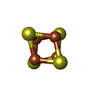 ChemComp-SF4:  ChemComp-RQM: |
| Source |
|
 Keywords Keywords | METAL BINDING PROTEIN / methanogenesis / acetyl-CoA / anaerobic metabolism / CO dehydrogenase |


 methanosarcina acetivorans (archaea)