 Movie
Movie Controller

[English] 日本語
 Yorodumi
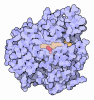
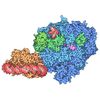
- PDB-31ox: Cryo-EM structure of the CO dehydrogenase (CODH) subcomplex from ... -
+ Open data

- Basic information
| Entry | Database: PDB / ID: 31ox | |||||||||||||||||||||||||||
|---|---|---|---|---|---|---|---|---|---|---|---|---|---|---|---|---|---|---|---|---|---|---|---|---|---|---|---|---|
| Title | Cryo-EM structure of the CO dehydrogenase (CODH) subcomplex from Methanosarcina acetivorans | |||||||||||||||||||||||||||
 Components Components |
| |||||||||||||||||||||||||||
 Keywords Keywords | METAL BINDING PROTEIN / methanogenesis / acetyl-CoA / anaerobic metabolism / CO dehydrogenase | |||||||||||||||||||||||||||
| Function / homology |  Function and homology information Function and homology informationmethanogenesis, from acetate / nitric oxide catabolic process / anaerobic carbon monoxide dehydrogenase / hydroxylamine reductase activity / anaerobic carbon-monoxide dehydrogenase activity / acetyl-CoA metabolic process / nickel cation binding / response to hydrogen peroxide / peroxidase activity / 4 iron, 4 sulfur cluster binding / iron ion binding Similarity search - Function | |||||||||||||||||||||||||||
| Biological species |  Methanosarcina acetivorans (archaea) Methanosarcina acetivorans (archaea) | |||||||||||||||||||||||||||
| Method | ELECTRON MICROSCOPY / single particle reconstruction / cryo EM / Resolution: 3.55 Å | |||||||||||||||||||||||||||
 Authors Authors | Zimmer, E. / Reif-Trauttmansdorff, T. / Schuller, J.M. | |||||||||||||||||||||||||||
| Funding support | European Union,  Germany, 2items Germany, 2items
| |||||||||||||||||||||||||||
 Citation Citation | Journal: bioRxiv / Year: 2026 Title: Interface swapping orchestrates carbon transfer in the archaeal acetyl-CoA decarbonylase/synthase. Authors: Erik Zimmer / Tristan Reif-Trauttmansdorff / Anthony Ciancone / Sofia Appelgren / Jörg Kahnt / Darja Deobald / Frank Abendroth / Olalla Vázquez / Georg K A Hochberg / Francis J O'Reilly / Jan M Schuller /  Abstract: The Wood-Ljungdahl pathway is one of biology's most ancient routes for carbon fixation and energy metabolism, used by organisms such as methanogenic archaea. One of its central metabolic complexes is ...The Wood-Ljungdahl pathway is one of biology's most ancient routes for carbon fixation and energy metabolism, used by organisms such as methanogenic archaea. One of its central metabolic complexes is the acetyl-CoA decarbonylase/synthase (ACDS) complex, catalyzing acetyl-CoA synthesis and cleavage through the coordinated action of carbon monoxide dehydrogenase (CODH), acetyl-CoA synthase (ACS), and corrinoid iron-sulfur protein (CoFeSP). Unlike bacterial CODH/ACS, archaeal ACDS lacks a stable bifunctional CODH-ACS architecture, raising the question of how reactive CO and methyl intermediates are efficiently transferred between catalytic modules. Using cryo-electron microscopy, crosslinking mass spectrometry, small-angle X-ray scattering, and biophysical analyses, we resolved the organization and dynamics of the ~2 MDa archaeal ACDS supercomplex from . We identified CoFeSP as a central architectural scaffold that self-assembles into hexa- to octameric oligomers via a conserved N-terminal region of the CdhD subunit. This scaffold likely tethers CODH and ACS through conserved disordered terminal regions, positioning the catalytic modules in the complex's periphery. We propose a mechanism in which ACS transiently alternates between CODH and CoFeSP, enabling efficient CO and methyl-group transfer without stable binary complexes. This dynamic organization represents a fundamental difference to the stable bifunctional CODH/ACS in bacteria, highlighting how transient interactions enable efficient acetyl-CoA metabolism in archaea. | |||||||||||||||||||||||||||
| History |
|
- Structure visualization
| Structure viewer | Molecule: MolmilJmol/JSmol |
|---|
- Downloads & links
-Download
| PDBx/mmCIF format | 31ox.cif.gz | 702.9 KB | Display | PDBx/mmCIF format |
|---|---|---|---|---|
| PDB format | pdb31ox.ent.gz | 487.7 KB | Display | PDB format |
| PDBx/mmJSON format | 31ox.json.gz | Tree view | PDBx/mmJSON format | |
| Others |  Other downloads Other downloads |
-Validation report
| Arichive directory | https://data.pdbj.org/pub/pdb/validation_reports/1o/31oxftp://data.pdbj.org/pub/pdb/validation_reports/1o/31ox | HTTPS FTP |
|---|
-Related structure data
| Related structure data |  58601MC C: citing same article ( M: map data used to model this data |
|---|---|
| Similar structure data |

-Links
 PDBj
PDBj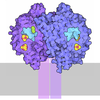
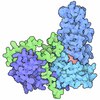
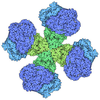
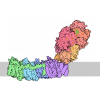
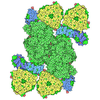
- Assembly
| Deposited unit | 
|
|---|---|
| 1 |
|
-Components
| #1: Protein | Mass: 18487.211 Da / Num. of mol.: 2 / Source method: isolated from a natural source / Source: (natural) Methanosarcina acetivorans (archaea) / Strain: MCD31 / References: UniProt: Q8TJC5#2: Protein | Mass: 88055.109 Da / Num. of mol.: 2 / Source method: isolated from a natural source / Source: (natural) Methanosarcina acetivorans (archaea) / Strain: MCD31References: UniProt: Q8TJC6, anaerobic carbon monoxide dehydrogenase #3: Chemical | ChemComp-SF4 / 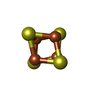 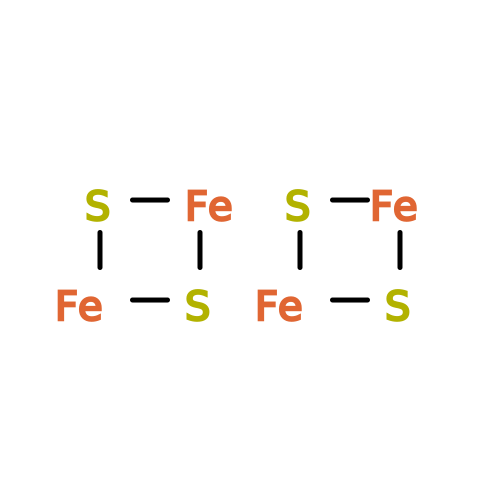 Mass: 351.640 Da / Num. of mol.: 7 / Source method: obtained synthetically / Formula: Fe4S4 / Feature type: SUBJECT OF INVESTIGATION Mass: 351.640 Da / Num. of mol.: 7 / Source method: obtained synthetically / Formula: Fe4S4 / Feature type: SUBJECT OF INVESTIGATION#4: Chemical |  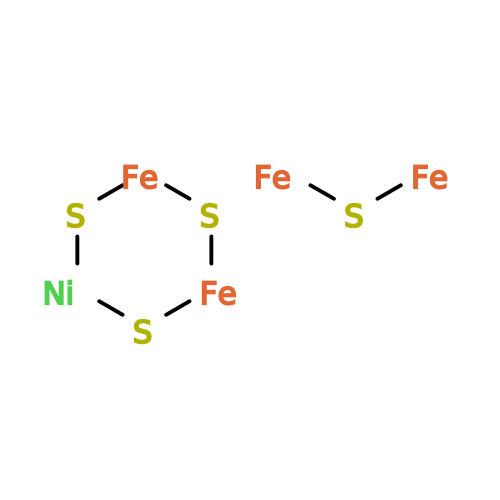 Mass: 410.333 Da / Num. of mol.: 2 / Source method: obtained synthetically / Formula: Fe4NiS4 / Feature type: SUBJECT OF INVESTIGATION Mass: 410.333 Da / Num. of mol.: 2 / Source method: obtained synthetically / Formula: Fe4NiS4 / Feature type: SUBJECT OF INVESTIGATIONHas ligand of interest | Y | Has protein modification | N | |
|---|
-Experimental details
-Experiment
| Experiment | Method: ELECTRON MICROSCOPY |
|---|---|
| EM experiment | Aggregation state: PARTICLE / 3D reconstruction method: single particle reconstruction |
- Sample preparation
| Component | Name: CO dehydrogenase (CODH) isoform Cdh2 / Type: COMPLEX / Entity ID: #1-#2 / Source: NATURAL | ||||||||||||||||||||
|---|---|---|---|---|---|---|---|---|---|---|---|---|---|---|---|---|---|---|---|---|---|
| Molecular weight |
| ||||||||||||||||||||
| Source (natural) | Organism: Methanosarcina acetivorans (archaea) / Strain: MCD31 | ||||||||||||||||||||
| Buffer solution | pH: 7.2 / Details: buffer was anaerobised | ||||||||||||||||||||
| Buffer component |
| ||||||||||||||||||||
| Specimen | Conc.: 1 mg/ml / Embedding applied: NO / Shadowing applied: NO / Staining applied: NO / Vitrification applied: YES Details: crosslinked with 1 mM BS3; addition of 0.04 % (w/v) n-Octyl-beta-D-glucopyranoside | ||||||||||||||||||||
| Specimen support | Details: QUANTIFOIL R 1.2/1.3 copper grids were glow discharged for 25 s with a current of 15 mA in a PELCO easiGlow device (Ted Pella). Grid material: COPPER / Grid type: Quantifoil R1.2/1.3 | ||||||||||||||||||||
| Vitrification | Instrument: FEI VITROBOT MARK IV / Cryogen name: ETHANE-PROPANE / Humidity: 100 % / Chamber temperature: 277 K / Details: blotted with blot force 4 for 4 s |
- Electron microscopy imaging
| Microscopy | Model: JEOL CRYO ARM 200 |
|---|---|
| Electron gun | Electron source:  FIELD EMISSION GUN / Accelerating voltage: 200 kV / Illumination mode: OTHER FIELD EMISSION GUN / Accelerating voltage: 200 kV / Illumination mode: OTHER |
| Electron lens | Mode: BRIGHT FIELD / Nominal defocus max: 2500 nm / Nominal defocus min: 500 nm / Cs: 2.7 mm |
| Image recording | Electron dose: 50 e/Å2 / Film or detector model: GATAN K2 SUMMIT (4k x 4k) / Num. of grids imaged: 1 / Num. of real images: 5987 |
- Processing
| EM software |
| ||||||||||||||||||||||||
|---|---|---|---|---|---|---|---|---|---|---|---|---|---|---|---|---|---|---|---|---|---|---|---|---|---|
| CTF correction | Type: PHASE FLIPPING AND AMPLITUDE CORRECTION | ||||||||||||||||||||||||
| Particle selection | Num. of particles selected: 371631 | ||||||||||||||||||||||||
| Symmetry | Point symmetry: C2 (2 fold cyclic) | ||||||||||||||||||||||||
| 3D reconstruction | Resolution: 3.55 Å / Resolution method: FSC 0.143 CUT-OFF / Num. of particles: 187510 / Symmetry type: POINT | ||||||||||||||||||||||||
| Atomic model building | Protocol: OTHER / Space: REAL | ||||||||||||||||||||||||
| Atomic model building | Source name: AlphaFold / Type: in silico model | ||||||||||||||||||||||||
| Refinement | Cross valid method: NONE Stereochemistry target values: GeoStd + Monomer Library + CDL v1.2 | ||||||||||||||||||||||||
| Displacement parameters | Biso mean: 24.18 Å2 | ||||||||||||||||||||||||
| Refine LS restraints |
|
