 Movie
Movie Controller
 Structure viewers
 About Yorodumi Papers


+Search query
-Structure paper
| Title | Signaling mechanism of the transmembrane energy receptor Aer. |
|---|---|
| Journal, issue, pages | bioRxiv, Year 2026 |
| Publish date | May 28, 2026 |
 Authors Authors | Flory A Olsthoorn / Alise R Muok / Zachary A Maschmann / Yajie Xu / Siddarth Chandrasekaran / Robert Dunleavy / Brian R Crane /  |
| PubMed Abstract | The aerotaxis receptor Aer is a bacterial chemoreceptor that senses intracellular redox changes via an N-terminal PAS domain bound to a flavin adenine dinucleotide (FAD) cofactor. Distinct from ...The aerotaxis receptor Aer is a bacterial chemoreceptor that senses intracellular redox changes via an N-terminal PAS domain bound to a flavin adenine dinucleotide (FAD) cofactor. Distinct from canonical methyl-accepting chemotaxis proteins (MCPs) such as Tar/Tsr, Aer lacks a periplasmic ligand-binding domain and adaptive methylation, transmitting conformational signals laterally from the PAS domain to the HAMP domain and the methylation helix cap (MH-cap) of the kinase control domain (KCD). To elucidate the Aer signalling mechanism, we determined cryo-electron microscopy (cryo-EM) structures of full-length Aer in oxidized flavin quinone (kinase-on) and anionic semiquinone (kinase-off) states. Structural comparison revealed redox-linked rearrangements of the FAD-binding pocket, reorientation of PAS-HAMP interactions, and strikingly altered MH-cap stability. PAS-MH-cap contact in the oxidized state compressed the receptor and stabilized proximal KCD helices, whereas reduction disrupted these contacts, increasing KCD flexibility. To probe distal effects on KCD architecture, we performed nanodisc reconstitution and pulse dipolar ESR spectroscopy on spin-labelled positions along the four-helix bundle. Distance distributions indicated redox-dependent changes in helix separation, particularly at the C-terminal MH2 region, consistent with PAS-driven loosening of KCD packing in kinase-off states. These data support a model in which FAD redox chemistry reorganizes flavin pocket residues that in turn subtly alter PAS conformation to influence PAS-HAMP and PAS-MH-cap packing and hence KCD conformational stability. The findings reveal an Aer-specific signaling axis distinct from periplasmic-ligand binding MCPs that has adapted MCP architecture for lateral PAS input and and cytoplasmic redox sensing. |
 External links External links | bioRxiv / PubMed:42244600 / PubMed Central |
| Methods | EM (single particle) |
| Resolution | 3.3 - 3.5 Å |
| Structure data | EMDB-58290, PDB-31cj: EMDB-58291, PDB-31ck: |
| Chemicals | 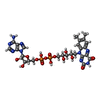 ChemComp-FAD: |
| Source |
|
 Keywords Keywords | FLAVOPROTEIN / Chemotaxis / Energy Taxis / Redox Sensing / Transmembrane Signaling / Cryo-EM / DdEER Spectroscopy |


 escherichia coli k-12 (bacteria)