National Institutes of Health/National Institute of General Medical Sciences (NIH/NIGMS)
GMR35122535
United States
Citation
Journal: bioRxiv / Year: 2026 Title: Signaling mechanism of the transmembrane energy receptor Aer. Authors: Flory A Olsthoorn / Alise R Muok / Zachary A Maschmann / Yajie Xu / Siddarth Chandrasekaran / Robert Dunleavy / Brian R Crane / Abstract: The aerotaxis receptor Aer is a bacterial chemoreceptor that senses intracellular redox changes via an N-terminal PAS domain bound to a flavin adenine dinucleotide (FAD) cofactor. Distinct from ...The aerotaxis receptor Aer is a bacterial chemoreceptor that senses intracellular redox changes via an N-terminal PAS domain bound to a flavin adenine dinucleotide (FAD) cofactor. Distinct from canonical methyl-accepting chemotaxis proteins (MCPs) such as Tar/Tsr, Aer lacks a periplasmic ligand-binding domain and adaptive methylation, transmitting conformational signals laterally from the PAS domain to the HAMP domain and the methylation helix cap (MH-cap) of the kinase control domain (KCD). To elucidate the Aer signalling mechanism, we determined cryo-electron microscopy (cryo-EM) structures of full-length Aer in oxidized flavin quinone (kinase-on) and anionic semiquinone (kinase-off) states. Structural comparison revealed redox-linked rearrangements of the FAD-binding pocket, reorientation of PAS-HAMP interactions, and strikingly altered MH-cap stability. PAS-MH-cap contact in the oxidized state compressed the receptor and stabilized proximal KCD helices, whereas reduction disrupted these contacts, increasing KCD flexibility. To probe distal effects on KCD architecture, we performed nanodisc reconstitution and pulse dipolar ESR spectroscopy on spin-labelled positions along the four-helix bundle. Distance distributions indicated redox-dependent changes in helix separation, particularly at the C-terminal MH2 region, consistent with PAS-driven loosening of KCD packing in kinase-off states. These data support a model in which FAD redox chemistry reorganizes flavin pocket residues that in turn subtly alter PAS conformation to influence PAS-HAMP and PAS-MH-cap packing and hence KCD conformational stability. The findings reveal an Aer-specific signaling axis distinct from periplasmic-ligand binding MCPs that has adapted MCP architecture for lateral PAS input and and cytoplasmic redox sensing.
Applied symmetry - Point group: C2 (2 fold cyclic) / Resolution.type: BY AUTHOR / Resolution: 3.5 Å / Resolution method: FSC 0.143 CUT-OFF / Software - Name: cryoSPARC / Number images used: 90018
Initial angle assignment
Type: MAXIMUM LIKELIHOOD / Software - Name: cryoSPARC
Final angle assignment
Type: MAXIMUM LIKELIHOOD / Software - Name: cryoSPARC
Final 3D classification
Software - Name: cryoSPARC Details: Final 2D classification revealed two conformational states: MH-cap bound and MH-cap free. MH-cap bound particles were 2D selected and then subtracted from the MH-cap free particle list.
FSC plot (resolution estimation)
-
Atomic model buiding 1
Initial model
Chain - Source name: AlphaFold / Chain - Initial model type: in silico model
Software
Name: ISOLDE
Refinement
Space: REAL / Protocol: FLEXIBLE FIT / Overall B value: 147.2
Output model
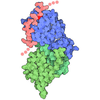
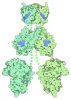
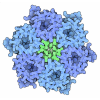
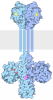
PDB-31ck: Oxidized E.coli aerotaxis receptor in MH-cap free state
+
About Yorodumi
-
News
-
Feb 9, 2022. New format data for meta-information of EMDB entries
New format data for meta-information of EMDB entries
Version 3 of the EMDB header file is now the official format.
The previous official version 1.9 will be removed from the archive.
In the structure databanks used in Yorodumi, some data are registered as the other names, "COVID-19 virus" and "2019-nCoV". Here are the details of the virus and the list of structure data.
Jan 31, 2019. EMDB accession codes are about to change! (news from PDBe EMDB page)
EMDB accession codes are about to change! (news from PDBe EMDB page)
The allocation of 4 digits for EMDB accession codes will soon come to an end. Whilst these codes will remain in use, new EMDB accession codes will include an additional digit and will expand incrementally as the available range of codes is exhausted. The current 4-digit format prefixed with “EMD-” (i.e. EMD-XXXX) will advance to a 5-digit format (i.e. EMD-XXXXX), and so on. It is currently estimated that the 4-digit codes will be depleted around Spring 2019, at which point the 5-digit format will come into force.
The EM Navigator/Yorodumi systems omit the EMD- prefix.
Related info.:Q: What is EMD? / ID/Accession-code notation in Yorodumi/EM Navigator
Yorodumi is a browser for structure data from EMDB, PDB, SASBDB, etc.
This page is also the successor to EM Navigator detail page, and also detail information page/front-end page for Omokage search.
The word "yorodu" (or yorozu) is an old Japanese word meaning "ten thousand". "mi" (miru) is to see.
Related info.:EMDB / PDB / SASBDB / Comparison of 3 databanks / Yorodumi Search / Aug 31, 2016. New EM Navigator & Yorodumi / Yorodumi Papers / Jmol/JSmol / Function and homology information / Changes in new EM Navigator and Yorodumi
 Movie
Movie Controller


 Open data
 Basic information
 Map data
 Sample
 Keywords
 Function and homology information
 Escherichia coli K-12 (bacteria)
 Authors
 United States, 1 items
  Citation
 Structure visualization
 Downloads & links
 emd_58291.png
 http://ftp.pdbj.org/pub/emdb/structures/EMD-58291



 Z (Sec.)
 Y (Row.)
 X (Col.)


 Sample components
 Processing
 Electron microscopy
 FIELD EMISSION GUN