[English] 日本語
Yorodumi Papers
- Database of articles cited by EMDB/PDB/SASBDB data -

+
Search query

Keywords
Structure methods
Author
Journal
IF

-
Structure paper

TitleStructure and organization of AMPA receptor-TARP complexes in the mammalian cerebellum.
Journal, issue, pagesScience, Page eaeb3577, Year 2025
Publish dateDec 11, 2025
AuthorsAlexander M Scrutton / Nayanika Sengupta / Josip Ivica / Imogen Stockwell / Sew Peak-Chew / Bishal Singh / Kunimichi Suzuki / Veronica T Chang / Stephen H McLaughlin / James M Krieger / A Radu Aricescu / Ingo H Greger /
PubMed AbstractAMPA receptors (AMPARs) are multimodal transducers of glutamatergic signals throughout the brain. Their diversity is exemplified in the cerebellum; at afferent synapses, AMPARs mediate high-frequency ...AMPA receptors (AMPARs) are multimodal transducers of glutamatergic signals throughout the brain. Their diversity is exemplified in the cerebellum; at afferent synapses, AMPARs mediate high-frequency excitation, whereas in Bergmann glia (BG) they support calcium transients that modulate synaptic transmission. This spectrum arises from different combinations of core subunits (GluA1-4), auxiliary proteins, and post-transcriptional modifications. Here, using mass-spectrometry, cryo-EM, and electrophysiology, we characterize major cerebellar AMPARs in pig: calcium-impermeable GluA2/A4 heteromers with four TARP subunits, mainly neuronal in origin, and BG-specific calcium-permeable GluA1/A4 heteromers containing two Type-2 TARPs. We also showed that GluA4 receptors consistently exhibit compact N-terminal domains that promote their synaptic delivery. Our study defines the organizational principles of mammalian cerebellar AMPAR complexes and reveals how different receptor subtypes support cell-type specific functions.
External linksScience / PubMed:41379938
MethodsEM (single particle)
Resolution3.26 - 4.5 Å
Structure data

EMDB-54543, PDB-9s3o:
Cerebellar GluA2/4 NTD heterophilic tetramer interface (focused refinement)
Method: EM (single particle) / Resolution: 3.9 Å

EMDB-54547, PDB-9s3q:
Cerebellar GluA1/4 NTD tetramer (focused refinement)
Method: EM (single particle) / Resolution: 3.26 Å

EMDB-54556, PDB-9s3z:
Cerebellar GluA1/4 LBD tetramer (focused refinement)
Method: EM (single particle) / Resolution: 3.55 Å

EMDB-54558, PDB-9s41:
Cerebellar GluA1/4 TMD with TARP gamma 7 (focused refinement)
Method: EM (single particle) / Resolution: 3.66 Å

EMDB-54559: Cerebellar GluAx/A4 TMD with four TARPs (focused refinement)
Method: EM (single particle) / Resolution: 3.57 Å

EMDB-55413: GluA4 N-terminal domain bound to nanobody NB74 (focused refinement)
Method: EM (single particle) / Resolution: 4.4 Å

EMDB-55414: GluA4 LBD-TMD with TARP gamma 2 (focused refinement)
Method: EM (single particle) / Resolution: 3.6 Å

EMDB-55418: GluA4 with TARP gamma2 (consensus refinement)
Method: EM (single particle) / Resolution: 3.9 Å

EMDB-55419: Full-length GluA4 with TARP gamma 2 (composite map)
Method: EM (single particle) / Resolution: 4.5 Å

Chemicals

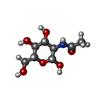
ChemComp-NAG:
2-acetamido-2-deoxy-beta-D-glucopyranose

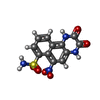
ChemComp-E2Q:
6-nitro-2,3-bis(oxidanylidene)-1,4-dihydrobenzo[f]quinoxaline-7-sulfonamide / antagonist*YM

Source
  • sus scrofa (pig)
  • Rattus norvegicus (Norway rat)
KeywordsSIGNALING PROTEIN / AMPA ionotropic glutamate receptor

+
About Yorodumi Papers

-
News

-
Feb 9, 2022. New format data for meta-information of EMDB entries

New format data for meta-information of EMDB entries

  • Version 3 of the EMDB header file is now the official format.
  • The previous official version 1.9 will be removed from the archive.

Related info.:EMDB header

External links:wwPDB to switch to version 3 of the EMDB data model

-
Aug 12, 2020. Covid-19 info

Covid-19 info

URL: https://pdbj.org/emnavi/covid19.php

New page: Covid-19 featured information page in EM Navigator.

Related info.:Covid-19 info / Mar 5, 2020. Novel coronavirus structure data

+
Mar 5, 2020. Novel coronavirus structure data

Novel coronavirus structure data

Related info.:Yorodumi Speices / Aug 12, 2020. Covid-19 info

External links:COVID-19 featured content - PDBj / Molecule of the Month (242):Coronavirus Proteases

+
Jan 31, 2019. EMDB accession codes are about to change! (news from PDBe EMDB page)

EMDB accession codes are about to change! (news from PDBe EMDB page)

  • The allocation of 4 digits for EMDB accession codes will soon come to an end. Whilst these codes will remain in use, new EMDB accession codes will include an additional digit and will expand incrementally as the available range of codes is exhausted. The current 4-digit format prefixed with “EMD-” (i.e. EMD-XXXX) will advance to a 5-digit format (i.e. EMD-XXXXX), and so on. It is currently estimated that the 4-digit codes will be depleted around Spring 2019, at which point the 5-digit format will come into force.
  • The EM Navigator/Yorodumi systems omit the EMD- prefix.

Related info.:Q: What is EMD? / ID/Accession-code notation in Yorodumi/EM Navigator

External links:EMDB Accession Codes are Changing Soon! / Contact to PDBj

+
Jul 12, 2017. Major update of PDB

Major update of PDB

  • wwPDB released updated PDB data conforming to the new PDBx/mmCIF dictionary.
  • This is a major update changing the version number from 4 to 5, and with Remediation, in which all the entries are updated.
  • In this update, many items about electron microscopy experimental information are reorganized (e.g. em_software).
  • Now, EM Navigator and Yorodumi are based on the updated data.

External links:wwPDB Remediation / Enriched Model Files Conforming to OneDep Data Standards Now Available in the PDB FTP Archive

-
Yorodumi Papers

Database of articles cited by EMDB/PDB/SASBDB data

  • Database of articles cited by EMDB, PDB, and SASBDB entries
  • Using PubMed data

Related info.:EMDB / PDB / SASBDB / Yorodumi / EMN Papers / Changes in new EM Navigator and Yorodumi

Read more