[English] 日本語
Yorodumi Papers
- Database of articles cited by EMDB/PDB/SASBDB data -

+
Search query

Keywords
Structure methods
Author
Journal
IF

-
Structure paper

TitleA multi-dentate, cooperative interaction between endo- and exo-ribonucleases within the bacterial RNA degradosome.
Journal, issue, pagesNucleic Acids Res, Vol. 53, Issue 18, Year 2025
Publish dateSep 23, 2025
AuthorsGiulia Paris / Kai Katsuya-Gaviria / Hannah Clarke / Margaret Johncock / Tom Dendooven / Aleksei Lulla / Ben F Luisi /
PubMed AbstractIn Escherichia coli and numerous other bacteria, two of the principal enzymes mediating messenger RNA decay and RNA processing-RNase E, an endoribonuclease, and polynucleotide phosphorylase (PNPase), ...In Escherichia coli and numerous other bacteria, two of the principal enzymes mediating messenger RNA decay and RNA processing-RNase E, an endoribonuclease, and polynucleotide phosphorylase (PNPase), an exoribonuclease-assemble into a multi-enzyme complex known as the RNA degradosome. While RNase E forms a homotetramer and PNPase a homotrimer, it remains unclear how these two enzymes interact within the RNA degradosome to potentially satisfy all mutual recognition sites. In this study, we used cryo-EM, biochemistry, and biophysical studies to discover and characterize a new binding mode for PNPase encompassing two or more motifs that are necessary and sufficient for strong interaction with RNase E. While a similar interaction is seen in Salmonella enterica, a different recognition mode arose for Pseudomonas aeruginosa, illustrating the evolutionary drive to maintain physical association of the two ribonucleases. The data presented here suggest a model for the quaternary organization of the RNA degradosome of E. coli, where one PNPase trimer interacts with one RNase E protomer. Conformational transitions are predicted to facilitate substrate capture and transfer to catalytic centres. The model suggests how the endo- and exo-ribonucleases might cooperate in cellular RNA turnover and recruitment of regulatory RNA by the degradosome assembly.
External linksNucleic Acids Res / PubMed:41036625 / PubMed Central
MethodsEM (single particle)
Resolution2.4 - 2.52 Å
Structure data

EMDB-53151, PDB-9qh0:
Escherichia coli polynucleotide phosphorylase in complex with recognition site of RNase E
Method: EM (single particle) / Resolution: 2.52 Å

EMDB-53153, PDB-9qh3:
Pseudomonas aeruginosa polynucleotide phosphorylase in complex with recognition site of RNase E
Method: EM (single particle) / Resolution: 2.4 Å

Chemicals

ChemComp-HOH:
WATER

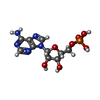
ChemComp-A:
ADENOSINE-5'-MONOPHOSPHATE

Source
  • escherichia coli (E. coli)
  • Pseudomonas aeruginosa (bacteria)
  • pseudomonas aeruginosa pao1 (bacteria)
KeywordsRNA BINDING PROTEIN / polynucleotide phosphorylase / ribonuclease E / RNA degradosome

+
About Yorodumi Papers

-
News

-
Feb 9, 2022. New format data for meta-information of EMDB entries

New format data for meta-information of EMDB entries

  • Version 3 of the EMDB header file is now the official format.
  • The previous official version 1.9 will be removed from the archive.

Related info.:EMDB header

External links:wwPDB to switch to version 3 of the EMDB data model

-
Aug 12, 2020. Covid-19 info

Covid-19 info

URL: https://pdbj.org/emnavi/covid19.php

New page: Covid-19 featured information page in EM Navigator.

Related info.:Covid-19 info / Mar 5, 2020. Novel coronavirus structure data

+
Mar 5, 2020. Novel coronavirus structure data

Novel coronavirus structure data

Related info.:Yorodumi Speices / Aug 12, 2020. Covid-19 info

External links:COVID-19 featured content - PDBj / Molecule of the Month (242):Coronavirus Proteases

+
Jan 31, 2019. EMDB accession codes are about to change! (news from PDBe EMDB page)

EMDB accession codes are about to change! (news from PDBe EMDB page)

  • The allocation of 4 digits for EMDB accession codes will soon come to an end. Whilst these codes will remain in use, new EMDB accession codes will include an additional digit and will expand incrementally as the available range of codes is exhausted. The current 4-digit format prefixed with “EMD-” (i.e. EMD-XXXX) will advance to a 5-digit format (i.e. EMD-XXXXX), and so on. It is currently estimated that the 4-digit codes will be depleted around Spring 2019, at which point the 5-digit format will come into force.
  • The EM Navigator/Yorodumi systems omit the EMD- prefix.

Related info.:Q: What is EMD? / ID/Accession-code notation in Yorodumi/EM Navigator

External links:EMDB Accession Codes are Changing Soon! / Contact to PDBj

+
Jul 12, 2017. Major update of PDB

Major update of PDB

  • wwPDB released updated PDB data conforming to the new PDBx/mmCIF dictionary.
  • This is a major update changing the version number from 4 to 5, and with Remediation, in which all the entries are updated.
  • In this update, many items about electron microscopy experimental information are reorganized (e.g. em_software).
  • Now, EM Navigator and Yorodumi are based on the updated data.

External links:wwPDB Remediation / Enriched Model Files Conforming to OneDep Data Standards Now Available in the PDB FTP Archive

-
Yorodumi Papers

Database of articles cited by EMDB/PDB/SASBDB data

  • Database of articles cited by EMDB, PDB, and SASBDB entries
  • Using PubMed data

Related info.:EMDB / PDB / SASBDB / Yorodumi / EMN Papers / Changes in new EM Navigator and Yorodumi

Read more