[English] 日本語
Yorodumi Papers
- Database of articles cited by EMDB/PDB/SASBDB data -

+
Search query

Keywords
Structure methods
Author
Journal
IF

-
Structure paper

TitleLigand binding Pro-miscuity of acylpeptide hydrolase, structural analysis of a detoxifying serine hydrolase.
Journal, issue, pagesProtein Sci, Vol. 34, Issue 11, Page e70320, Year 2025
Publish dateOct 11, 2025
AuthorsAnna J Kiss-Szemán / Luca Takács / Imre Jákli / Zoltán Bánóczi / Naoki Hosogi / Daouda A K Traore / Veronika Harmat / András Perczel / Dóra K Menyhárd /
PubMed AbstractAcylpeptide hydrolase (APEH) or acylaminoacyl-peptidase (AAP) is a serine hydrolase that regulates protein metabolism. It can also bind to and process unusual substrates, acting as a detoxifier. To ...Acylpeptide hydrolase (APEH) or acylaminoacyl-peptidase (AAP) is a serine hydrolase that regulates protein metabolism. It can also bind to and process unusual substrates, acting as a detoxifier. To better understand its promiscuous specificity, we determined the cryo-EM structures of mammalian APEH complexed with classical serine protease partners: a chloromethyl-ketone (CMK) inhibitor, an organophosphate (OP) pesticide (dichlorvos), and benzenesulfonyl-fluoride. Since CMK derivatives of N-acetylated peptides were suggested to induce apoptosis by inhibiting APEH, while OP complexes may serve as biomarkers of OP exposure and are linked to cognitive enhancement, these complexes carry physiological significance. We identified a unique strand-breaker Pro residue in the hydrolase domain, which relaxes the active site into a partially inactivated but more spacious conformation, transforming the classical serine protease apparatus into a versatile yet potent hydrolysis center with broad specificity, distinguishing the mammalian enzyme not only from other APEHs but also from serine α/β hydrolases sharing essentially the same fold.
External linksProtein Sci / PubMed:41074793 / PubMed Central
MethodsEM (single particle) / X-ray diffraction
Resolution2.3 - 3.2 Å
Structure data

EMDB-51464, PDB-9gne:
CryoEM structure of mammalian AAP in complex with acetyl-alanyl-chloromethylketone
Method: EM (single particle) / Resolution: 3.2 Å

EMDB-51501, PDB-9gou:
Cryo-EM structure of acylaminoacyl-peptidase in complex with dichlorvos
Method: EM (single particle) / Resolution: 2.65 Å

EMDB-52489, PDB-9hxq:
Cryo-EM structure of acylaminoacyl peptidase (AAP) in covalent complex with inhibitor AEBSF
Method: EM (single particle) / Resolution: 2.8 Å

PDB-9s6b:
Aeropyrum pernix acylaminoacyl peptidase co-crystallized with meropenem.
Method: X-RAY DIFFRACTION / Resolution: 2.3 Å

Chemicals

PDB-1ina:
Unknown entry

PDB-1ing:
INFLUENZA A SUBTYPE N2 NEURAMINIDASE COMPLEXED WITH AROMATIC BANA109 INHIBITOR

ChemComp-AES:
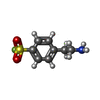
4-(2-AMINOETHYL)BENZENESULFONYL FLUORIDE / protease inhibitor*YM

ChemComp-1AX:
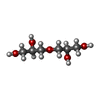
(2R,2'R)-3,3'-oxydipropane-1,2-diol

ChemComp-HOH:
WATER

Source
  • Sus scrofa domesticus (domestic pig)
  • sus scrofa (pig)
  • aeropyrum pernix k1 (archaea)
KeywordsHYDROLASE / covalent inhibitor / serine-protease / flexible active site / oligopeptidase / self-assembly / dichlorvos / dimethoxy-phosphate / acyl-peptide-hydrolase / oxidized protein hydrolase / APEH / AARE / AAP / OPH / inhibitor / covalent / acylpeptide hydrolase / acylaminoacyl peptidase / sulphonate / serine protease / HbPG / ligand binding

+
About Yorodumi Papers

-
News

-
Feb 9, 2022. New format data for meta-information of EMDB entries

New format data for meta-information of EMDB entries

  • Version 3 of the EMDB header file is now the official format.
  • The previous official version 1.9 will be removed from the archive.

Related info.:EMDB header

External links:wwPDB to switch to version 3 of the EMDB data model

-
Aug 12, 2020. Covid-19 info

Covid-19 info

URL: https://pdbj.org/emnavi/covid19.php

New page: Covid-19 featured information page in EM Navigator.

Related info.:Covid-19 info / Mar 5, 2020. Novel coronavirus structure data

+
Mar 5, 2020. Novel coronavirus structure data

Novel coronavirus structure data

Related info.:Yorodumi Speices / Aug 12, 2020. Covid-19 info

External links:COVID-19 featured content - PDBj / Molecule of the Month (242):Coronavirus Proteases

+
Jan 31, 2019. EMDB accession codes are about to change! (news from PDBe EMDB page)

EMDB accession codes are about to change! (news from PDBe EMDB page)

  • The allocation of 4 digits for EMDB accession codes will soon come to an end. Whilst these codes will remain in use, new EMDB accession codes will include an additional digit and will expand incrementally as the available range of codes is exhausted. The current 4-digit format prefixed with “EMD-” (i.e. EMD-XXXX) will advance to a 5-digit format (i.e. EMD-XXXXX), and so on. It is currently estimated that the 4-digit codes will be depleted around Spring 2019, at which point the 5-digit format will come into force.
  • The EM Navigator/Yorodumi systems omit the EMD- prefix.

Related info.:Q: What is EMD? / ID/Accession-code notation in Yorodumi/EM Navigator

External links:EMDB Accession Codes are Changing Soon! / Contact to PDBj

+
Jul 12, 2017. Major update of PDB

Major update of PDB

  • wwPDB released updated PDB data conforming to the new PDBx/mmCIF dictionary.
  • This is a major update changing the version number from 4 to 5, and with Remediation, in which all the entries are updated.
  • In this update, many items about electron microscopy experimental information are reorganized (e.g. em_software).
  • Now, EM Navigator and Yorodumi are based on the updated data.

External links:wwPDB Remediation / Enriched Model Files Conforming to OneDep Data Standards Now Available in the PDB FTP Archive

-
Yorodumi Papers

Database of articles cited by EMDB/PDB/SASBDB data

  • Database of articles cited by EMDB, PDB, and SASBDB entries
  • Using PubMed data

Related info.:EMDB / PDB / SASBDB / Yorodumi / EMN Papers / Changes in new EM Navigator and Yorodumi

Read more