[English] 日本語
Yorodumi Papers
- Database of articles cited by EMDB/PDB/SASBDB data -

+
Search query

Keywords
Structure methods
Author
Journal
IF

-
Structure paper

TitleMechanistic understanding of UvrA damage detection and lesion hand-off to UvrB in Nucleotide Excision Repair.
Journal, issue, pagesNat Commun, Vol. 16, Issue 1, Page 3416, Year 2025
Publish dateApr 10, 2025
AuthorsMarianna Genta / Giulia Ferrara / Riccardo Capelli / Diego Rondelli / Sarah Sertic / Martino Bolognesi / Menico Rizzi / Franca Rossi / David Jeruzalmi / Antonio Chaves-Sanjuan / Riccardo Miggiano /
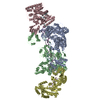
PubMed AbstractNucleotide excision repair (NER) represents one of the major molecular machineries that control chromosome stability in all living species. In Eubacteria, the initial stages of the repair process are ...Nucleotide excision repair (NER) represents one of the major molecular machineries that control chromosome stability in all living species. In Eubacteria, the initial stages of the repair process are carried out by the UvrABC excinuclease complex. Despite the wealth of structural data available, some crucial details of the pathway remain elusive. In this study, we present a structural investigation of the Mycobacterium tuberculosis UvrAUvrB complex and of the UvrA dimer, both in complex with damaged DNA. Our analyses yield insights into the DNA binding mode of UvrA, showing an unexplored conformation of Insertion Domains (IDs), underlying the essential role of these domains in DNA coordination. Furthermore, we observe an interplay between the ID and the UvrB Binding Domain (UBD): after the recognition of the damage, the IDs repositions with the concomitant reorganization of UBD, allowing the formation of the complex between UvrA and UvrB. These events are detected along the formation of the uncharacterized UvrAUvrB-DNA and the UvrAUvrB-DNA complexes which we interpret as hierarchical steps initiating the DNA repair cascade in the NER pathway, resulting in the formation of the pre-incision complex.
External linksNat Commun / PubMed:40210888 / PubMed Central
MethodsEM (single particle)
Resolution3.2 - 4.9 Å
Structure data

EMDB-51168: MtUvrA2 bound to endogenous E. coli DNA at low resolution
Method: EM (single particle) / Resolution: 4.2 Å

EMDB-51169, PDB-9ga2:
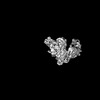
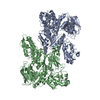
MtUvrA2 dimer empty
Method: EM (single particle) / Resolution: 4.9 Å

EMDB-51170, PDB-9ga3:
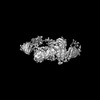
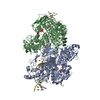
MtUvrA2UvrB bound to damaged oligonucleotide
Method: EM (single particle) / Resolution: 4.3 Å

EMDB-51171: MtUvrA2UvrB2 bound to damaged oligonucleotide (half 1)
Method: EM (single particle) / Resolution: 3.6 Å

EMDB-51172: MtUvrA2UvrB2 bound to damaged oligonucleotide (half 2)
Method: EM (single particle) / Resolution: 3.7 Å

EMDB-51173: Composite map of MtUvrA2UvrB2-DNA
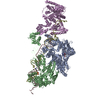
PDB-9ga4: MtUvrA2UvrB2 bound to damaged oligonucleotide
Method: EM (single particle) / Resolution: 3.7 Å

EMDB-51174, PDB-9ga5:
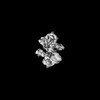
MtUvrA2 bound to endogenous E. coli DNA
Method: EM (single particle) / Resolution: 3.2 Å

EMDB-51220: Consensus map of MtUvrA2UvrB2-DNA
Method: EM (single particle) / Resolution: 3.7 Å

Chemicals

ChemComp-ZN:
Unknown entry

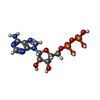
ChemComp-ADP:
ADENOSINE-5'-DIPHOSPHATE / ADP, energy-carrying molecule*YM

Source
  • mycobacterium tuberculosis (bacteria)
  • escherichia coli (E. coli)
KeywordsDNA BINDING PROTEIN / DNA repair / NER / UVRA / UVRB / UVR / MTB

+
About Yorodumi Papers

-
News

-
Feb 9, 2022. New format data for meta-information of EMDB entries

New format data for meta-information of EMDB entries

  • Version 3 of the EMDB header file is now the official format.
  • The previous official version 1.9 will be removed from the archive.

Related info.:EMDB header

External links:wwPDB to switch to version 3 of the EMDB data model

-
Aug 12, 2020. Covid-19 info

Covid-19 info

URL: https://pdbj.org/emnavi/covid19.php

New page: Covid-19 featured information page in EM Navigator.

Related info.:Covid-19 info / Mar 5, 2020. Novel coronavirus structure data

+
Mar 5, 2020. Novel coronavirus structure data

Novel coronavirus structure data

Related info.:Yorodumi Speices / Aug 12, 2020. Covid-19 info

External links:COVID-19 featured content - PDBj / Molecule of the Month (242):Coronavirus Proteases

+
Jan 31, 2019. EMDB accession codes are about to change! (news from PDBe EMDB page)

EMDB accession codes are about to change! (news from PDBe EMDB page)

  • The allocation of 4 digits for EMDB accession codes will soon come to an end. Whilst these codes will remain in use, new EMDB accession codes will include an additional digit and will expand incrementally as the available range of codes is exhausted. The current 4-digit format prefixed with “EMD-” (i.e. EMD-XXXX) will advance to a 5-digit format (i.e. EMD-XXXXX), and so on. It is currently estimated that the 4-digit codes will be depleted around Spring 2019, at which point the 5-digit format will come into force.
  • The EM Navigator/Yorodumi systems omit the EMD- prefix.

Related info.:Q: What is EMD? / ID/Accession-code notation in Yorodumi/EM Navigator

External links:EMDB Accession Codes are Changing Soon! / Contact to PDBj

+
Jul 12, 2017. Major update of PDB

Major update of PDB

  • wwPDB released updated PDB data conforming to the new PDBx/mmCIF dictionary.
  • This is a major update changing the version number from 4 to 5, and with Remediation, in which all the entries are updated.
  • In this update, many items about electron microscopy experimental information are reorganized (e.g. em_software).
  • Now, EM Navigator and Yorodumi are based on the updated data.

External links:wwPDB Remediation / Enriched Model Files Conforming to OneDep Data Standards Now Available in the PDB FTP Archive

-
Yorodumi Papers

Database of articles cited by EMDB/PDB/SASBDB data

  • Database of articles cited by EMDB, PDB, and SASBDB entries
  • Using PubMed data

Related info.:EMDB / PDB / SASBDB / Yorodumi / EMN Papers / Changes in new EM Navigator and Yorodumi

Read more