 Movie
Movie Controller
 Structure viewers
 About Yorodumi Papers


+Search query
-Structure paper
| Title | Next-generation chemogenetic inhibition using a brain-permeant non-prescription agent. |
|---|---|
| Journal, issue, pages | Signal Transduct Target Ther, Vol. 11, Issue 1, Year 2026 |
| Publish date | Jul 3, 2026 |
 Authors Authors | Steven O Devenish / Sahil D Patel / Laura V Ussingkær / Luiz F Almeida Silva / Olivia Goff / Amy Richardson / Jesse I Mobbs / Hariprasad Venugopal / David M Thal / Dimitri M Kullmann /   |
| PubMed Abstract | Chemogenetics allows the controllable manipulation of brain circuits upon delivery of a selective activating ligand, and has been invaluable in dissecting brain circuits underlying many behaviours. ...Chemogenetics allows the controllable manipulation of brain circuits upon delivery of a selective activating ligand, and has been invaluable in dissecting brain circuits underlying many behaviours. The Gαi/o-coupled designer muscarinic receptor hM4Di is an especially versatile tool for on-demand inhibition, and has proven effective not only in fundamental neuroscience but also as a therapeutic transgene in preclinical models of epilepsy and other CNS disorders. Indeed, by placing the circuit modulation under the control of an exogenous ligand, chemogenetics mitigates the potential risk of overdosage intrinsic to viral-vector mediated gene therapy. An obstacle to clinical translation, however, is the absence of an activating ligand with favourable biodistribution and side effect profile. Here we show that mutation of hM4Di at two sites (S85 and Y416) imparts full and potent agonism to the widely used over-the-counter antihistamine diphenhydramine. We complement medium-throughput screening in human embryonic kidney cells with in vitro electrophysiological characterization in neuronal circuits, and reveal the interaction of diphenhydramine with key residues using cryo-electron microscopy. Administration of diphenhydramine to mice expressing the modified receptor in the ventral hippocampus reversibly modulated anxiety-related behaviour and attenuated the severity of chemoconvulsant-induced seizures. We further demonstrate on-demand seizure suppression in a chronic epilepsy model. G protein-coupled Receptors Activated by Non-Prescription Agents (GRANPAs) lower the barrier to clinical translation of a powerful chemogenetic approach to brain circuit manipulation. |
 External links External links | Signal Transduct Target Ther / PubMed:42393022 / PubMed Central |
| Methods | EM (single particle) |
| Resolution | 2.6 - 3.0 Å |
| Structure data | EMDB-48827, PDB-9n29:  EMDB-48828: Focused refinement map of hM4Di(GRANPA) in complex with mGsI and diphenhydramine |
| Chemicals | 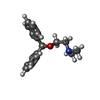 ChemComp-2PM: |
| Source |
|
 Keywords Keywords | SIGNALING PROTEIN / G protein-coupled receptor / acetylcholine binding / seven transmembrane protein / MEMBRANE PROTEIN |


 homo sapiens (human)
 rattus norvegicus (Norway rat)
 lama glama (llama)