[English] 日本語
Yorodumi Papers
- Database of articles cited by EMDB/PDB/SASBDB data -

+
Search query

Keywords
Structure methods
Author
Journal
IF

-
Structure paper

TitleStructural basis for C-degron selectivity across KLHDCX family E3 ubiquitin ligases.
Journal, issue, pagesNat Commun, Vol. 15, Issue 1, Page 9899, Year 2024
Publish dateNov 15, 2024
AuthorsDaniel C Scott / Sagar Chittori / Nicholas Purser / Moeko T King / Samuel A Maiwald / Kelly Churion / Amanda Nourse / Chan Lee / Joao A Paulo / Darcie J Miller / Stephen J Elledge / J Wade Harper / Gary Kleiger / Brenda A Schulman /
PubMed AbstractSpecificity of the ubiquitin-proteasome system depends on E3 ligase-substrate interactions. Many such pairings depend on E3 ligases binding to peptide-like sequences - termed N- or C-degrons - at the ...Specificity of the ubiquitin-proteasome system depends on E3 ligase-substrate interactions. Many such pairings depend on E3 ligases binding to peptide-like sequences - termed N- or C-degrons - at the termini of substrates. However, our knowledge of structural features distinguishing closely related C-degron substrate-E3 pairings is limited. Here, by systematically comparing ubiquitylation activities towards a suite of common model substrates, and defining interactions by biochemistry, crystallography, and cryo-EM, we reveal principles of C-degron recognition across the KLHDCX family of Cullin-RING ligases (CRLs). First, a motif common across these E3 ligases anchors a substrate's C-terminus. However, distinct locations of this C-terminus anchor motif in different blades of the KLHDC2, KLHDC3, and KLHDC10 β-propellers establishes distinct relative positioning and molecular environments for substrate C-termini. Second, our structural data show KLHDC3 has a pre-formed pocket establishing preference for an Arg or Gln preceding a C-terminal Gly, whereas conformational malleability contributes to KLHDC10's recognition of varying features adjacent to substrate C-termini. Finally, additional non-consensus interactions, mediated by C-degron binding grooves and/or by distal propeller surfaces and substrate globular domains, can substantially impact substrate binding and ubiquitylatability. Overall, the data reveal combinatorial mechanisms determining specificity and plasticity of substrate recognition by KLDCX-family C-degron E3 ligases.
External linksNat Commun / PubMed:39548056 / PubMed Central
MethodsEM (single particle) / X-ray diffraction
Resolution1.88 - 3.3 Å
Structure data

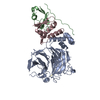
EMDB-46644: Cryo-EM structure of a trapped ARIH1-diUB-CRL2-KLHDC10 complex - consensus map
Method: EM (single particle) / Resolution: 3.3 Å

EMDB-46645, PDB-9d8p:
Focused map of Cryo-EM structure of Ubiquitin C-degron bound to KLHDC10-EloB/C
Method: EM (single particle) / Resolution: 3.2 Å

PDB-9d1i:
Structure of Ubiquitin bound to KLHDC3-EloB/C
Method: X-RAY DIFFRACTION / Resolution: 2 Å

PDB-9d1y:
Structure of G75R Ubiquitin bound to KLHDC3-EloB/C
Method: X-RAY DIFFRACTION / Resolution: 2.6 Å

PDB-9d1z:
Structure of G75Q Ubiquitin bound to KLHDC3-EloB/C
Method: X-RAY DIFFRACTION / Resolution: 1.88 Å

Chemicals

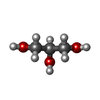
ChemComp-GOL:
GLYCEROL

ChemComp-HOH:
WATER

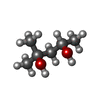
ChemComp-MPD:
(4S)-2-METHYL-2,4-PENTANEDIOL / precipitant*YM

Source
  • homo sapiens (human)
KeywordsLIGASE / KLHDC3 / Ubiquitin / C-degron / Cullin-RING / E3 / KLHDC10

+
About Yorodumi Papers

-
News

-
Feb 9, 2022. New format data for meta-information of EMDB entries

New format data for meta-information of EMDB entries

  • Version 3 of the EMDB header file is now the official format.
  • The previous official version 1.9 will be removed from the archive.

Related info.:EMDB header

External links:wwPDB to switch to version 3 of the EMDB data model

-
Aug 12, 2020. Covid-19 info

Covid-19 info

URL: https://pdbj.org/emnavi/covid19.php

New page: Covid-19 featured information page in EM Navigator.

Related info.:Covid-19 info / Mar 5, 2020. Novel coronavirus structure data

+
Mar 5, 2020. Novel coronavirus structure data

Novel coronavirus structure data

Related info.:Yorodumi Speices / Aug 12, 2020. Covid-19 info

External links:COVID-19 featured content - PDBj / Molecule of the Month (242):Coronavirus Proteases

+
Jan 31, 2019. EMDB accession codes are about to change! (news from PDBe EMDB page)

EMDB accession codes are about to change! (news from PDBe EMDB page)

  • The allocation of 4 digits for EMDB accession codes will soon come to an end. Whilst these codes will remain in use, new EMDB accession codes will include an additional digit and will expand incrementally as the available range of codes is exhausted. The current 4-digit format prefixed with “EMD-” (i.e. EMD-XXXX) will advance to a 5-digit format (i.e. EMD-XXXXX), and so on. It is currently estimated that the 4-digit codes will be depleted around Spring 2019, at which point the 5-digit format will come into force.
  • The EM Navigator/Yorodumi systems omit the EMD- prefix.

Related info.:Q: What is EMD? / ID/Accession-code notation in Yorodumi/EM Navigator

External links:EMDB Accession Codes are Changing Soon! / Contact to PDBj

+
Jul 12, 2017. Major update of PDB

Major update of PDB

  • wwPDB released updated PDB data conforming to the new PDBx/mmCIF dictionary.
  • This is a major update changing the version number from 4 to 5, and with Remediation, in which all the entries are updated.
  • In this update, many items about electron microscopy experimental information are reorganized (e.g. em_software).
  • Now, EM Navigator and Yorodumi are based on the updated data.

External links:wwPDB Remediation / Enriched Model Files Conforming to OneDep Data Standards Now Available in the PDB FTP Archive

-
Yorodumi Papers

Database of articles cited by EMDB/PDB/SASBDB data

  • Database of articles cited by EMDB, PDB, and SASBDB entries
  • Using PubMed data

Related info.:EMDB / PDB / SASBDB / Yorodumi / EMN Papers / Changes in new EM Navigator and Yorodumi

Read more