 Movie
Movie Controller
 Structure viewers
 About Yorodumi Papers


+Search query
-Structure paper
| Title | Structural basis for C-degron selectivity across KLHDCX family E3 ubiquitin ligases. |
|---|---|
| Journal, issue, pages | Nat Commun, Vol. 15, Issue 1, Page 9899, Year 2024 |
| Publish date | Nov 15, 2024 |
 Authors Authors | Daniel C Scott / Sagar Chittori / Nicholas Purser / Moeko T King / Samuel A Maiwald / Kelly Churion / Amanda Nourse / Chan Lee / Joao A Paulo / Darcie J Miller / Stephen J Elledge / J Wade Harper / Gary Kleiger / Brenda A Schulman /   |
| PubMed Abstract | Specificity of the ubiquitin-proteasome system depends on E3 ligase-substrate interactions. Many such pairings depend on E3 ligases binding to peptide-like sequences - termed N- or C-degrons - at the ...Specificity of the ubiquitin-proteasome system depends on E3 ligase-substrate interactions. Many such pairings depend on E3 ligases binding to peptide-like sequences - termed N- or C-degrons - at the termini of substrates. However, our knowledge of structural features distinguishing closely related C-degron substrate-E3 pairings is limited. Here, by systematically comparing ubiquitylation activities towards a suite of common model substrates, and defining interactions by biochemistry, crystallography, and cryo-EM, we reveal principles of C-degron recognition across the KLHDCX family of Cullin-RING ligases (CRLs). First, a motif common across these E3 ligases anchors a substrate's C-terminus. However, distinct locations of this C-terminus anchor motif in different blades of the KLHDC2, KLHDC3, and KLHDC10 β-propellers establishes distinct relative positioning and molecular environments for substrate C-termini. Second, our structural data show KLHDC3 has a pre-formed pocket establishing preference for an Arg or Gln preceding a C-terminal Gly, whereas conformational malleability contributes to KLHDC10's recognition of varying features adjacent to substrate C-termini. Finally, additional non-consensus interactions, mediated by C-degron binding grooves and/or by distal propeller surfaces and substrate globular domains, can substantially impact substrate binding and ubiquitylatability. Overall, the data reveal combinatorial mechanisms determining specificity and plasticity of substrate recognition by KLDCX-family C-degron E3 ligases. |
 External links External links | Nat Commun / PubMed:39548056 / PubMed Central |
| Methods | EM (single particle) / X-ray diffraction |
| Resolution | 1.88 - 3.3 Å |
| Structure data |  EMDB-46644: Cryo-EM structure of a trapped ARIH1-diUB-CRL2-KLHDC10 complex - consensus map EMDB-46645, PDB-9d8p:  PDB-9d1i:  PDB-9d1y:  PDB-9d1z: |
| Chemicals |  ChemComp-GOL:  ChemComp-HOH:  ChemComp-MPD: |
| Source |
|
 Keywords Keywords | LIGASE / KLHDC3 / Ubiquitin / C-degron / Cullin-RING / E3 / KLHDC10 |

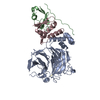
 homo sapiens (human)