[English] 日本語
Yorodumi Papers
- Database of articles cited by EMDB/PDB/SASBDB data -

+
Search query

Keywords
Structure methods
Author
Journal
IF

-
Structure paper

TitleDistinct oligomeric assemblies of STING induced by non-nucleotide agonists.
Journal, issue, pagesNat Commun, Vol. 16, Issue 1, Page 3440, Year 2025
Publish dateApr 11, 2025
AuthorsAnant Gharpure / Ariana Sulpizio / Johannes R Loeffler / Monica L Fernández-Quintero / Andy S Tran / Luke L Lairson / Andrew B Ward /
PubMed AbstractSTING plays essential roles coordinating innate immune responses to processes that range from pathogenic infection to genomic instability. Its adaptor function is activated by cyclic dinucleotide ...STING plays essential roles coordinating innate immune responses to processes that range from pathogenic infection to genomic instability. Its adaptor function is activated by cyclic dinucleotide (CDN) secondary messengers originating from self (2'3'-cGAMP) or bacterial sources (3'3'-CDNs). Different classes of CDNs possess distinct binding modes, stabilizing STING's ligand-binding domain (LBD) in either a closed or open conformation. The closed conformation, induced by the endogenous ligand 2'3'-cGAMP, has been extensively studied using cryo-EM. However, significant questions remain regarding the structural basis of STING activation by open conformation-inducing ligands. Using cryo-EM, we investigate potential differences in conformational changes and oligomeric assemblies of STING for closed and open conformation-inducing synthetic agonists. While we observe a characteristic 180° rotation for both classes, the open-LBD inducing agonist diABZI-3 uniquely induces a quaternary structure reminiscent but distinct from the reported autoinhibited state of apo-STING. Additionally, we observe slower rates of activation for this ligand class in functional assays, which collectively suggests the existence of a potential additional regulatory mechanism for open conformation-inducing ligands that involves head-to-head interactions and restriction of curved oligomer formation. These observations have potential implications in the selection of an optimal class of STING agonist in the context of a defined therapeutic application.
External linksNat Commun / PubMed:40216780 / PubMed Central
MethodsEM (single particle)
Resolution3.09 - 3.67 Å
Structure data

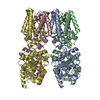
EMDB-45897, PDB-9ct3:
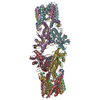
HsSTING with SR-717 and C53
Method: EM (single particle) / Resolution: 3.09 Å

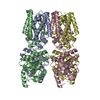
EMDB-45898, PDB-9ct4:
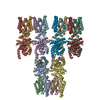
HsSTING with diABZI and C53, curved conformation
Method: EM (single particle) / Resolution: 3.29 Å

EMDB-45899, PDB-9ct5:
HsSTING with diABZI and C53, together conformation
Method: EM (single particle) / Resolution: 3.67 Å

EMDB-45900, PDB-9ct6:
HsSTING with diABZI and C53, apart conformation
Method: EM (single particle) / Resolution: 3.56 Å

Chemicals

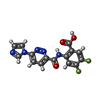
ChemComp-V67:
4,5-difluoro-2-{[6-(1H-imidazol-1-yl)pyridazine-3-carbonyl]amino}benzoic acid

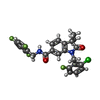
ChemComp-9IM:
1-[(2-chloro-6-fluorophenyl)methyl]-3,3-dimethyl-2-oxo-N-[(2,4,6-trifluorophenyl)methyl]-2,3-dihydro-1H-indole-6-carboxamide

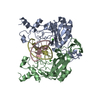
PDB-1az0:
ECORV ENDONUCLEASE/DNA COMPLEX

Source
  • homo sapiens (human)
KeywordsIMMUNE SYSTEM / Innate immunity / membrane protein

+
About Yorodumi Papers

-
News

-
Feb 9, 2022. New format data for meta-information of EMDB entries

New format data for meta-information of EMDB entries

  • Version 3 of the EMDB header file is now the official format.
  • The previous official version 1.9 will be removed from the archive.

Related info.:EMDB header

External links:wwPDB to switch to version 3 of the EMDB data model

-
Aug 12, 2020. Covid-19 info

Covid-19 info

URL: https://pdbj.org/emnavi/covid19.php

New page: Covid-19 featured information page in EM Navigator.

Related info.:Covid-19 info / Mar 5, 2020. Novel coronavirus structure data

+
Mar 5, 2020. Novel coronavirus structure data

Novel coronavirus structure data

Related info.:Yorodumi Speices / Aug 12, 2020. Covid-19 info

External links:COVID-19 featured content - PDBj / Molecule of the Month (242):Coronavirus Proteases

+
Jan 31, 2019. EMDB accession codes are about to change! (news from PDBe EMDB page)

EMDB accession codes are about to change! (news from PDBe EMDB page)

  • The allocation of 4 digits for EMDB accession codes will soon come to an end. Whilst these codes will remain in use, new EMDB accession codes will include an additional digit and will expand incrementally as the available range of codes is exhausted. The current 4-digit format prefixed with “EMD-” (i.e. EMD-XXXX) will advance to a 5-digit format (i.e. EMD-XXXXX), and so on. It is currently estimated that the 4-digit codes will be depleted around Spring 2019, at which point the 5-digit format will come into force.
  • The EM Navigator/Yorodumi systems omit the EMD- prefix.

Related info.:Q: What is EMD? / ID/Accession-code notation in Yorodumi/EM Navigator

External links:EMDB Accession Codes are Changing Soon! / Contact to PDBj

+
Jul 12, 2017. Major update of PDB

Major update of PDB

  • wwPDB released updated PDB data conforming to the new PDBx/mmCIF dictionary.
  • This is a major update changing the version number from 4 to 5, and with Remediation, in which all the entries are updated.
  • In this update, many items about electron microscopy experimental information are reorganized (e.g. em_software).
  • Now, EM Navigator and Yorodumi are based on the updated data.

External links:wwPDB Remediation / Enriched Model Files Conforming to OneDep Data Standards Now Available in the PDB FTP Archive

-
Yorodumi Papers

Database of articles cited by EMDB/PDB/SASBDB data

  • Database of articles cited by EMDB, PDB, and SASBDB entries
  • Using PubMed data

Related info.:EMDB / PDB / SASBDB / Yorodumi / EMN Papers / Changes in new EM Navigator and Yorodumi

Read more