[English] 日本語
Yorodumi Papers
- Database of articles cited by EMDB/PDB/SASBDB data -

+
Search query

Keywords
Structure methods
Author
Journal
IF

-
Structure paper

TitleCalcineurin-fusion facilitates cryo-EM structure determination of a Family A GPCR.
Journal, issue, pagesProc Natl Acad Sci U S A, Vol. 121, Issue 48, Page e2414544121, Year 2024
Publish dateNov 26, 2024
AuthorsJun Xu / Geng Chen / Haoqing Wang / Sheng Cao / Jie Heng / Xavier Deupi / Yang Du / Brian K Kobilka /
PubMed AbstractAdvances in singe-particle cryo-electron microscopy (cryo-EM) have made it possible to solve the structures of numerous Family A and Family B G protein-coupled receptors (GPCRs) in complex with G ...Advances in singe-particle cryo-electron microscopy (cryo-EM) have made it possible to solve the structures of numerous Family A and Family B G protein-coupled receptors (GPCRs) in complex with G proteins and arrestins, as well as several Family C GPCRs. Determination of these structures has been facilitated by the presence of large extramembrane components (such as G protein, arrestin, or Venus flytrap domains) in these complexes that aid in particle alignment during the processing of the cryo-EM data. In contrast, determination of the inactive state structure of Family A GPCRs is more challenging due to the relatively small size of the seven transmembrane domain (7TM) and to the surrounding detergent micelle that, in the absence of other features, make particle alignment impossible. Here, we describe an alternative protein engineering strategy where the heterodimeric protein calcineurin is fused to a GPCR by three points of attachment, the cytoplasmic ends of TM5, TM6, and TM7. This three-point attachment provides a more rigid link with the GPCR transmembrane domain that facilitates particle alignment during data processing, allowing us to determine the structures of the β adrenergic receptor (βAR) in the apo, antagonist-bound, and agonist-bound states. We expect that this fusion strategy may have broad application in cryo-EM structural determination of other Family A GPCRs.
External linksProc Natl Acad Sci U S A / PubMed:39565314 / PubMed Central
MethodsEM (single particle)
Resolution3.49 - 3.95 Å
Structure data

EMDB-45602, PDB-9chu:
Cryo-EM structure of calcineurin fused beta2 adrenergic receptor in norepinephrine bound inactive state
Method: EM (single particle) / Resolution: 3.49 Å

EMDB-45603, PDB-9chv:
cryo-EM structure of calcineurin-fused beta2 adrenergic receptor in apo state
Method: EM (single particle) / Resolution: 3.95 Å

EMDB-45604, PDB-9chx:
cryo-EM structure of calcineurin-fused beta2 adrenergic receptor in carazolol bound inactive state
Method: EM (single particle) / Resolution: 3.5 Å

Chemicals

ChemComp-E5E:
Noradrenaline

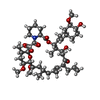
ChemComp-FK5:
8-DEETHYL-8-[BUT-3-ENYL]-ASCOMYCIN / medication*YM

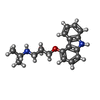
ChemComp-CAU:
(2S)-1-(9H-Carbazol-4-yloxy)-3-(isopropylamino)propan-2-ol

Source
  • homo sapiens (human)
  • mus musculus (house mouse)
KeywordsMEMBRANE PROTEIN/HYDROLASE/ISOMERASE / GPCR / beta2AR / calcineurin / inactive state / MEMBRANE PROTEIN / MEMBRANE PROTEIN-HYDROLASE-ISOMERASE complex / cryo-EM / calcineurin fusion

+
About Yorodumi Papers

-
News

-
Feb 9, 2022. New format data for meta-information of EMDB entries

New format data for meta-information of EMDB entries

  • Version 3 of the EMDB header file is now the official format.
  • The previous official version 1.9 will be removed from the archive.

Related info.:EMDB header

External links:wwPDB to switch to version 3 of the EMDB data model

-
Aug 12, 2020. Covid-19 info

Covid-19 info

URL: https://pdbj.org/emnavi/covid19.php

New page: Covid-19 featured information page in EM Navigator.

Related info.:Covid-19 info / Mar 5, 2020. Novel coronavirus structure data

+
Mar 5, 2020. Novel coronavirus structure data

Novel coronavirus structure data

Related info.:Yorodumi Speices / Aug 12, 2020. Covid-19 info

External links:COVID-19 featured content - PDBj / Molecule of the Month (242):Coronavirus Proteases

+
Jan 31, 2019. EMDB accession codes are about to change! (news from PDBe EMDB page)

EMDB accession codes are about to change! (news from PDBe EMDB page)

  • The allocation of 4 digits for EMDB accession codes will soon come to an end. Whilst these codes will remain in use, new EMDB accession codes will include an additional digit and will expand incrementally as the available range of codes is exhausted. The current 4-digit format prefixed with “EMD-” (i.e. EMD-XXXX) will advance to a 5-digit format (i.e. EMD-XXXXX), and so on. It is currently estimated that the 4-digit codes will be depleted around Spring 2019, at which point the 5-digit format will come into force.
  • The EM Navigator/Yorodumi systems omit the EMD- prefix.

Related info.:Q: What is EMD? / ID/Accession-code notation in Yorodumi/EM Navigator

External links:EMDB Accession Codes are Changing Soon! / Contact to PDBj

+
Jul 12, 2017. Major update of PDB

Major update of PDB

  • wwPDB released updated PDB data conforming to the new PDBx/mmCIF dictionary.
  • This is a major update changing the version number from 4 to 5, and with Remediation, in which all the entries are updated.
  • In this update, many items about electron microscopy experimental information are reorganized (e.g. em_software).
  • Now, EM Navigator and Yorodumi are based on the updated data.

External links:wwPDB Remediation / Enriched Model Files Conforming to OneDep Data Standards Now Available in the PDB FTP Archive

-
Yorodumi Papers

Database of articles cited by EMDB/PDB/SASBDB data

  • Database of articles cited by EMDB, PDB, and SASBDB entries
  • Using PubMed data

Related info.:EMDB / PDB / SASBDB / Yorodumi / EMN Papers / Changes in new EM Navigator and Yorodumi

Read more