 Movie
Movie Controller
 Structure viewers
 About Yorodumi Papers


+Search query
-Structure paper
| Title | Discovery of three novel neutralizing antibody epitopes on the human astrovirus capsid spike and mechanistic insights into virus neutralization. |
|---|---|
| Journal, issue, pages | J Virol, Vol. 99, Issue 2, Page e0161924, Year 2025 |
| Publish date | Feb 25, 2025 |
 Authors Authors | Sarah Lanning / Nayeli Aguilar-Hernández / Vitor Hugo B Serrão / Tomás López / Sara M O'Rourke / Adam Lentz / Lena Ricemeyer / Rafaela Espinosa / Susana López / Carlos F Arias / Rebecca M DuBois /   |
| PubMed Abstract | Human astroviruses (HAstVs) are a leading cause of viral childhood diarrhea that infects nearly every individual during their lifetime. Although human astroviruses are highly prevalent, no approved ...Human astroviruses (HAstVs) are a leading cause of viral childhood diarrhea that infects nearly every individual during their lifetime. Although human astroviruses are highly prevalent, no approved vaccine currently exists. Antibody responses appear to play an important role in protection from HAstV infection; however, knowledge about the neutralizing epitope landscape is lacking, as only three neutralizing antibody epitopes have previously been determined. Here, we structurally define the epitopes of three uncharacterized HAstV-neutralizing monoclonal antibodies: antibody 4B6 with X-ray crystallography to 2.67 Å, and antibodies 3H4 and 3B4 simultaneously with single-particle cryogenic-electron microscopy to 3.33 Å. We assess the epitope locations relative to conserved regions on the capsid spike and find that while antibodies 4B6 and 3B4 target the upper variable loop regions of the HAstV spike protein, antibody 3H4 targets a novel region near the base of the spike that is more conserved. Additionally, we found that all three antibodies bind with high affinity, and they compete with receptor FcRn binding to the capsid spike. These studies inform which regions of the HAstV capsid can be targeted by monoclonal antibody therapies and could aid in rational vaccine design.IMPORTANCEHuman astroviruses (HAstVs) infect nearly every child in the world, causing diarrhea, vomiting, and fever. Despite the prevalence of human astroviruses, little is known about how antibodies block virus infection. Here, we determined high-resolution structures of the astrovirus capsid protein in a complex with three virus-neutralizing antibodies. The antibodies bind distinct sites on the capsid spike domain. The antibodies block virus attachment to human cells and prevent capsid spike interaction with the human neonatal Fc receptor. These findings support the use of the human astrovirus capsid spike as an antigen in a vaccine to prevent astrovirus disease. |
 External links External links | J Virol / PubMed:39846739 / PubMed Central |
| Methods | EM (single particle) / X-ray diffraction |
| Resolution | 2.67 - 3.33 Å |
| Structure data | EMDB-45427, PDB-9cbn:  PDB-9cn2: |
| Chemicals | 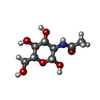 ChemComp-NAG:  ChemComp-HOH: |
| Source |
|
 Keywords Keywords | VIRAL PROTEIN/IMMUNE SYSTEM / antibody / virus / spike / homodimer / VIRAL PROTEIN-IMMUNE SYSTEM complex / VIRAL PROTEIN / neutralization |


 mus musculus (house mouse)
 human astrovirus 1