[English] 日本語
Yorodumi Papers
- Database of articles cited by EMDB/PDB/SASBDB data -

+
Search query

Keywords
Structure methods
Author
Journal
IF

-
Structure paper

TitleMultiple mechanisms for licensing human replication origins.
Journal, issue, pagesNature, Vol. 636, Issue 8042, Page 488-498, Year 2024
Publish dateNov 27, 2024
AuthorsRan Yang / Olivia Hunker / Marleigh Wise / Franziska Bleichert /
PubMed AbstractLoading of replicative helicases is obligatory for the assembly of DNA replication machineries. The eukaryotic MCM2-7 replicative helicase motor is deposited onto DNA by the origin recognition ...Loading of replicative helicases is obligatory for the assembly of DNA replication machineries. The eukaryotic MCM2-7 replicative helicase motor is deposited onto DNA by the origin recognition complex (ORC) and co-loader proteins as a head-to-head double hexamer to license replication origins. Although extensively studied in budding yeast, the mechanisms of origin licensing in multicellular eukaryotes remain poorly defined. Here we use biochemical reconstitution and electron microscopy to reconstruct the human MCM loading pathway. We find that unlike in yeast, the ORC6 subunit of the ORC is not essential for-but enhances-human MCM loading. Electron microscopy analyses identify several intermediates en route to MCM double hexamer formation in the presence and absence of ORC6, including a DNA-loaded, closed-ring MCM single hexamer intermediate that can mature into a head-to-head double hexamer through multiple mechanisms. ORC6 and ORC3 facilitate the recruitment of the ORC to the dimerization interface of the first hexamer into MCM-ORC (MO) complexes that are distinct from the yeast MO complex and may orient the ORC for second MCM hexamer loading. Additionally, MCM double hexamer formation can proceed through dimerization of independently loaded MCM single hexamers, promoted by a propensity of human MCM2-7 hexamers to self-dimerize. This flexibility in human MCM loading may provide resilience against cellular replication stress, and the reconstitution system will enable studies addressing outstanding questions regarding DNA replication initiation and replication-coupled events in the future.
External linksNature / PubMed:39604729 / PubMed Central
MethodsEM (single particle)
Resolution2.8 - 3.8 Å
Structure data

EMDB-43707, PDB-8w0e:
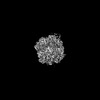
Cryo-EM structure of a human MCM2-7 single hexamer on dsDNA
Method: EM (single particle) / Resolution: 3.4 Å

EMDB-43708, PDB-8w0f:
Cryo-EM structure of a human MCM2-7 double hexamer on dsDNA
Method: EM (single particle) / Resolution: 2.8 Å

EMDB-43709, PDB-8w0g:
Cryo-EM structure of a human MCM2-7 dimer
Method: EM (single particle) / Resolution: 3.8 Å

EMDB-43710, PDB-8w0i:
Cryo-EM structure of the human MCM2-7 heterohexamer
Method: EM (single particle) / Resolution: 3.5 Å

EMDB-45400, PDB-9caq:
Cryo-EM structure of a human MCM2-7 double hexamer formed from independently loaded MCM2-7 single hexamers
Method: EM (single particle) / Resolution: 3.2 Å

Chemicals

ChemComp-ZN:
Unknown entry

ChemComp-MG:
Unknown entry

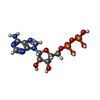
ChemComp-ATP:
ADENOSINE-5'-TRIPHOSPHATE / ATP, energy-carrying molecule*YM

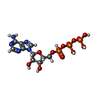
ChemComp-ADP:
ADENOSINE-5'-DIPHOSPHATE / ADP, energy-carrying molecule*YM

Source
  • homo sapiens (human)
  • saccharomyces cerevisiae (brewer's yeast)

KeywordsREPLICATION / complex / helicase / AAA+ ATPase / DNA BINDING PROTEIN

+
About Yorodumi Papers

-
News

-
Feb 9, 2022. New format data for meta-information of EMDB entries

New format data for meta-information of EMDB entries

  • Version 3 of the EMDB header file is now the official format.
  • The previous official version 1.9 will be removed from the archive.

Related info.:EMDB header

External links:wwPDB to switch to version 3 of the EMDB data model

-
Aug 12, 2020. Covid-19 info

Covid-19 info

URL: https://pdbj.org/emnavi/covid19.php

New page: Covid-19 featured information page in EM Navigator.

Related info.:Covid-19 info / Mar 5, 2020. Novel coronavirus structure data

+
Mar 5, 2020. Novel coronavirus structure data

Novel coronavirus structure data

Related info.:Yorodumi Speices / Aug 12, 2020. Covid-19 info

External links:COVID-19 featured content - PDBj / Molecule of the Month (242):Coronavirus Proteases

+
Jan 31, 2019. EMDB accession codes are about to change! (news from PDBe EMDB page)

EMDB accession codes are about to change! (news from PDBe EMDB page)

  • The allocation of 4 digits for EMDB accession codes will soon come to an end. Whilst these codes will remain in use, new EMDB accession codes will include an additional digit and will expand incrementally as the available range of codes is exhausted. The current 4-digit format prefixed with “EMD-” (i.e. EMD-XXXX) will advance to a 5-digit format (i.e. EMD-XXXXX), and so on. It is currently estimated that the 4-digit codes will be depleted around Spring 2019, at which point the 5-digit format will come into force.
  • The EM Navigator/Yorodumi systems omit the EMD- prefix.

Related info.:Q: What is EMD? / ID/Accession-code notation in Yorodumi/EM Navigator

External links:EMDB Accession Codes are Changing Soon! / Contact to PDBj

+
Jul 12, 2017. Major update of PDB

Major update of PDB

  • wwPDB released updated PDB data conforming to the new PDBx/mmCIF dictionary.
  • This is a major update changing the version number from 4 to 5, and with Remediation, in which all the entries are updated.
  • In this update, many items about electron microscopy experimental information are reorganized (e.g. em_software).
  • Now, EM Navigator and Yorodumi are based on the updated data.

External links:wwPDB Remediation / Enriched Model Files Conforming to OneDep Data Standards Now Available in the PDB FTP Archive

-
Yorodumi Papers

Database of articles cited by EMDB/PDB/SASBDB data

  • Database of articles cited by EMDB, PDB, and SASBDB entries
  • Using PubMed data

Related info.:EMDB / PDB / SASBDB / Yorodumi / EMN Papers / Changes in new EM Navigator and Yorodumi

Read more