[English] 日本語
Yorodumi Papers
- Database of articles cited by EMDB/PDB/SASBDB data -

+
Search query

Keywords
Structure methods
Author
Journal
IF

-
Structure paper

TitleSingle-Molecule Insight Into α-Synuclein Fibril Structure and Mechanics Modulated by Chemical Compounds.
Journal, issue, pagesAdv Sci (Weinh), Vol. 12, Issue 14, Page e2416721, Year 2025
Publish dateFeb 14, 2025
AuthorsXiang Li / Lulu Bi / Shenqing Zhang / Qianhui Xu / Wencheng Xia / Youqi Tao / Shaojuan Wu / Yanan Li / Weidong Le / Wenyan Kang / Dan Li / Bo Sun / Cong Liu /
PubMed Abstractα-Syn fibrils, a key pathological hallmark of Parkinson's disease, is closely associated with disease initiation and progression. Several small molecules are found to bind or dissolve α-syn ...α-Syn fibrils, a key pathological hallmark of Parkinson's disease, is closely associated with disease initiation and progression. Several small molecules are found to bind or dissolve α-syn fibrils, offering potential therapeutic applications. Here, an innovative optical tweezers-based, fluorescence-combined approach is developed to probe the mechanical characteristics of α-syn fibrils at the single-molecule level. When subjected to axial stretching, local deformation within α-syn fibrils appeared at forces above 50 pN. These structural alternations occurred stepwise and are irreversible, suggesting unfolding of individual α-syn molecules or subdomains. Additionally, α-syn fibrils exhibits high heterogeneity in lateral disruption, with rupture force ranging from 50 to 500 pN. The impact of different compounds on the structure and mechanical features of α-syn fibrils is further examined. Notably, epigallocatechin gallate (EGCG) generally attenuates the rupture force of fibrils by wedging into the N-terminal polar groove and induces fibril dissociation. Conversely, copper chlorophyllin A (CCA) attaches to four different sites wrapping around the fibril core, reinforcing the stability of the fibril against rupture forces. The work offers an effective method for characterizing single-fibril properties and bridges compound-induced structural alternations with mechanical response. These insights are valuable for understanding amyloid fibril mechanics and their regulation by small molecules.
External linksAdv Sci (Weinh) / PubMed:39951335 / PubMed Central
MethodsEM (helical sym.)
Resolution3.1 Å
Structure data

EMDB-38733, PDB-8xwd:
Croy-EM structure of alpha synuclein fibril with EGCG
Method: EM (helical sym.) / Resolution: 3.1 Å

Chemicals

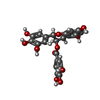
ChemComp-KDH:
(2R,3R)-5,7-dihydroxy-2-(3,4,5-trihydroxyphenyl)-3,4-dihydro-2H-chromen-3-yl 3,4,5-trihydroxybenzoate

Source
  • homo sapiens (human)
KeywordsPROTEIN FIBRIL / amyloid

+
About Yorodumi Papers

-
News

-
Feb 9, 2022. New format data for meta-information of EMDB entries

New format data for meta-information of EMDB entries

  • Version 3 of the EMDB header file is now the official format.
  • The previous official version 1.9 will be removed from the archive.

Related info.:EMDB header

External links:wwPDB to switch to version 3 of the EMDB data model

-
Aug 12, 2020. Covid-19 info

Covid-19 info

URL: https://pdbj.org/emnavi/covid19.php

New page: Covid-19 featured information page in EM Navigator.

Related info.:Covid-19 info / Mar 5, 2020. Novel coronavirus structure data

+
Mar 5, 2020. Novel coronavirus structure data

Novel coronavirus structure data

Related info.:Yorodumi Speices / Aug 12, 2020. Covid-19 info

External links:COVID-19 featured content - PDBj / Molecule of the Month (242):Coronavirus Proteases

+
Jan 31, 2019. EMDB accession codes are about to change! (news from PDBe EMDB page)

EMDB accession codes are about to change! (news from PDBe EMDB page)

  • The allocation of 4 digits for EMDB accession codes will soon come to an end. Whilst these codes will remain in use, new EMDB accession codes will include an additional digit and will expand incrementally as the available range of codes is exhausted. The current 4-digit format prefixed with “EMD-” (i.e. EMD-XXXX) will advance to a 5-digit format (i.e. EMD-XXXXX), and so on. It is currently estimated that the 4-digit codes will be depleted around Spring 2019, at which point the 5-digit format will come into force.
  • The EM Navigator/Yorodumi systems omit the EMD- prefix.

Related info.:Q: What is EMD? / ID/Accession-code notation in Yorodumi/EM Navigator

External links:EMDB Accession Codes are Changing Soon! / Contact to PDBj

+
Jul 12, 2017. Major update of PDB

Major update of PDB

  • wwPDB released updated PDB data conforming to the new PDBx/mmCIF dictionary.
  • This is a major update changing the version number from 4 to 5, and with Remediation, in which all the entries are updated.
  • In this update, many items about electron microscopy experimental information are reorganized (e.g. em_software).
  • Now, EM Navigator and Yorodumi are based on the updated data.

External links:wwPDB Remediation / Enriched Model Files Conforming to OneDep Data Standards Now Available in the PDB FTP Archive

-
Yorodumi Papers

Database of articles cited by EMDB/PDB/SASBDB data

  • Database of articles cited by EMDB, PDB, and SASBDB entries
  • Using PubMed data

Related info.:EMDB / PDB / SASBDB / Yorodumi / EMN Papers / Changes in new EM Navigator and Yorodumi

Read more