 Movie
Movie Controller
 Structure viewers
 About Yorodumi Papers


+Search query
-Structure paper
| Title | Structural and functional characterization of SPARTA system. |
|---|---|
| Journal, issue, pages | Biochem Biophys Res Commun, Vol. 825, Page 153972, Year 2026 |
| Publish date | Aug 6, 2026 |
 Authors Authors | Hongze Zhao / Pingping Huang / Lijie Guo / Xinning Jiang / Zhaoxing Li / Bingjie Tao / Meiling Lu / Lianwen Qi / Lei Zhang / Yibei Xiao / Meirong Chen /  |
| PubMed Abstract | Short prokaryotic Argonaute associated with TIR-APAZ (SPARTA) is a bacterial defense system that oligomerizes to activate the TIR domain, depleting NAD upon guide-mediated target DNA recognition. ...Short prokaryotic Argonaute associated with TIR-APAZ (SPARTA) is a bacterial defense system that oligomerizes to activate the TIR domain, depleting NAD upon guide-mediated target DNA recognition. Previous studies have shown a marked activity divergence between thermophilic Crenotalea thermophila SPARTA (CrtSPARTA) and Maribacter polysiphoniae SPARTA (MapSPARTA); however, the underlying mechanism remains unclear. Here, through biochemical and structural analysis, we found that compared with the relatively rigid CrtSPARTA, MapSPARTA exhibits much more flexibility in its TIR domain, which flips during the formation of active tetramers. Interestingly, we found that the activity of CrtSPARTA, but not MapSPARTA, could be significantly enhanced when we weakened the interaction between the MID and TIR domains by introducing mutations at the interface, suggesting that the MID-TIR interaction restricts the release of CrtTIR and thus the activation of CrtSPARTA. Following guide-target recognition, this flexibility-induced activation can be further promoted by higher temperatures within the physiological range or Ca, together suggesting that the restriction of TIR by the MID-TIR interaction may be a strategy to prevent auto-activation of thermophilic CrtSPARTA. Meanwhile, we also found that tRNA fragments can serve as guide RNAs for SPARTA activation, which probably reveals the origin of the RNA guide for prokaryotic Argonaute. This also suggests the possibility that SPARTA may function cooperatively with other defense systems involving a tRNA endonuclease to efficiently respond to viral infection. |
 External links External links | Biochem Biophys Res Commun / PubMed:42172904 |
| Methods | EM (single particle) |
| Resolution | 3.2 - 3.5 Å |
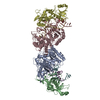
| Structure data | EMDB-36592, PDB-8jr8:  EMDB-37490: Focused map for area 1 of MapSPARTA tetramer bound with guide-target  EMDB-37496: Focused map for area 2 of MapSPARTA tetramer bound with guide-target  EMDB-37510: Focused map for area 3 of MapSPARTA tetramer bound with guide-target  EMDB-37512: Focused map for area 4 of MapSPARTA tetramer bound with guide-target  EMDB-37608: Raw consensus map of MapSPARTA tetramer bound with guide-target EMDB-37708, PDB-8wp2: |
| Source |
|
 Keywords Keywords | DNA BINDING PROTEIN/DNA/RNA / SPARTA / Ago / Tir / DNA BINDING PROTEIN-DNA-RNA complex / RNA BINDING PROTEIN/DNA/RNA / RNA BINDING PROTEIN-DNA-RNA complex |


 maribacter polysiphoniae (bacteria)