[English] 日本語
Yorodumi Papers
- Database of articles cited by EMDB/PDB/SASBDB data -

+
Search query

Keywords
Structure methods
Author
Journal
IF

-
Structure paper

TitleStructural and Functional Characterization of Heterologous Nitrogenase Complexes.
Journal, issue, pagesBiochemistry, Year 2026
Publish dateJul 2, 2026
AuthorsYizhou Li / Sarah M Narehood / Brian D Cook / Kelly L McGuire / Mark A Herzik / F Akif Tezcan /
PubMed AbstractNitrogenase is the only known enzyme that catalyzes the reduction of dinitrogen to ammonia. The most prevalent isozyme, molybdenum nitrogenase, comprises the catalytic molybdenum-iron protein (MoFeP) ...Nitrogenase is the only known enzyme that catalyzes the reduction of dinitrogen to ammonia. The most prevalent isozyme, molybdenum nitrogenase, comprises the catalytic molybdenum-iron protein (MoFeP) and the ATP-dependent reductase iron protein (FeP). Although Mo-nitrogenases are widespread across bacteria and archaea and appear to share conserved mechanistic and structural features, FeP and MoFeP show considerable sequence variability across diazotrophs. This raises questions about the conservation of chemomechanical mechanisms coupling FeP-dependent ATP hydrolysis and electron transfer to MoFeP, and about the functional compatibility of nitrogenase components from divergent species. Previous studies showed that some heterologous FeP-MoFeP pairs can functionally complement each other, whereas other pairs lack catalytic activity, but the absence of structural information on such heterologous pairs has limited mechanistic understanding. To this end, we investigated the functional and structural compatibility of FeP and MoFeP from () and (), two phylogenetically and ecologically distinct species. Building on our prior work with -nitrogenase and recently developed cryogenic electron microscopy (cryoEM) protocols, we determined the ADP·BeF-trapped structure of the homologous FeP-MoFeP complex and showed that it adopted the same geometry as its counterpart. Activity measurements showed that heterologous combinations retained 60-80% of homologous catalytic activities despite 30-50% sequence divergence in FeP and MoFeP. High-resolution cryoEM structures of FeP-MoFeP and FeP-MoFeP corroborated these activities and revealed that functional complementation tolerates substantial sequence variation when the core structural elements supporting ATP binding/hydrolysis, protein-protein interaction, electron transfer, and substrate reduction are conserved.
External linksBiochemistry / PubMed:42390130
MethodsEM (single particle)
Resolution2.15 - 2.92 Å
Structure data

EMDB-75566, PDB-10zk:
CryoEM structure of Gluconacetobacter diazotrophicus nitrogenase complex (2:1 FeP:MoFeP) inhibited by BeFx (C2 symmetry)
Method: EM (single particle) / Resolution: 2.73 Å

EMDB-75567, PDB-10zl:
CryoEM structure of Gluconacetobacter diazotrophicus MoFeP (C2 symmetry)
Method: EM (single particle) / Resolution: 2.15 Å

EMDB-75568, PDB-10zm:
CryoEM structure of heterologous nitrogenase complex (2:1 G. diazotrophicus-FeP:A. vinelandii-MoFeP) inhibited by BeFx (C2 symmetry)
Method: EM (single particle) / Resolution: 2.22 Å

EMDB-75569, PDB-10zn:
CryoEM structure of Heterologous nitrogenase complex (2:1 A. vinelandii-FeP:G. diazotrophicus-MoFeP) inhibited by BeFx (C2 symmetry)
Method: EM (single particle) / Resolution: 2.92 Å

Chemicals

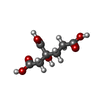
ChemComp-HCA:
3-HYDROXY-3-CARBOXY-ADIPIC ACID

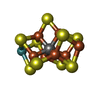
ChemComp-ICS:
iron-sulfur-molybdenum cluster with interstitial carbon

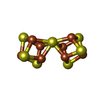
ChemComp-CLF:
FE(8)-S(7) CLUSTER

ChemComp-FE:
Unknown entry

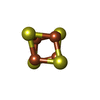
ChemComp-SF4:
IRON/SULFUR CLUSTER

ChemComp-MG:
Unknown entry

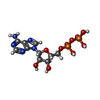
ChemComp-ADP:
ADENOSINE-5'-DIPHOSPHATE / ADP, energy-carrying molecule*YM

ChemComp-0BE:
BERYLLIUM

ChemComp-HOH:
WATER

Source
  • gluconacetobacter diazotrophicus pa1 5 (bacteria)

  • azotobacter vinelandii dj (bacteria)
KeywordsOXIDOREDUCTASE / Nitrogenase / Nitrogenase complex / Gluconacetobacter diazotrophicus / molybdenum-iron protein / Iron protein / MoFeP / FeP / FeP-MoFeP / Heterologous Nitrogenase complex / Azotobacter vinelandii

+
About Yorodumi Papers

-
News

-
Feb 9, 2022. New format data for meta-information of EMDB entries

New format data for meta-information of EMDB entries

  • Version 3 of the EMDB header file is now the official format.
  • The previous official version 1.9 will be removed from the archive.

Related info.:EMDB header

External links:wwPDB to switch to version 3 of the EMDB data model

-
Aug 12, 2020. Covid-19 info

Covid-19 info

URL: https://pdbj.org/emnavi/covid19.php

New page: Covid-19 featured information page in EM Navigator.

Related info.:Covid-19 info / Mar 5, 2020. Novel coronavirus structure data

+
Mar 5, 2020. Novel coronavirus structure data

Novel coronavirus structure data

Related info.:Yorodumi Speices / Aug 12, 2020. Covid-19 info

External links:COVID-19 featured content - PDBj / Molecule of the Month (242):Coronavirus Proteases

+
Jan 31, 2019. EMDB accession codes are about to change! (news from PDBe EMDB page)

EMDB accession codes are about to change! (news from PDBe EMDB page)

  • The allocation of 4 digits for EMDB accession codes will soon come to an end. Whilst these codes will remain in use, new EMDB accession codes will include an additional digit and will expand incrementally as the available range of codes is exhausted. The current 4-digit format prefixed with “EMD-” (i.e. EMD-XXXX) will advance to a 5-digit format (i.e. EMD-XXXXX), and so on. It is currently estimated that the 4-digit codes will be depleted around Spring 2019, at which point the 5-digit format will come into force.
  • The EM Navigator/Yorodumi systems omit the EMD- prefix.

Related info.:Q: What is EMD? / ID/Accession-code notation in Yorodumi/EM Navigator

External links:EMDB Accession Codes are Changing Soon! / Contact to PDBj

+
Jul 12, 2017. Major update of PDB

Major update of PDB

  • wwPDB released updated PDB data conforming to the new PDBx/mmCIF dictionary.
  • This is a major update changing the version number from 4 to 5, and with Remediation, in which all the entries are updated.
  • In this update, many items about electron microscopy experimental information are reorganized (e.g. em_software).
  • Now, EM Navigator and Yorodumi are based on the updated data.

External links:wwPDB Remediation / Enriched Model Files Conforming to OneDep Data Standards Now Available in the PDB FTP Archive

-
Yorodumi Papers

Database of articles cited by EMDB/PDB/SASBDB data

  • Database of articles cited by EMDB, PDB, and SASBDB entries
  • Using PubMed data

Related info.:EMDB / PDB / SASBDB / Yorodumi / EMN Papers / Changes in new EM Navigator and Yorodumi

Read more