[English] 日本語
Yorodumi Papers
- Database of articles cited by EMDB/PDB/SASBDB data -

+
Search query

Keywords
Structure methods
Author
Journal
IF

-
Structure paper

TitleLigand binding modes of the bitter taste receptor T2R14 and T2R46.
Journal, issue, pagesNat Struct Mol Biol, Vol. 33, Issue 4, Page 691-700, Year 2026
Publish dateApr 20, 2026
AuthorsQiuxiang Tan / Yu Yu / Xuteng Han / Kezhen Liu / Shuo Han / Mu Wang / Yuan Wei / Yingrong Zhu / Qiuru Chen / Limin Ma / Cuiying Yi / Xiaojing Chu / Beili Wu / Qiang Zhao /
PubMed AbstractBitter taste receptors (T2Rs) are considered attractive drug targets. However, the ligand recognition and selectivity of these receptors remain elusive, hampering their drug development. Here we ...Bitter taste receptors (T2Rs) are considered attractive drug targets. However, the ligand recognition and selectivity of these receptors remain elusive, hampering their drug development. Here we present seven structures of human T2R14 and T2R46 in apo or ligand-bound state. Combined with molecular docking and mutagenesis data, the structures reveal an extracellular ligand-binding site in T2R14 for most of its ligands, which is different from the intracellular binding site reported recently. In contrast, T2R46 exhibits a conserved binding pocket that accommodates various ligands with distinct interaction patterns. Furthermore, the second extracellular loop in T2R14 and T2R46 acts as a tethered agonist to potentially facilitate agonist response of these two receptors to the weak tastant agonists. These findings could accelerate drug discovery targeting T2Rs.
External linksNat Struct Mol Biol / PubMed:42009775 / PubMed Central
MethodsEM (single particle)
Resolution2.7 - 3.6 Å
Structure data

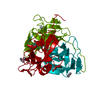
EMDB-65511, PDB-9w0p:
CryoEM structure of T2R14 in complex with chlorhexidine and heterotrimeric G protein complex
Method: EM (single particle) / Resolution: 3.6 Å

EMDB-65512, PDB-9w0q:
Cryo-EM structure of T2R14 in complex with tangeretin and heterotrimeric G protein
Method: EM (single particle) / Resolution: 3.2 Å

EMDB-65513, PDB-9w0r:
Cryo-EM structure of apo-T2R46 in complex with heterotrimeric G protein
Method: EM (single particle) / Resolution: 2.7 Å

EMDB-65514, PDB-9w0s:
CryoEM structure of T2R46 in complex with Arteminisin and heterotrimeric G protein complex
Method: EM (single particle) / Resolution: 3.3 Å

EMDB-65515, PDB-9w0t:
CryoEM structure of the T2R46 in complex with Denatomium benozate and heterotrimeric G protein complex
Method: EM (single particle) / Resolution: 3.3 Å

EMDB-65516, PDB-9w0u:
CryoEM structure of the T2R46 in complex with tangeretin and heterotrimeric G protein complex
Method: EM (single particle) / Resolution: 2.9 Å

EMDB-65518, PDB-9w0w:
CryoEM structure of the T2R46 in complex with strychine and heterotrimeric G protein complex
Method: EM (single particle) / Resolution: 3.2 Å

Chemicals

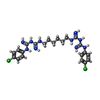
ChemComp-XC9:
1-[6-[azanylidene-[[azanylidene-[[(4-chlorophenyl)amino]methyl]-$l^{4}-azanyl]methyl]-$l^{4}-azanyl]hexyl]-3-[~{N}-(4-chlorophenyl)carbamimidoyl]guanidine

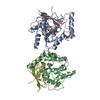
PDB-1eui:
ESCHERICHIA COLI URACIL-DNA GLYCOSYLASE COMPLEX WITH URACIL-DNA GLYCOSYLASE INHIBITOR PROTEIN

PDB-1euw:
ATOMIC RESOLUTION STRUCTURE OF E. COLI DUTPASE

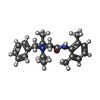
ChemComp-WK3:
N-benzyl-2-(2,6-dimethylanilino)-N,N-diethyl-2-oxoethan-1-aminium

ChemComp-SY9:
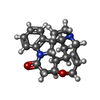
STRYCHNINE

Source
  • homo sapiens (human)
  • escherichia coli (E. coli)
KeywordsMEMBRANE PROTEIN / G protein-coupled receptor / Bitter taste receptor 14 / Bitter taste receptor 46 / ligand binding / signal transduction

+
About Yorodumi Papers

-
News

-
Feb 9, 2022. New format data for meta-information of EMDB entries

New format data for meta-information of EMDB entries

  • Version 3 of the EMDB header file is now the official format.
  • The previous official version 1.9 will be removed from the archive.

Related info.:EMDB header

External links:wwPDB to switch to version 3 of the EMDB data model

-
Aug 12, 2020. Covid-19 info

Covid-19 info

URL: https://pdbj.org/emnavi/covid19.php

New page: Covid-19 featured information page in EM Navigator.

Related info.:Covid-19 info / Mar 5, 2020. Novel coronavirus structure data

+
Mar 5, 2020. Novel coronavirus structure data

Novel coronavirus structure data

Related info.:Yorodumi Speices / Aug 12, 2020. Covid-19 info

External links:COVID-19 featured content - PDBj / Molecule of the Month (242):Coronavirus Proteases

+
Jan 31, 2019. EMDB accession codes are about to change! (news from PDBe EMDB page)

EMDB accession codes are about to change! (news from PDBe EMDB page)

  • The allocation of 4 digits for EMDB accession codes will soon come to an end. Whilst these codes will remain in use, new EMDB accession codes will include an additional digit and will expand incrementally as the available range of codes is exhausted. The current 4-digit format prefixed with “EMD-” (i.e. EMD-XXXX) will advance to a 5-digit format (i.e. EMD-XXXXX), and so on. It is currently estimated that the 4-digit codes will be depleted around Spring 2019, at which point the 5-digit format will come into force.
  • The EM Navigator/Yorodumi systems omit the EMD- prefix.

Related info.:Q: What is EMD? / ID/Accession-code notation in Yorodumi/EM Navigator

External links:EMDB Accession Codes are Changing Soon! / Contact to PDBj

+
Jul 12, 2017. Major update of PDB

Major update of PDB

  • wwPDB released updated PDB data conforming to the new PDBx/mmCIF dictionary.
  • This is a major update changing the version number from 4 to 5, and with Remediation, in which all the entries are updated.
  • In this update, many items about electron microscopy experimental information are reorganized (e.g. em_software).
  • Now, EM Navigator and Yorodumi are based on the updated data.

External links:wwPDB Remediation / Enriched Model Files Conforming to OneDep Data Standards Now Available in the PDB FTP Archive

-
Yorodumi Papers

Database of articles cited by EMDB/PDB/SASBDB data

  • Database of articles cited by EMDB, PDB, and SASBDB entries
  • Using PubMed data

Related info.:EMDB / PDB / SASBDB / Yorodumi / EMN Papers / Changes in new EM Navigator and Yorodumi

Read more