[English] 日本語
Yorodumi Papers
- Database of articles cited by EMDB/PDB/SASBDB data -

+
Search query

Keywords
Structure methods
Author
Journal
IF

-
Structure paper

TitleStructural basis for the subtype-selectivity of K2.2 channel activators.
Journal, issue, pagesNat Commun, Vol. 17, Issue 1, Page 531, Year 2026
Publish dateJan 8, 2026
AuthorsYoung-Woo Nam / Alena Ramanishka / Yang Xu / Rose Marie Haynes Yasuda / Joshua A Nasburg / Dohyun Im / Meng Cui / K George Chandy / Heike Wulff / Miao Zhang /
PubMed AbstractSmall-conductance (K2.2) and intermediate-conductance (K3.1) Ca-activated K channels are gated by a Ca-calmodulin dependent mechanism. NS309 potentiates the activity of both K2.2 and K3.1, while ...Small-conductance (K2.2) and intermediate-conductance (K3.1) Ca-activated K channels are gated by a Ca-calmodulin dependent mechanism. NS309 potentiates the activity of both K2.2 and K3.1, while rimtuzalcap selectively activates K2.2. Rimtuzalcap has been used in clinical trials for the treatment of spinocerebellar ataxia and essential tremor. We report cryo-electron microscopy structures of NS309-bound K2.2 and K3.1, in addition to structures of rimtuzalcap-bound K2.2 and mutant K3.1_R355K. The different conformations of calmodulin and the cytoplasmic HC helices in the two channels underlie the subtype-selectivity of rimtuzalcap for K2.2. NS309 binds to pre-existing pockets in both channels, while the bulkier rimtuzalcap binds in an induced-fit pocket in K2.2 requiring conformational changes. In K2.2, calmodulin's N-lobes are sufficiently far apart to enable conformational changes to accommodate either NS309 or rimtuzalcap. In K3.1, calmodulin's N-lobes are closer to each other and constrained by K3.1's HC helices, which allows binding of NS309 but not rimtuzalcap. Replacement of arginine-355 in K3.1's HB helix with lysine (K3.1_R355K) allows the binding of rimtuzalcap and renders the mutant channel sensitive to rimtuzalcap. These structures provide a framework for structure-based drug design targeting K2.2 channels.
External linksNat Commun / PubMed:41507196 / PubMed Central
MethodsEM (single particle)
Resolution2.96 - 4.73 Å
Structure data

EMDB-70217, PDB-9o85:
Cryo-EM structure of KCa2.2_I/calmodulin channel in complex with rimtuzalcap
Method: EM (single particle) / Resolution: 3.13 Å

EMDB-70240, PDB-9o93:
Cryo-EM structure of KCa2.2_II/calmodulin channel in complex with rimtuzalcap
Method: EM (single particle) / Resolution: 2.96 Å

EMDB-70275, PDB-9oa8:
Cryo-EM structure of KCa3.1/calmodulin channel in complex with NS309
Method: EM (single particle) / Resolution: 3.59 Å

EMDB-72519, PDB-9y5q:
Cryo EM structure of KCa3.1_R355K_I/calmodulin channel in complex with rimtuzalcap
Method: EM (single particle) / Resolution: 4.73 Å

EMDB-72841, PDB-9ydz:
Cryo EM structure of KCa3.1_R355K_II/calmodulin channel in complex with rimtuzalcap
Method: EM (single particle) / Resolution: 3.4 Å

Chemicals

ChemComp-K:
Unknown entry

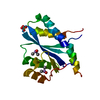
PDB-1b92:
MOBILITY OF AN HIV-1 INTEGRASE ACTIVE SITE LOOP IS CORRELATED WITH CATALYTIC ACTIVITY

ChemComp-CA:
Unknown entry

ChemComp-HOH:
WATER

ChemComp-1KP:
(3E)-6,7-dichloro-3-(hydroxyimino)-1,3-dihydro-2H-indol-2-one

Source
  • rattus norvegicus (Norway rat)
  • homo sapiens (human)
KeywordsTRANSPORT PROTEIN / Ion channel / Small-conductance calcium-activated potassium channel / Membrane protein / Intermediate conductance calcium-activated potassium channel / Calmodulin binding protein

+
About Yorodumi Papers

-
News

-
Feb 9, 2022. New format data for meta-information of EMDB entries

New format data for meta-information of EMDB entries

  • Version 3 of the EMDB header file is now the official format.
  • The previous official version 1.9 will be removed from the archive.

Related info.:EMDB header

External links:wwPDB to switch to version 3 of the EMDB data model

-
Aug 12, 2020. Covid-19 info

Covid-19 info

URL: https://pdbj.org/emnavi/covid19.php

New page: Covid-19 featured information page in EM Navigator.

Related info.:Covid-19 info / Mar 5, 2020. Novel coronavirus structure data

+
Mar 5, 2020. Novel coronavirus structure data

Novel coronavirus structure data

Related info.:Yorodumi Speices / Aug 12, 2020. Covid-19 info

External links:COVID-19 featured content - PDBj / Molecule of the Month (242):Coronavirus Proteases

+
Jan 31, 2019. EMDB accession codes are about to change! (news from PDBe EMDB page)

EMDB accession codes are about to change! (news from PDBe EMDB page)

  • The allocation of 4 digits for EMDB accession codes will soon come to an end. Whilst these codes will remain in use, new EMDB accession codes will include an additional digit and will expand incrementally as the available range of codes is exhausted. The current 4-digit format prefixed with “EMD-” (i.e. EMD-XXXX) will advance to a 5-digit format (i.e. EMD-XXXXX), and so on. It is currently estimated that the 4-digit codes will be depleted around Spring 2019, at which point the 5-digit format will come into force.
  • The EM Navigator/Yorodumi systems omit the EMD- prefix.

Related info.:Q: What is EMD? / ID/Accession-code notation in Yorodumi/EM Navigator

External links:EMDB Accession Codes are Changing Soon! / Contact to PDBj

+
Jul 12, 2017. Major update of PDB

Major update of PDB

  • wwPDB released updated PDB data conforming to the new PDBx/mmCIF dictionary.
  • This is a major update changing the version number from 4 to 5, and with Remediation, in which all the entries are updated.
  • In this update, many items about electron microscopy experimental information are reorganized (e.g. em_software).
  • Now, EM Navigator and Yorodumi are based on the updated data.

External links:wwPDB Remediation / Enriched Model Files Conforming to OneDep Data Standards Now Available in the PDB FTP Archive

-
Yorodumi Papers

Database of articles cited by EMDB/PDB/SASBDB data

  • Database of articles cited by EMDB, PDB, and SASBDB entries
  • Using PubMed data

Related info.:EMDB / PDB / SASBDB / Yorodumi / EMN Papers / Changes in new EM Navigator and Yorodumi

Read more