[English] 日本語
Yorodumi Papers
- Database of articles cited by EMDB/PDB/SASBDB data -

+
Search query

Keywords
Structure methods
Author
Journal
IF

-
Structure paper

TitleCryo-EM structural analyses reveal plant-specific adaptations of the CDC48 unfoldase.
Journal, issue, pagesPlant Commun, Vol. 7, Issue 1, Page 101572, Year 2026
Publish dateJan 12, 2026
AuthorsBrandon Huntington / Anandsukeerthi Sandholu / Jun Wang / Junrui Zhang / Lingyun Zhao / Bilal M Qureshi / Umar F Shahul Hameed / Stefan T Arold /
PubMed AbstractTargeted protein degradation through the CDC48 unfoldase enables the maintenance and rapid adaptation of proteomes across eukaryotes. However, the substantial differences among animals, fungi, and ...Targeted protein degradation through the CDC48 unfoldase enables the maintenance and rapid adaptation of proteomes across eukaryotes. However, the substantial differences among animals, fungi, and plants presumably drove extensive adaptation of CDC48-mediated degradation. Although animal and fungal CDC48 systems have shown structural and functional preservation, comparable analysis has been lacking for plants. We determined the structural and functional characteristics of Arabidopsis thaliana CDC48A in multiple states and in complex with the target-identifying cofactors UFD1 and NPL4. Our analysis revealed several features that distinguish AtCDC48A from its animal and yeast counterparts despite 80% sequence identity. Key findings include that AtCDC48A exhibits distinct domain dynamics and engages AtNPL4 in a unique manner. Moreover, AtNPL4 and AtUFD1 do not form an obligate heterodimer; instead, AtNPL4 can independently bind to AtCDC48A and mediate target degradation, although their combined action is synergistic. An evolutionary analysis indicates that these Arabidopsis features are conserved across plants and represent the ancestral state of eukaryotic CDC48 systems. Collectively, our findings suggest that plant CDC48 retains a more modular and combinatorial mode of cofactor usage, highlighting a specific adaptation of targeted protein degradation in plants.
External linksPlant Commun / PubMed:41137397
MethodsEM (single particle) / X-ray diffraction
Resolution2.6 - 3.9 Å
Structure data

EMDB-63608, PDB-9m3v:
Arabidopsis thaliana CDC48A, nucleotide-free (Apo)
Method: EM (single particle) / Resolution: 3.9 Å

EMDB-63609, PDB-9m3w:
Arabidopsis thaliana CDC48A bound to AMP-PNP (AMPPNP-Up)
Method: EM (single particle) / Resolution: 3.2 Å

EMDB-63610, PDB-9m3x:
Arabidopsis thaliana CDC48A bound to AMP-PNP (AMPPNP-Down)
Method: EM (single particle) / Resolution: 3.3 Å

EMDB-63611, PDB-9m3y:
Arabidopsis thaliana CDC48A bound to ADP
Method: EM (single particle) / Resolution: 3.0 Å

EMDB-63612, PDB-9m3z:
Arabidopsis thaliana CDC48A-NPL4-UFD1B (AtCNU) complex
Method: EM (single particle) / Resolution: 3.9 Å

PDB-9m4g:
Structure of AtCDC48 N-domain
Method: X-RAY DIFFRACTION / Resolution: 2.6 Å

PDB-9m4n:
Structure of AtCDC48
Method: X-RAY DIFFRACTION / Resolution: 3.45 Å

Chemicals

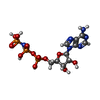
ChemComp-ANP:
PHOSPHOAMINOPHOSPHONIC ACID-ADENYLATE ESTER / AMP-PNP, energy-carrying molecule analogue*YM

ChemComp-MG:
Unknown entry

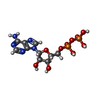
ChemComp-ADP:
ADENOSINE-5'-DIPHOSPHATE / ADP, energy-carrying molecule*YM

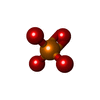
ChemComp-PO4:
PHOSPHATE ION

ChemComp-HOH:
WATER

Source
  • arabidopsis thaliana (thale cress)
KeywordsPLANT PROTEIN / Targeted protein degradation / plant protein quality control / AAA+ ATPase / cryo-EM / adaptation / ubiquitin-proteasome system / p97/VCP/CDC48 / Ubiquitin-proteasome / Unfoldase / AAA ATPase / Hexamer / ATP-dependent chaperone / Protein unfollding

+
About Yorodumi Papers

-
News

-
Feb 9, 2022. New format data for meta-information of EMDB entries

New format data for meta-information of EMDB entries

  • Version 3 of the EMDB header file is now the official format.
  • The previous official version 1.9 will be removed from the archive.

Related info.:EMDB header

External links:wwPDB to switch to version 3 of the EMDB data model

-
Aug 12, 2020. Covid-19 info

Covid-19 info

URL: https://pdbj.org/emnavi/covid19.php

New page: Covid-19 featured information page in EM Navigator.

Related info.:Covid-19 info / Mar 5, 2020. Novel coronavirus structure data

+
Mar 5, 2020. Novel coronavirus structure data

Novel coronavirus structure data

Related info.:Yorodumi Speices / Aug 12, 2020. Covid-19 info

External links:COVID-19 featured content - PDBj / Molecule of the Month (242):Coronavirus Proteases

+
Jan 31, 2019. EMDB accession codes are about to change! (news from PDBe EMDB page)

EMDB accession codes are about to change! (news from PDBe EMDB page)

  • The allocation of 4 digits for EMDB accession codes will soon come to an end. Whilst these codes will remain in use, new EMDB accession codes will include an additional digit and will expand incrementally as the available range of codes is exhausted. The current 4-digit format prefixed with “EMD-” (i.e. EMD-XXXX) will advance to a 5-digit format (i.e. EMD-XXXXX), and so on. It is currently estimated that the 4-digit codes will be depleted around Spring 2019, at which point the 5-digit format will come into force.
  • The EM Navigator/Yorodumi systems omit the EMD- prefix.

Related info.:Q: What is EMD? / ID/Accession-code notation in Yorodumi/EM Navigator

External links:EMDB Accession Codes are Changing Soon! / Contact to PDBj

+
Jul 12, 2017. Major update of PDB

Major update of PDB

  • wwPDB released updated PDB data conforming to the new PDBx/mmCIF dictionary.
  • This is a major update changing the version number from 4 to 5, and with Remediation, in which all the entries are updated.
  • In this update, many items about electron microscopy experimental information are reorganized (e.g. em_software).
  • Now, EM Navigator and Yorodumi are based on the updated data.

External links:wwPDB Remediation / Enriched Model Files Conforming to OneDep Data Standards Now Available in the PDB FTP Archive

-
Yorodumi Papers

Database of articles cited by EMDB/PDB/SASBDB data

  • Database of articles cited by EMDB, PDB, and SASBDB entries
  • Using PubMed data

Related info.:EMDB / PDB / SASBDB / Yorodumi / EMN Papers / Changes in new EM Navigator and Yorodumi

Read more