[English] 日本語
Yorodumi Papers
- Database of articles cited by EMDB/PDB/SASBDB data -

+
Search query

Keywords
Structure methods
Author
Journal
IF

-
Structure paper

TitleA unique gating mechanism revealed by the cryo-EM structure of monomeric ATP9A flippase.
Journal, issue, pagesJ Biol Chem, Vol. 301, Issue 10, Page 110631, Year 2025
Publish dateAug 26, 2025
AuthorsKazuhiro Abe / Parthiban Marimuthu / Yuheng Qian / Chai C Gopalasingam / Christoph Gerle / Hideki Shigematsu / Kotaro Tanaka / Himanshu Khandelia /
PubMed AbstractAmong mammalian P4-ATPase flippases, only ATP9A and ATP9B do not require the auxiliary subunit CDC50 protein. Whilst its yeast homolog, Neo1, is essential for cell survival, little is known about ...Among mammalian P4-ATPase flippases, only ATP9A and ATP9B do not require the auxiliary subunit CDC50 protein. Whilst its yeast homolog, Neo1, is essential for cell survival, little is known about mammalian ATP9A. We present cryo-EM structures of human monomeric ATP9A at a resolution reaching 2.2 Å, in the outward-facing E2P state. Two distinguishable conformations were obtained from a single sample, one with its outward gate open and the other in its closed form. Unlike canonical gating observed for most P-type ATPases, which is driven by the movement of transmembrane (TM) helices 1 and 2 linked to the A domain, outward gating in ATP9A is achieved by the movement of TM6-10 helices, likely initiated by the unwinding of TM6. As a result, the volume of the phospholipid binding cavity in the open state surpasses that of other flippases, which could allow binding of phospholipids with larger hydrophilic headgroups than that of phosphatidylserine. ATP9A shows an ATPase activity that is significantly increased by the addition of phospholipids that retain the overall negative charge, including phosphatidylserine, phosphatidylinositol, and its phosphorylated species, compared with other electroneutral phospholipids. The observation of spontaneous binding of phosphorylated species of phosphatidylinositol in molecular simulation reinforces this fact. Our data provide mechanistic rationales for ATP9A gating, achieved by the rearrangement of the second half of the TM helices. Since TM4-TM10 is anchored by the CDC50 protein subunit in other flippases, the here-observed outward gating mechanism is unique to P4B-type flippases, which function as a monomer.
External linksJ Biol Chem / PubMed:40876594 / PubMed Central
MethodsEM (single particle)
Resolution2.18 - 3.01 Å
Structure data

EMDB-64986, PDB-9vdk:
Cryo-EM structure of human ATP9A in BeF-bound E2P state open form
Method: EM (single particle) / Resolution: 2.18 Å

EMDB-64987, PDB-9vdl:
Cryo-EM structure of human ATP9A in BeF-bound E2P state closed form
Method: EM (single particle) / Resolution: 2.31 Å

EMDB-64988, PDB-9vdm:
Cryo-EM structure of human ATP9A (AMPPCP) E2P state open form
Method: EM (single particle) / Resolution: 3.01 Å

EMDB-64989, PDB-9vdn:
Cryo-EM structure of human ATP9A (AlF) E2P state open form
Method: EM (single particle) / Resolution: 2.61 Å

Chemicals

ChemComp-MG:
Unknown entry

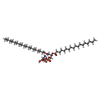
ChemComp-P5S:
O-[(R)-{[(2R)-2,3-bis(octadecanoyloxy)propyl]oxy}(hydroxy)phosphoryl]-L-serine

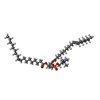
ChemComp-PCW:
1,2-DIOLEOYL-SN-GLYCERO-3-PHOSPHOCHOLINE / DOPC, phospholipid*YM

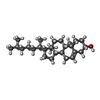
ChemComp-CLR:
CHOLESTEROL

ChemComp-HOH:
WATER

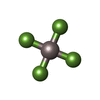
ChemComp-ALF:
TETRAFLUOROALUMINATE ION

Source
  • homo sapiens (human)
KeywordsTRANSPORT PROTEIN / P-type ATPase / flippase / human

+
About Yorodumi Papers

-
News

-
Feb 9, 2022. New format data for meta-information of EMDB entries

New format data for meta-information of EMDB entries

  • Version 3 of the EMDB header file is now the official format.
  • The previous official version 1.9 will be removed from the archive.

Related info.:EMDB header

External links:wwPDB to switch to version 3 of the EMDB data model

-
Aug 12, 2020. Covid-19 info

Covid-19 info

URL: https://pdbj.org/emnavi/covid19.php

New page: Covid-19 featured information page in EM Navigator.

Related info.:Covid-19 info / Mar 5, 2020. Novel coronavirus structure data

+
Mar 5, 2020. Novel coronavirus structure data

Novel coronavirus structure data

Related info.:Yorodumi Speices / Aug 12, 2020. Covid-19 info

External links:COVID-19 featured content - PDBj / Molecule of the Month (242):Coronavirus Proteases

+
Jan 31, 2019. EMDB accession codes are about to change! (news from PDBe EMDB page)

EMDB accession codes are about to change! (news from PDBe EMDB page)

  • The allocation of 4 digits for EMDB accession codes will soon come to an end. Whilst these codes will remain in use, new EMDB accession codes will include an additional digit and will expand incrementally as the available range of codes is exhausted. The current 4-digit format prefixed with “EMD-” (i.e. EMD-XXXX) will advance to a 5-digit format (i.e. EMD-XXXXX), and so on. It is currently estimated that the 4-digit codes will be depleted around Spring 2019, at which point the 5-digit format will come into force.
  • The EM Navigator/Yorodumi systems omit the EMD- prefix.

Related info.:Q: What is EMD? / ID/Accession-code notation in Yorodumi/EM Navigator

External links:EMDB Accession Codes are Changing Soon! / Contact to PDBj

+
Jul 12, 2017. Major update of PDB

Major update of PDB

  • wwPDB released updated PDB data conforming to the new PDBx/mmCIF dictionary.
  • This is a major update changing the version number from 4 to 5, and with Remediation, in which all the entries are updated.
  • In this update, many items about electron microscopy experimental information are reorganized (e.g. em_software).
  • Now, EM Navigator and Yorodumi are based on the updated data.

External links:wwPDB Remediation / Enriched Model Files Conforming to OneDep Data Standards Now Available in the PDB FTP Archive

-
Yorodumi Papers

Database of articles cited by EMDB/PDB/SASBDB data

  • Database of articles cited by EMDB, PDB, and SASBDB entries
  • Using PubMed data

Related info.:EMDB / PDB / SASBDB / Yorodumi / EMN Papers / Changes in new EM Navigator and Yorodumi

Read more