[English] 日本語
Yorodumi Papers
- Database of articles cited by EMDB/PDB/SASBDB data -

+
Search query

Keywords
Structure methods
Author
Journal
IF

-
Structure paper

TitleCryo-EM reveals an extrahelical allosteric binding site at the M mAChR.
Journal, issue, pagesNat Commun, Vol. 16, Issue 1, Page 7046, Year 2025
Publish dateJul 31, 2025
AuthorsWessel A C Burger / Jesse I Mobbs / Bhavika Rana / Jinan Wang / Keya Joshi / Patrick R Gentry / Mahmuda Yeasmin / Hariprasad Venugopal / Aaron M Bender / Craig W Lindsley / Yinglong Miao / Arthur Christopoulos / Celine Valant / David M Thal /
PubMed AbstractThe M muscarinic acetylcholine receptor (M mAChR) represents a promising therapeutic target for neurological disorders. However, the high conservation of its orthosteric binding site poses ...The M muscarinic acetylcholine receptor (M mAChR) represents a promising therapeutic target for neurological disorders. However, the high conservation of its orthosteric binding site poses significant challenges for drug development. While selective positive allosteric modulators (PAMs) offer a potential solution, a structural understanding of the M mAChR and its allosteric binding sites remains limited. Here, we present a 2.8 Å cryo-electron microscopy structure of the M mAChR complexed with heterotrimeric G protein and the agonist iperoxo, completing the active-state structural characterization of the mAChR family. To identify the binding site of M-selective PAMs, we implement an integrated approach combining mutagenesis, pharmacological assays, structural biology, and molecular dynamics simulations. Our mutagenesis studies reveal that selective M PAMs bind outside previously characterized M mAChR allosteric sites. Subsequently, we obtain a 2.1 Å structure of M mAChR co-bound with acetylcholine and the selective PAM VU6007678, revealing an allosteric pocket at the extrahelical interface between transmembrane domains 3 and 4 that is confirmed through mutagenesis and simulations. These findings demonstrate the diverse mechanisms of allosteric regulation in mAChRs and highlight the value of integrating pharmacological and structural approaches to identify allosteric binding sites.
External linksNat Commun / PubMed:40745154 / PubMed Central
MethodsEM (single particle)
Resolution2.06 - 2.79 Å
Structure data

EMDB-48110, PDB-9ejz:
Human M5 muscarinic acetylcholine receptor complex with mini-Gq, agonist acetylcholine and positive allosteric modulator VU6007678
Method: EM (single particle) / Resolution: 2.06 Å

EMDB-48111, PDB-9ek0:
Human M5 muscarinic acetylcholine receptor complex with mini-Gq and iperoxo
Method: EM (single particle) / Resolution: 2.79 Å

Chemicals

PDB-1bks:
TRYPTOPHAN SYNTHASE (E.C.4.2.1.20) FROM SALMONELLA TYPHIMURIUM

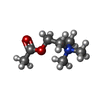
ChemComp-ACH:
ACETYLCHOLINE / neurotransmitter*YM

ChemComp-HOH:
WATER

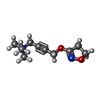
ChemComp-IXO:
4-(4,5-dihydro-1,2-oxazol-3-yloxy)-N,N,N-trimethylbut-2-yn-1-aminium

Source
  • homo sapiens (human)
  • lama glama (llama)
  • rattus norvegicus (Norway rat)
  • mus musculus (house mouse)
KeywordsMEMBRANE PROTEIN / G protein-coupled receptor / acetylcholine binding / seven transmembrane protein

+
About Yorodumi Papers

-
News

-
Feb 9, 2022. New format data for meta-information of EMDB entries

New format data for meta-information of EMDB entries

  • Version 3 of the EMDB header file is now the official format.
  • The previous official version 1.9 will be removed from the archive.

Related info.:EMDB header

External links:wwPDB to switch to version 3 of the EMDB data model

-
Aug 12, 2020. Covid-19 info

Covid-19 info

URL: https://pdbj.org/emnavi/covid19.php

New page: Covid-19 featured information page in EM Navigator.

Related info.:Covid-19 info / Mar 5, 2020. Novel coronavirus structure data

+
Mar 5, 2020. Novel coronavirus structure data

Novel coronavirus structure data

Related info.:Yorodumi Speices / Aug 12, 2020. Covid-19 info

External links:COVID-19 featured content - PDBj / Molecule of the Month (242):Coronavirus Proteases

+
Jan 31, 2019. EMDB accession codes are about to change! (news from PDBe EMDB page)

EMDB accession codes are about to change! (news from PDBe EMDB page)

  • The allocation of 4 digits for EMDB accession codes will soon come to an end. Whilst these codes will remain in use, new EMDB accession codes will include an additional digit and will expand incrementally as the available range of codes is exhausted. The current 4-digit format prefixed with “EMD-” (i.e. EMD-XXXX) will advance to a 5-digit format (i.e. EMD-XXXXX), and so on. It is currently estimated that the 4-digit codes will be depleted around Spring 2019, at which point the 5-digit format will come into force.
  • The EM Navigator/Yorodumi systems omit the EMD- prefix.

Related info.:Q: What is EMD? / ID/Accession-code notation in Yorodumi/EM Navigator

External links:EMDB Accession Codes are Changing Soon! / Contact to PDBj

+
Jul 12, 2017. Major update of PDB

Major update of PDB

  • wwPDB released updated PDB data conforming to the new PDBx/mmCIF dictionary.
  • This is a major update changing the version number from 4 to 5, and with Remediation, in which all the entries are updated.
  • In this update, many items about electron microscopy experimental information are reorganized (e.g. em_software).
  • Now, EM Navigator and Yorodumi are based on the updated data.

External links:wwPDB Remediation / Enriched Model Files Conforming to OneDep Data Standards Now Available in the PDB FTP Archive

-
Yorodumi Papers

Database of articles cited by EMDB/PDB/SASBDB data

  • Database of articles cited by EMDB, PDB, and SASBDB entries
  • Using PubMed data

Related info.:EMDB / PDB / SASBDB / Yorodumi / EMN Papers / Changes in new EM Navigator and Yorodumi

Read more