[English] 日本語
Yorodumi Papers
- Database of articles cited by EMDB/PDB/SASBDB data -

+
Search query

Keywords
Structure methods
Author
Journal
IF

-
Structure paper

TitleStructural insights into ligand recognition and G protein preferences across histamine receptors.
Journal, issue, pagesCommun Biol, Vol. 8, Issue 1, Page 957, Year 2025
Publish dateJun 27, 2025
AuthorsYuma Matsuzaki / Fumiya K Sano / Hidetaka S Oshima / Hiroaki Akasaka / Kazuhiro Kobayashi / Tatsuki Tanaka / Yuzuru Itoh / Wataru Shihoya / Yoshiaki Kise / Tsukasa Kusakizako / Asuka Inoue / Osamu Nureki /
PubMed AbstractHistamine exerts critical physiological roles by activating four receptor subtypes, each exhibiting a specific G protein preference. Among these, the histamine H receptor (HR) modulates chemotaxis ...Histamine exerts critical physiological roles by activating four receptor subtypes, each exhibiting a specific G protein preference. Among these, the histamine H receptor (HR) modulates chemotaxis and interferon production through G protein activation, suggesting its therapeutic potential. Despite its physiological significance, the mechanisms underlying HR signalling and G protein preference across histamine receptors remain poorly understood. Here, we present the cryo-electron microscopy structure of the HR-G complex, revealing unique mechanisms of histamine recognition and receptor activation. We further solved the structures of the histamine H receptor (HR) bound to the non-canonical G proteins G and G. Through a combination of functional and computational analyses, we identified the intracellular loop 2 as a critical determinant of G protein preference in HR and HR. Collectively, our comprehensive study revealed the structural basis for distinct mechanisms of ligand recognition and receptor activation, offering a profound insight into G protein preference across receptor subtypes.
External linksCommun Biol / PubMed:40579541 / PubMed Central
MethodsEM (single particle)
Resolution2.77 - 3.23 Å
Structure data

EMDB-63324, PDB-9lrb:
Cryo-EM structure of the histamine H1 receptor-Gs protein complex
Method: EM (single particle) / Resolution: 2.77 Å

EMDB-63325, PDB-9lrc:
Cryo-EM structure of the histamine H4 receptor-Gi protein complex (Receptor focused)
Method: EM (single particle) / Resolution: 2.84 Å

EMDB-63326, PDB-9lrd:
Cryo-EM structure of the histamine H1 receptor-Gi protein complex
Method: EM (single particle) / Resolution: 3.23 Å

EMDB-63327, PDB-9lre:
Cryo-EM structure of the histamine H4 receptor-Gi protein complex (Overall)
Method: EM (single particle) / Resolution: 2.84 Å

Chemicals

ChemComp-HSM:
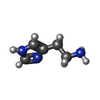
HISTAMINE / neurotransmitter, hormone*YM

ChemComp-HOH:
WATER

Source
  • homo sapiens (human)
  • rattus norvegicus (Norway rat)
  • bos taurus (domestic cattle)
  • unidentified (others)
  • mus musculus (house mouse)
KeywordsMEMBRANE PROTEIN / GPCR / Class A GPCR / Histamine / G protein / Complex / Receptor

+
About Yorodumi Papers

-
News

-
Feb 9, 2022. New format data for meta-information of EMDB entries

New format data for meta-information of EMDB entries

  • Version 3 of the EMDB header file is now the official format.
  • The previous official version 1.9 will be removed from the archive.

Related info.:EMDB header

External links:wwPDB to switch to version 3 of the EMDB data model

-
Aug 12, 2020. Covid-19 info

Covid-19 info

URL: https://pdbj.org/emnavi/covid19.php

New page: Covid-19 featured information page in EM Navigator.

Related info.:Covid-19 info / Mar 5, 2020. Novel coronavirus structure data

+
Mar 5, 2020. Novel coronavirus structure data

Novel coronavirus structure data

Related info.:Yorodumi Speices / Aug 12, 2020. Covid-19 info

External links:COVID-19 featured content - PDBj / Molecule of the Month (242):Coronavirus Proteases

+
Jan 31, 2019. EMDB accession codes are about to change! (news from PDBe EMDB page)

EMDB accession codes are about to change! (news from PDBe EMDB page)

  • The allocation of 4 digits for EMDB accession codes will soon come to an end. Whilst these codes will remain in use, new EMDB accession codes will include an additional digit and will expand incrementally as the available range of codes is exhausted. The current 4-digit format prefixed with “EMD-” (i.e. EMD-XXXX) will advance to a 5-digit format (i.e. EMD-XXXXX), and so on. It is currently estimated that the 4-digit codes will be depleted around Spring 2019, at which point the 5-digit format will come into force.
  • The EM Navigator/Yorodumi systems omit the EMD- prefix.

Related info.:Q: What is EMD? / ID/Accession-code notation in Yorodumi/EM Navigator

External links:EMDB Accession Codes are Changing Soon! / Contact to PDBj

+
Jul 12, 2017. Major update of PDB

Major update of PDB

  • wwPDB released updated PDB data conforming to the new PDBx/mmCIF dictionary.
  • This is a major update changing the version number from 4 to 5, and with Remediation, in which all the entries are updated.
  • In this update, many items about electron microscopy experimental information are reorganized (e.g. em_software).
  • Now, EM Navigator and Yorodumi are based on the updated data.

External links:wwPDB Remediation / Enriched Model Files Conforming to OneDep Data Standards Now Available in the PDB FTP Archive

-
Yorodumi Papers

Database of articles cited by EMDB/PDB/SASBDB data

  • Database of articles cited by EMDB, PDB, and SASBDB entries
  • Using PubMed data

Related info.:EMDB / PDB / SASBDB / Yorodumi / EMN Papers / Changes in new EM Navigator and Yorodumi

Read more