[English] 日本語
Yorodumi Papers
- Database of articles cited by EMDB/PDB/SASBDB data -

+
Search query

Keywords
Structure methods
Author
Journal
IF

-
Structure paper

TitleModularity of Zorya defense systems during phage inhibition.
Journal, issue, pagesNat Commun, Vol. 16, Issue 1, Page 2344, Year 2025
Publish dateMar 8, 2025
AuthorsGiuseppina Mariano / Justin C Deme / Jennifer J Readshaw / Matthew J Grobbelaar / Mackenzie Keenan / Yasmin El-Masri / Lindsay Bamford / Suraj Songra / Tim R Blower / Tracy Palmer / Susan M Lea /
PubMed AbstractBacteria have evolved an extraordinary diversity of defense systems against bacteriophage (phage) predation. However, the molecular mechanisms underlying these anti-phage systems often remain elusive. ...Bacteria have evolved an extraordinary diversity of defense systems against bacteriophage (phage) predation. However, the molecular mechanisms underlying these anti-phage systems often remain elusive. Here, we provide mechanistic and structural insights into Zorya phage defense systems. Using cryo-EM structural analyses, we show that the Zorya type I and II core components, ZorA and ZorB, assemble in a 5:2 complex that is similar to inner-membrane ion-driven, rotary motors that power flagellar rotation, type 9 secretion, gliding and the Ton nutrient uptake systems. The ZorAB complex has an elongated cytoplasmic tail assembled by bundling the C-termini of the five ZorA subunits. Mutagenesis demonstrates that peptidoglycan binding by the periplasmic domains of ZorB, the structured cytoplasmic tail of ZorA, and ion flow through the motor is important for function in both type I and II systems. Furthermore, we identify ZorE as the effector module of the Zorya II system, possessing nickase activity. Our work reveals the molecular basis of the activity of Zorya systems and highlights the ZorE nickase as crucial for population-wide immunity in the type II system.
External linksNat Commun / PubMed:40057510 / PubMed Central
MethodsEM (single particle)
Resolution2.2 - 2.8 Å
Structure data

EMDB-43560, PDB-8vvi:
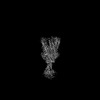
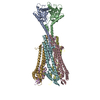
Cryo-EM structure of a type II ZorAB complex from Sulfuricurvum kujiense
Method: EM (single particle) / Resolution: 2.8 Å

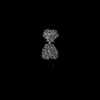
EMDB-43561: Cryo-EM structure of a type I ZorAB complex from Shewanella sp. strain ANA-3, consensus map
Method: EM (single particle) / Resolution: 2.2 Å

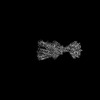
EMDB-43562: Cryo-EM structure of a type I ZorAB complex from Shewanella sp. strain ANA-3, PG-binding domain focused map
Method: EM (single particle) / Resolution: 2.4 Å

EMDB-43563: Cryo-EM structure of a type I ZorAB complex from Shewanella sp. strain ANA-3, composite map
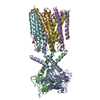
PDB-8vvn: Cryo-EM structure of a type I ZorAB complex from Shewanella sp. strain ANA-3
Method: EM (single particle) / Resolution: 2.2 Å

Chemicals

ChemComp-NA:
Unknown entry

ChemComp-HOH:
WATER

Source
  • sulfuricurvum kujiense dsm 16994 (bacteria)

  • shewanella sp. ana-3 (bacteria)
KeywordsMEMBRANE PROTEIN / phage defense / zorya / phage / membrane protein complex

+
About Yorodumi Papers

-
News

-
Feb 9, 2022. New format data for meta-information of EMDB entries

New format data for meta-information of EMDB entries

  • Version 3 of the EMDB header file is now the official format.
  • The previous official version 1.9 will be removed from the archive.

Related info.:EMDB header

External links:wwPDB to switch to version 3 of the EMDB data model

-
Aug 12, 2020. Covid-19 info

Covid-19 info

URL: https://pdbj.org/emnavi/covid19.php

New page: Covid-19 featured information page in EM Navigator.

Related info.:Covid-19 info / Mar 5, 2020. Novel coronavirus structure data

+
Mar 5, 2020. Novel coronavirus structure data

Novel coronavirus structure data

Related info.:Yorodumi Speices / Aug 12, 2020. Covid-19 info

External links:COVID-19 featured content - PDBj / Molecule of the Month (242):Coronavirus Proteases

+
Jan 31, 2019. EMDB accession codes are about to change! (news from PDBe EMDB page)

EMDB accession codes are about to change! (news from PDBe EMDB page)

  • The allocation of 4 digits for EMDB accession codes will soon come to an end. Whilst these codes will remain in use, new EMDB accession codes will include an additional digit and will expand incrementally as the available range of codes is exhausted. The current 4-digit format prefixed with “EMD-” (i.e. EMD-XXXX) will advance to a 5-digit format (i.e. EMD-XXXXX), and so on. It is currently estimated that the 4-digit codes will be depleted around Spring 2019, at which point the 5-digit format will come into force.
  • The EM Navigator/Yorodumi systems omit the EMD- prefix.

Related info.:Q: What is EMD? / ID/Accession-code notation in Yorodumi/EM Navigator

External links:EMDB Accession Codes are Changing Soon! / Contact to PDBj

+
Jul 12, 2017. Major update of PDB

Major update of PDB

  • wwPDB released updated PDB data conforming to the new PDBx/mmCIF dictionary.
  • This is a major update changing the version number from 4 to 5, and with Remediation, in which all the entries are updated.
  • In this update, many items about electron microscopy experimental information are reorganized (e.g. em_software).
  • Now, EM Navigator and Yorodumi are based on the updated data.

External links:wwPDB Remediation / Enriched Model Files Conforming to OneDep Data Standards Now Available in the PDB FTP Archive

-
Yorodumi Papers

Database of articles cited by EMDB/PDB/SASBDB data

  • Database of articles cited by EMDB, PDB, and SASBDB entries
  • Using PubMed data

Related info.:EMDB / PDB / SASBDB / Yorodumi / EMN Papers / Changes in new EM Navigator and Yorodumi

Read more