[English] 日本語
Yorodumi Papers
- Database of articles cited by EMDB/PDB/SASBDB data -

+
Search query

Keywords
Structure methods
Author
Journal
IF

-
Structure paper

TitleStructural basis for abscisic acid efflux mediated by ABCG25 in Arabidopsis thaliana.
Journal, issue, pagesNat Plants, Vol. 9, Issue 10, Page 1697-1708, Year 2023
Publish dateSep 4, 2023
AuthorsWei Ying / Lianghuan Liao / Hong Wei / Yongxiang Gao / Xin Liu / Linfeng Sun /
PubMed AbstractAbscisic acid (ABA) is a phytohormone essential to the regulation of numerous aspects of plant growth and development. The cellular level of ABA is critical to its signalling and is determined by its ...Abscisic acid (ABA) is a phytohormone essential to the regulation of numerous aspects of plant growth and development. The cellular level of ABA is critical to its signalling and is determined by its rate of biosynthesis, catabolism and the rates of ABA transport. ABCG25 in Arabidopsis thaliana has been identified to be an ABA exporter and play roles in regulating stomatal closure and seed germination. However, its ABA transport mechanism remains unknown. Here we report the structures of ABCG25 under different states using cryo-electron microscopy single particle analysis: the apo state and ABA-bound state of the wild-type ABCG25 and the ATP-bound state of the ATPase catalytic mutant. ABCG25 forms a homodimer. ABA binds to a cone-shaped, cytosolic-facing cavity formed in the middle of the transmembrane domains. Key residues in ABA binding are identified and verified by a cell-based ABA transport assay. ATP binding leads to closing of the nucleotide-binding domains of opposing monomers and conformational transitions of the transmembrane domains. Together, these results provide insights into the substrate recognition and transport mechanisms of ABCG25 in Arabidopsis, and facilitate our understanding of the ABA transport and signalling pathway in plants.
External linksNat Plants / PubMed:37666962 / PubMed Central
MethodsEM (single particle)
Resolution3.0 - 3.7 Å
Structure data

EMDB-35768, PDB-8iwj:
ABCG25 Wild Type in Apo-state
Method: EM (single particle) / Resolution: 3.0 Å

EMDB-35769, PDB-8iwk:
ABCG25 Wild Type purified with DDM plus CHS in ABA-bound state
Method: EM (single particle) / Resolution: 3.0 Å

EMDB-35774, PDB-8iwn:
ABCG25 EQ mutant in ATP-bound state
Method: EM (single particle) / Resolution: 3.0 Å

EMDB-36780, PDB-8k0x:
ABCG25 Wild Type purified with DDM in the ABA-bound state
Method: EM (single particle) / Resolution: 3.2 Å

EMDB-36781, PDB-8k0z:
ABCG25 Wild Type purified with DDM in the apo-state
Method: EM (single particle) / Resolution: 3.7 Å

Chemicals

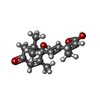
ChemComp-A8S:
(2Z,4E)-5-[(1S)-1-hydroxy-2,6,6-trimethyl-4-oxocyclohex-2-en-1-yl]-3-methylpenta-2,4-dienoic acid / hormone*YM

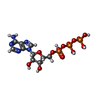
ChemComp-ATP:
ADENOSINE-5'-TRIPHOSPHATE / ATP, energy-carrying molecule*YM

ChemComp-MG:
Unknown entry

Source
  • arabidopsis thaliana (thale cress)
KeywordsTRANSPORT PROTEIN / ABA / ABCG / plant hormone

+
About Yorodumi Papers

-
News

-
Feb 9, 2022. New format data for meta-information of EMDB entries

New format data for meta-information of EMDB entries

  • Version 3 of the EMDB header file is now the official format.
  • The previous official version 1.9 will be removed from the archive.

Related info.:EMDB header

External links:wwPDB to switch to version 3 of the EMDB data model

-
Aug 12, 2020. Covid-19 info

Covid-19 info

URL: https://pdbj.org/emnavi/covid19.php

New page: Covid-19 featured information page in EM Navigator.

Related info.:Covid-19 info / Mar 5, 2020. Novel coronavirus structure data

+
Mar 5, 2020. Novel coronavirus structure data

Novel coronavirus structure data

Related info.:Yorodumi Speices / Aug 12, 2020. Covid-19 info

External links:COVID-19 featured content - PDBj / Molecule of the Month (242):Coronavirus Proteases

+
Jan 31, 2019. EMDB accession codes are about to change! (news from PDBe EMDB page)

EMDB accession codes are about to change! (news from PDBe EMDB page)

  • The allocation of 4 digits for EMDB accession codes will soon come to an end. Whilst these codes will remain in use, new EMDB accession codes will include an additional digit and will expand incrementally as the available range of codes is exhausted. The current 4-digit format prefixed with “EMD-” (i.e. EMD-XXXX) will advance to a 5-digit format (i.e. EMD-XXXXX), and so on. It is currently estimated that the 4-digit codes will be depleted around Spring 2019, at which point the 5-digit format will come into force.
  • The EM Navigator/Yorodumi systems omit the EMD- prefix.

Related info.:Q: What is EMD? / ID/Accession-code notation in Yorodumi/EM Navigator

External links:EMDB Accession Codes are Changing Soon! / Contact to PDBj

+
Jul 12, 2017. Major update of PDB

Major update of PDB

  • wwPDB released updated PDB data conforming to the new PDBx/mmCIF dictionary.
  • This is a major update changing the version number from 4 to 5, and with Remediation, in which all the entries are updated.
  • In this update, many items about electron microscopy experimental information are reorganized (e.g. em_software).
  • Now, EM Navigator and Yorodumi are based on the updated data.

External links:wwPDB Remediation / Enriched Model Files Conforming to OneDep Data Standards Now Available in the PDB FTP Archive

-
Yorodumi Papers

Database of articles cited by EMDB/PDB/SASBDB data

  • Database of articles cited by EMDB, PDB, and SASBDB entries
  • Using PubMed data

Related info.:EMDB / PDB / SASBDB / Yorodumi / EMN Papers / Changes in new EM Navigator and Yorodumi

Read more