response to intra-S DNA damage checkpoint signaling / Parkin-FBXW7-Cul1 ubiquitin ligase complex / F-box domain binding / PcG protein complex / DNA translocase activity / negative regulation of beige fat cell differentiation / cullin-RING-type E3 NEDD8 transferase / NEDD8 transferase activity / cullin-RING ubiquitin ligase complex / maintenance of protein location in nucleus ...response to intra-S DNA damage checkpoint signaling / Parkin-FBXW7-Cul1 ubiquitin ligase complex / F-box domain binding / PcG protein complex / DNA translocase activity / negative regulation of beige fat cell differentiation / cullin-RING-type E3 NEDD8 transferase / NEDD8 transferase activity / cullin-RING ubiquitin ligase complex / maintenance of protein location in nucleus / Cul7-RING ubiquitin ligase complex / cellular response to chemical stress / Loss of Function of FBXW7 in Cancer and NOTCH1 Signaling / positive regulation of protein autoubiquitination / RNA polymerase II transcription initiation surveillance / protein neddylation / DNA catabolic process / ubiquitin ligase activator activity / NEDD8 ligase activity / positive regulation of intrinsic apoptotic signaling pathway in response to DNA damage / protein K27-linked ubiquitination / negative regulation of response to oxidative stress / VCB complex / Cul5-RING ubiquitin ligase complex / ubiquitin-ubiquitin ligase activity / ubiquitin-dependent protein catabolic process via the C-end degron rule pathway / SCF ubiquitin ligase complex / Cul2-RING ubiquitin ligase complex / Cul3-RING ubiquitin ligase complex / negative regulation of type I interferon production / SCF-dependent proteasomal ubiquitin-dependent protein catabolic process / Cul4A-RING E3 ubiquitin ligase complex / Cul4-RING E3 ubiquitin ligase complex / Prolactin receptor signaling / negative regulation of mitophagy / Cul4B-RING E3 ubiquitin ligase complex / ubiquitin ligase complex scaffold activity / 3'-5' DNA helicase activity / DNA 3'-5' helicase / replication fork processing / cullin family protein binding / protein monoubiquitination / negative regulation of double-strand break repair via homologous recombination / ubiquitin-like ligase-substrate adaptor activity / site of DNA damage / signal transduction in response to DNA damage / Nuclear events stimulated by ALK signaling in cancer / protein K48-linked ubiquitination / transcription-coupled nucleotide-excision repair / negative regulation of insulin receptor signaling pathway / regulation of cellular response to insulin stimulus / positive regulation of TORC1 signaling / post-translational protein modification / intrinsic apoptotic signaling pathway / molecular function activator activity / animal organ morphogenesis / T cell activation / DNA helicase activity / Regulation of BACH1 activity / MAP3K8 (TPL2)-dependent MAPK1/3 activation / negative regulation of canonical NF-kappaB signal transduction / cellular response to amino acid stimulus / SCF-beta-TrCP mediated degradation of Emi1 / NIK-->noncanonical NF-kB signaling / Vpu mediated degradation of CD4 / Dectin-1 mediated noncanonical NF-kB signaling / Degradation of DVL / Degradation of CRY and PER proteins / G1/S transition of mitotic cell cycle / negative regulation of canonical Wnt signaling pathway / Activation of NF-kappaB in B cells / Iron uptake and transport / Degradation of GLI1 by the proteasome / GSK3B and BTRC:CUL1-mediated-degradation of NFE2L2 / Recognition of DNA damage by PCNA-containing replication complex / Negative regulation of NOTCH4 signaling / RING-type E3 ubiquitin transferase / positive regulation of protein phosphorylation / Hedgehog 'on' state / Vif-mediated degradation of APOBEC3G / FBXL7 down-regulates AURKA during mitotic entry and in early mitosis / Ubiquitin-Mediated Degradation of Phosphorylated Cdc25A / Degradation of GLI2 by the proteasome / GLI3 is processed to GLI3R by the proteasome / beta-catenin binding / double-strand break repair via homologous recombination / NOTCH1 Intracellular Domain Regulates Transcription / Degradation of beta-catenin by the destruction complex / Evasion by RSV of host interferon responses / DNA Damage Recognition in GG-NER / Oxygen-dependent proline hydroxylation of Hypoxia-inducible Factor Alpha / CLEC7A (Dectin-1) signaling / Constitutive Signaling by NOTCH1 PEST Domain Mutants / Constitutive Signaling by NOTCH1 HD+PEST Domain Mutants / Dual Incision in GG-NER / Transcription-Coupled Nucleotide Excision Repair (TC-NER) / SCF(Skp2)-mediated degradation of p27/p21 / FCERI mediated NF-kB activation / Formation of TC-NER Pre-Incision Complex / Regulation of expression of SLITs and ROBOs 類似検索 - 分子機能
National Institutes of Health/National Institute of General Medical Sciences (NIH/NIGMS)
R35 GM136401
米国
National Institutes of Health/National Cancer Institute (NIH/NCI)
P01 CA092584
米国
引用
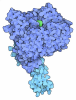
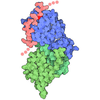
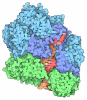
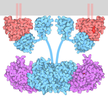
ジャーナル: Nat Commun / 年: 2026 タイトル: Structural basis for fork reversal and RAD51 regulation by the SCF ubiquitin ligase complex of F-box helicase 1. 著者: Briana H Greer / Javier Mendia-Garcia / Elwood A Mullins / Emma M Peacock / Sander K Haigh / Carl J Schiltz / Clara Aicart-Ramos / Miaw-Sheue Tsai / David Cortez / Fernando Moreno-Herrero / Brandt F Eichman / 要旨: Replication fork reversal helps maintain genomic stability during replication stress. F-box helicase 1 (FBH1) catalyzes fork reversal and is an SCF (SKP-CUL1-F-box) E3 ubiquitin ligase that limits ...Replication fork reversal helps maintain genomic stability during replication stress. F-box helicase 1 (FBH1) catalyzes fork reversal and is an SCF (SKP-CUL1-F-box) E3 ubiquitin ligase that limits RAD51 association with chromatin. Here, we show that preferential binding of SCF to the lagging strand template at DNA fork structures stimulates helicase activity and is required for fork reversal. A cryo-EM structure of SCF bound to DNA representing a stalled fork reveals an intimate interaction between FBH1 and the fork junction. Disruption of this interface severely curtails fork reversal in vitro and replication progression in cells, providing a model for how ssDNA translocation by FBH1 facilitates annealing of parental DNA by a fundamentally different mechanism than the fork remodelers SMARCAL, HLTF, and ZRANB3. The structure provides a model for SCF disassembly of RAD51 filaments through translocation and ubiquitination, and implies that RAD51 is associated with the lagging strand at stalled forks.
 ムービー
ムービー コントローラー


 データを開く
 基本情報
基本情報
 マップデータ
 試料
試料 キーワード
キーワード 機能・相同性情報
 Homo sapiens (ヒト) / synthetic construct (人工物)
 データ登録者
 米国, 2件
  引用
引用
 構造の表示
構造の表示
 ダウンロードとリンク
 emd_72358.png
 http://ftp.pdbj.org/pub/emdb/structures/EMD-72358





 Z (Sec.)
 Y (Row.)
 X (Col.)


 試料の構成要素
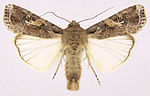 Spodoptera frugiperda (ツマジロクサヨトウ)
 解析
解析 電子顕微鏡法
 FIELD EMISSION GUN


