 Movie
Movie Controller

[English] 日本語
 Yorodumi
- PDB-9zr7: Cryo-EM structure of NRAS(Q61K)-BRIL fusion in complex with Fab(B... -
+ Open data

- Basic information
| Entry | Database: PDB / ID: 9zr7 | ||||||||||||||||||||||||
|---|---|---|---|---|---|---|---|---|---|---|---|---|---|---|---|---|---|---|---|---|---|---|---|---|---|
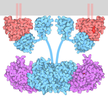
| Title | Cryo-EM structure of NRAS(Q61K)-BRIL fusion in complex with Fab(BAG2) and Monobody(Mb24) | ||||||||||||||||||||||||
 Components Components |
| ||||||||||||||||||||||||
 Keywords Keywords | ONCOPROTEIN/Immune System / NRAS / BRIL-fusion / ONCOPROTEIN / ONCOPROTEIN-Immune System complex | ||||||||||||||||||||||||
| Function / homology |  Function and homology information Function and homology informationpositive regulation of endothelial cell proliferation / small monomeric GTPase / electron transport chain / G protein activity / Ras protein signal transduction / electron transfer activity / periplasmic space / iron ion binding / Golgi membrane / GTPase activity ...positive regulation of endothelial cell proliferation / small monomeric GTPase / electron transport chain / G protein activity / Ras protein signal transduction / electron transfer activity / periplasmic space / iron ion binding / Golgi membrane / GTPase activity / heme binding / GTP binding / protein-containing complex binding / plasma membrane Similarity search - Function | ||||||||||||||||||||||||
| Biological species |  Homo sapiens (human) Homo sapiens (human) | ||||||||||||||||||||||||
| Method | ELECTRON MICROSCOPY / single particle reconstruction / cryo EM / Resolution: 3.28 Å | ||||||||||||||||||||||||
 Authors Authors | Hu, Z. / Koide, S. | ||||||||||||||||||||||||
| Funding support |  United States, 1items United States, 1items
| ||||||||||||||||||||||||
 Citation Citation | Journal: J Mol Biol / Year: 2026 Title: Protein Engineering-Enabled Cryo-EM Investigation of Small GTPases. Authors: Zhengshan Hu / Unnatiben Rajeshbhai Patel / Eliezra Glasser / Akiko Koide / Shohei Koide / Abstract: Small GTPases play important roles in cellular signaling. Due to their small sizes (∼21 kDa), structural studies of small GTPases have been predominantly performed using x-ray crystallography in ...Small GTPases play important roles in cellular signaling. Due to their small sizes (∼21 kDa), structural studies of small GTPases have been predominantly performed using x-ray crystallography in which crystal lattice contacts made it challenging to define unperturbed conformations of the key switch regions. Here, we developed a protein-engineering strategy that enables cryo-EM analysis of small soluble proteins and applied to RAS. We fused the C-terminal α5 helix of the RAS globular domain to a small protein BRIL by forming a continuous helix, which leaves most RAS surfaces exposed to the solvent and unperturbed, followed by the complex formation with an anti-BRIL Fab. This engineered complex with an increased molecular weight, termed "RAS-lollipop", enabled single-particle cryo-EM of RAS. Using this approach, we determined the cryo-EM structure of NRAS, whose structural studies using crystallography have been the least successful among the RAS isoforms. We revealed the conformations of the switch region and α 5 helix that differ from those observed in published crystal structures, and also defined the binding site of an NRAS-specific monobody. We uncovered an unexpected surfactant-like property of this monobody, which reduces orientation biases of particles on cryo-EM grids. Together, this work establishes a platform for visualizing small GTPases and potentially other small proteins with minimal perturbation of their surfaces. | ||||||||||||||||||||||||
| History |
|
- Structure visualization
| Structure viewer | Molecule: MolmilJmol/JSmol |
|---|
- Downloads & links
-Download
| PDBx/mmCIF format | 9zr7.cif.gz | 120.4 KB | Display | PDBx/mmCIF format |
|---|---|---|---|---|
| PDB format | pdb9zr7.ent.gz | 85.2 KB | Display | PDB format |
| PDBx/mmJSON format | 9zr7.json.gz | Tree view | PDBx/mmJSON format | |
| Others |  Other downloads Other downloads |
-Validation report
| Arichive directory | https://data.pdbj.org/pub/pdb/validation_reports/zr/9zr7ftp://data.pdbj.org/pub/pdb/validation_reports/zr/9zr7 | HTTPS FTP |
|---|
-Related structure data
| Related structure data |  74594MC M: map data used to model this data C: citing same article ( |
|---|---|
| Similar structure data |
-Links
 PDBj
PDBj

- Assembly
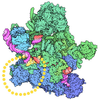
| Deposited unit | 
|
|---|---|
| 1 |
|
-Components
| #1: Protein | Mass: 34441.625 Da / Num. of mol.: 1 Source method: isolated from a genetically manipulated source Source: (gene. exp.) Homo sapiens (human) / Gene: NRAS, cybC / Production host:   Escherichia coli (E. coli) Escherichia coli (E. coli)References: UniProt: P12825, UniProt: P0ABE7, small monomeric GTPase |
|---|---|
| #2: Antibody | Mass: 24390.232 Da / Num. of mol.: 1 Source method: isolated from a genetically manipulated source Source: (gene. exp.) Homo sapiens (human) / Production host: Escherichia coli (E. coli) |
| #3: Antibody | Mass: 23266.871 Da / Num. of mol.: 1 Source method: isolated from a genetically manipulated source Source: (gene. exp.) Homo sapiens (human) / Production host: Escherichia coli (E. coli) |
| #4: Chemical | ChemComp-GDP / 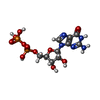 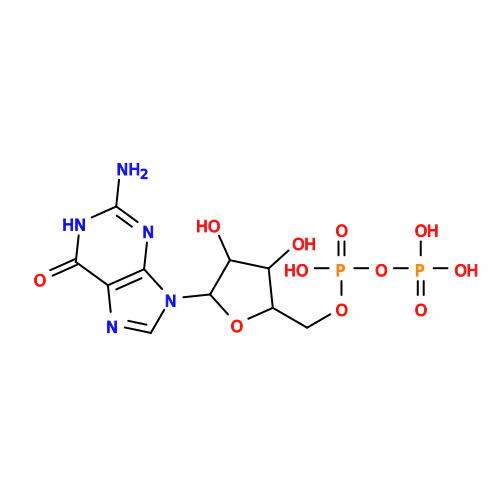 Type: RNA linking / Mass: 443.201 Da / Num. of mol.: 1 / Source method: obtained synthetically / Formula: C10H15N5O11P2 / Comment: GDP, energy-carrying molecule*YM Type: RNA linking / Mass: 443.201 Da / Num. of mol.: 1 / Source method: obtained synthetically / Formula: C10H15N5O11P2 / Comment: GDP, energy-carrying molecule*YM |
| Has ligand of interest | N |
| Has protein modification | Y |
-Experimental details
-Experiment
| Experiment | Method: ELECTRON MICROSCOPY |
|---|---|
| EM experiment | Aggregation state: PARTICLE / 3D reconstruction method: single particle reconstruction |
- Sample preparation
| Component | Name: Complex of NRAS(Q61K)-BRIL, anti-BRIL Fab(BAG2), and Monobody(Mb24) Type: COMPLEX / Entity ID: #2-#3 / Source: RECOMBINANT |
|---|---|
| Source (natural) | Organism: Homo sapiens (human) |
| Source (recombinant) | Organism: Escherichia coli (E. coli) |
| Buffer solution | pH: 7.4 |
| Specimen | Embedding applied: NO / Shadowing applied: NO / Staining applied: NO / Vitrification applied: YES |
| Vitrification | Cryogen name: ETHANE |
- Electron microscopy imaging
| Experimental equipment |  Model: Titan Krios / Image courtesy: FEI Company |
|---|---|
| Microscopy | Model: TFS KRIOS |
| Electron gun | Electron source:  FIELD EMISSION GUN / Accelerating voltage: 300 kV / Illumination mode: FLOOD BEAM FIELD EMISSION GUN / Accelerating voltage: 300 kV / Illumination mode: FLOOD BEAM |
| Electron lens | Mode: BRIGHT FIELD / Nominal defocus max: 2500 nm / Nominal defocus min: 500 nm |
| Image recording | Electron dose: 47.22 e/Å2 / Film or detector model: GATAN K3 (6k x 4k) |
- Processing
| EM software |
| ||||||||||||||||||||||||
|---|---|---|---|---|---|---|---|---|---|---|---|---|---|---|---|---|---|---|---|---|---|---|---|---|---|
| CTF correction | Type: PHASE FLIPPING AND AMPLITUDE CORRECTION | ||||||||||||||||||||||||
| 3D reconstruction | Resolution: 3.28 Å / Resolution method: FSC 0.143 CUT-OFF / Num. of particles: 64660 / Symmetry type: POINT | ||||||||||||||||||||||||
| Refinement | Stereochemistry target values: REAL-SPACE (WEIGHTED MAP SUM AT ATOM CENTERS) | ||||||||||||||||||||||||
| Refine LS restraints |
|
