 Movie
Movie Controller

[English] 日本語
 Yorodumi
- PDB-9zpd: Cryo-EM structure of human PI3KC3-C2 in complex with Rubicon Midd... -
+ Open data

- Basic information
| Entry | Database: PDB / ID: 9zpd | ||||||||||||||||||||||||
|---|---|---|---|---|---|---|---|---|---|---|---|---|---|---|---|---|---|---|---|---|---|---|---|---|---|
| Title | Cryo-EM structure of human PI3KC3-C2 in complex with Rubicon Middle Region of C terminus | ||||||||||||||||||||||||
 Components Components |
| ||||||||||||||||||||||||
 Keywords Keywords | SIGNALING PROTEIN / Lipid kinase / endocytic sorting / cytokinesis / autophagosome maturation / lysosome recycling / LC3-associated phagocytosis | ||||||||||||||||||||||||
| Function / homology |  Function and homology information Function and homology informationnegative regulation of autophagosome maturation / regulation of protein serine/threonine kinase activity / lytic vacuole / maintenance of Golgi location / phosphatidylinositol 3-kinase inhibitor activity / cellular response to aluminum ion / positive regulation of protein lipidation / positive regulation of stress granule assembly / postsynaptic endosome / Toll Like Receptor 9 (TLR9) Cascade ...negative regulation of autophagosome maturation / regulation of protein serine/threonine kinase activity / lytic vacuole / maintenance of Golgi location / phosphatidylinositol 3-kinase inhibitor activity / cellular response to aluminum ion / positive regulation of protein lipidation / positive regulation of stress granule assembly / postsynaptic endosome / Toll Like Receptor 9 (TLR9) Cascade / Synthesis of PIPs at the late endosome membrane / phosphatidylinositol 3-kinase complex, class III / cellular response to oxygen-glucose deprivation / Synthesis of PIPs at the early endosome membrane / phosphatidylinositol 3-kinase complex, class III, type II / phosphatidylinositol 3-kinase complex, class III, type I / phosphatidylinositol phosphate binding / SARS-CoV-2 modulates autophagy / response to mitochondrial depolarisation / presynaptic endosome / positive regulation of attachment of mitotic spindle microtubules to kinetochore / host-mediated activation of viral genome replication / engulfment of apoptotic cell / negative regulation of lysosome organization / multivesicular body sorting pathway / phosphatidylinositol kinase activity / SMAD protein signal transduction / positive regulation of autophagosome assembly / Synthesis of PIPs at the Golgi membrane / cytoplasmic side of mitochondrial outer membrane / early endosome to late endosome transport / receptor catabolic process / response to L-leucine / protein targeting to lysosome / late endosome to vacuole transport / negative regulation of endocytosis / endosome organization / pexophagy / Dengue virus modulates apoptosis / positive regulation of natural killer cell mediated cytotoxicity / double-strand break repair via classical nonhomologous end joining / phagophore assembly site / Translation of Replicase and Assembly of the Replication Transcription Complex / positive regulation of autophagosome maturation / centrosome cycle / cellular response to nitrogen starvation / spindle organization / negative regulation of programmed cell death / phosphatidylinositol 3-kinase / phosphatidylinositol-3-phosphate biosynthetic process / 1-phosphatidylinositol-3-kinase activity / response to vitamin E / retrograde vesicle-mediated transport, Golgi to endoplasmic reticulum / Macroautophagy / p38MAPK cascade / response to iron(II) ion / SNARE complex assembly / RSV-host interactions / cytoplasmic pattern recognition receptor signaling pathway / phosphatidylinositol phosphate biosynthetic process / phosphatidylinositol-mediated signaling / autolysosome / autophagosome membrane / PI3K Cascade / autophagosome maturation / chromosome, centromeric region / JNK cascade / RHO GTPases Activate NADPH Oxidases / mitotic metaphase chromosome alignment / axoneme / cellular response to glucose starvation / synaptic vesicle endocytosis / cellular defense response / autophagosome assembly / phagocytosis / mitophagy / phosphatidylinositol 3-kinase binding / immune system process / regulation of macroautophagy / positive regulation of intrinsic apoptotic signaling pathway / phagocytic vesicle / endoplasmic reticulum-Golgi intermediate compartment membrane / positive regulation of autophagy / negative regulation of autophagy / autophagosome / cellular response to epidermal growth factor stimulus / cellular response to copper ion / cellular response to amino acid starvation / negative regulation of phosphatidylinositol 3-kinase/protein kinase B signal transduction / regulation of autophagy / macroautophagy / regulation of cytokinesis / phosphatidylinositol 3-kinase/protein kinase B signal transduction / SNARE binding / Antigen Presentation: Folding, assembly and peptide loading of class I MHC / trans-Golgi network / chromosome segregation / circadian rhythm / protein processing / SH3 domain binding Similarity search - Function | ||||||||||||||||||||||||
| Biological species |  Homo sapiens (human) Homo sapiens (human) | ||||||||||||||||||||||||
| Method | ELECTRON MICROSCOPY / single particle reconstruction / cryo EM / Resolution: 3.38 Å | ||||||||||||||||||||||||
 Authors Authors | Chen, M. / Ni, Q. / Hurley, J.H. | ||||||||||||||||||||||||
| Funding support |  United States, 2items United States, 2items
| ||||||||||||||||||||||||
 Citation Citation | Journal: To Be Published Title: Cryo-EM reconstruction of PI3KC3-C2 in complex with Rubicon Middle Region of C terminus Authors: Chen, M. / Ni, Q. / Hurley, J.H. | ||||||||||||||||||||||||
| History |
|
- Structure visualization
| Structure viewer | Molecule: MolmilJmol/JSmol |
|---|
- Downloads & links
-Download
| PDBx/mmCIF format | 9zpd.cif.gz | 489.7 KB | Display | PDBx/mmCIF format |
|---|---|---|---|---|
| PDB format | pdb9zpd.ent.gz | 364.2 KB | Display | PDB format |
| PDBx/mmJSON format | 9zpd.json.gz | Tree view | PDBx/mmJSON format | |
| Others |  Other downloads Other downloads |
-Validation report
| Arichive directory | https://data.pdbj.org/pub/pdb/validation_reports/zp/9zpdftp://data.pdbj.org/pub/pdb/validation_reports/zp/9zpd | HTTPS FTP |
|---|
-Related structure data
| Related structure data |  74527MC  13bvC  9zpcC C: citing same article ( M: map data used to model this data |
|---|---|
| Similar structure data |


-Links
 PDBj
PDBj
- Assembly
| Deposited unit | 
|
|---|---|
| 1 |
|
-Components
-Protein , 4 types, 5 molecules ABCDE
| #1: Protein | Mass: 162838.141 Da / Num. of mol.: 1 Source method: isolated from a genetically manipulated source Source: (gene. exp.) Homo sapiens (human) / Gene: PIK3R4 / Production host: Homo sapiens (human)References: UniProt: A0JP11, non-specific serine/threonine protein kinase |
|---|---|
| #2: Protein | Mass: 101680.328 Da / Num. of mol.: 1 Source method: isolated from a genetically manipulated source Source: (gene. exp.) Homo sapiens (human) / Gene: PIK3C3, VPS34 / Production host: Homo sapiens (human) / References: UniProt: Q8NEB9, phosphatidylinositol 3-kinase |
| #3: Protein | Mass: 78258.836 Da / Num. of mol.: 1 Source method: isolated from a genetically manipulated source Source: (gene. exp.) Homo sapiens (human) / Gene: UVRAG / Production host: Homo sapiens (human) / References: UniProt: Q9P2Y5 |
| #4: Protein | Mass: 75300.797 Da / Num. of mol.: 2 Source method: isolated from a genetically manipulated source Source: (gene. exp.) Homo sapiens (human) / Gene: BECN1, GT197, RUBCN, KIAA0226 / Production host: Homo sapiens (human) / References: UniProt: Q14457, UniProt: Q92622 |
-Non-polymers , 2 types, 2 molecules 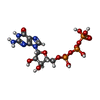

| #5: Chemical | ChemComp-GTP / 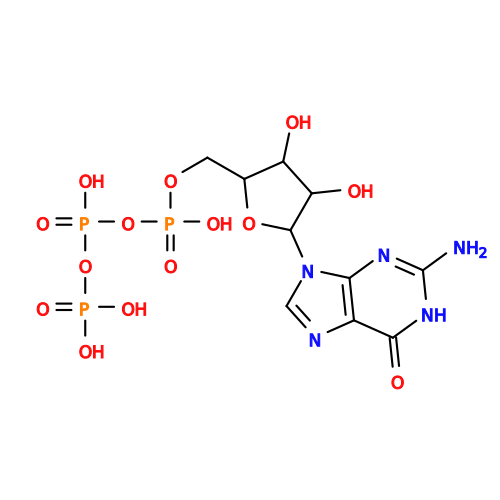 Mass: 523.180 Da / Num. of mol.: 1 / Source method: obtained synthetically / Formula: C10H16N5O14P3 / Feature type: SUBJECT OF INVESTIGATION / Comment: GTP, energy-carrying molecule*YM Mass: 523.180 Da / Num. of mol.: 1 / Source method: obtained synthetically / Formula: C10H16N5O14P3 / Feature type: SUBJECT OF INVESTIGATION / Comment: GTP, energy-carrying molecule*YM |
|---|---|
| #6: Chemical | ChemComp-ZN /  Mass: 65.409 Da / Num. of mol.: 1 / Source method: obtained synthetically / Formula: Zn / Feature type: SUBJECT OF INVESTIGATION Mass: 65.409 Da / Num. of mol.: 1 / Source method: obtained synthetically / Formula: Zn / Feature type: SUBJECT OF INVESTIGATION |
-Details
| Has ligand of interest | Y |
|---|---|
| Has protein modification | N |
-Experimental details
-Experiment
| Experiment | Method: ELECTRON MICROSCOPY |
|---|---|
| EM experiment | Aggregation state: PARTICLE / 3D reconstruction method: single particle reconstruction |
- Sample preparation
| Component | Name: Human Phosphatidylinositol-3 kinase class III complex II in complex with Rubicon Middle Region of C terminus Type: COMPLEX / Entity ID: #1-#4 / Source: RECOMBINANT | |||||||||||||||||||||||||
|---|---|---|---|---|---|---|---|---|---|---|---|---|---|---|---|---|---|---|---|---|---|---|---|---|---|---|
| Molecular weight | Experimental value: NO | |||||||||||||||||||||||||
| Source (natural) | Organism: Homo sapiens (human) | |||||||||||||||||||||||||
| Source (recombinant) | Organism: Homo sapiens (human) | |||||||||||||||||||||||||
| Buffer solution | pH: 7.5 | |||||||||||||||||||||||||
| Buffer component |
| |||||||||||||||||||||||||
| Specimen | Conc.: 0.15 mg/ml / Embedding applied: NO / Shadowing applied: NO / Staining applied: NO / Vitrification applied: YES | |||||||||||||||||||||||||
| Specimen support | Grid material: COPPER / Grid mesh size: 200 divisions/in. / Grid type: Quantifoil Active R2/1 | |||||||||||||||||||||||||
| Vitrification | Instrument: FEI VITROBOT MARK IV / Cryogen name: ETHANE / Humidity: 100 % / Chamber temperature: 277 K |
- Electron microscopy imaging
| Experimental equipment |  Model: Titan Krios / Image courtesy: FEI Company |
|---|---|
| Microscopy | Model: TFS KRIOS |
| Electron gun | Electron source:  FIELD EMISSION GUN / Accelerating voltage: 300 kV / Illumination mode: FLOOD BEAM FIELD EMISSION GUN / Accelerating voltage: 300 kV / Illumination mode: FLOOD BEAM |
| Electron lens | Mode: BRIGHT FIELD / Nominal defocus max: 2000 nm / Nominal defocus min: 800 nm |
| Image recording | Electron dose: 50 e/Å2 / Film or detector model: GATAN K3 (6k x 4k) |
- Processing
| EM software |
| ||||||||||||||||||||||||||||||||||||||||
|---|---|---|---|---|---|---|---|---|---|---|---|---|---|---|---|---|---|---|---|---|---|---|---|---|---|---|---|---|---|---|---|---|---|---|---|---|---|---|---|---|---|
| CTF correction | Type: PHASE FLIPPING AND AMPLITUDE CORRECTION | ||||||||||||||||||||||||||||||||||||||||
| 3D reconstruction | Resolution: 3.38 Å / Resolution method: FSC 0.143 CUT-OFF / Num. of particles: 175726 / Symmetry type: POINT | ||||||||||||||||||||||||||||||||||||||||
| Atomic model building | B value: 95.23 / Protocol: FLEXIBLE FIT / Space: REAL | ||||||||||||||||||||||||||||||||||||||||
| Atomic model building | Source name: AlphaFold / Type: in silico model |
