regulation of protein serine/threonine kinase activity / lytic vacuole / maintenance of Golgi location / cellular response to aluminum ion / positive regulation of protein lipidation / positive regulation of stress granule assembly / postsynaptic endosome / Toll Like Receptor 9 (TLR9) Cascade / Synthesis of PIPs at the late endosome membrane / phosphatidylinositol 3-kinase complex, class III ...regulation of protein serine/threonine kinase activity / lytic vacuole / maintenance of Golgi location / cellular response to aluminum ion / positive regulation of protein lipidation / positive regulation of stress granule assembly / postsynaptic endosome / Toll Like Receptor 9 (TLR9) Cascade / Synthesis of PIPs at the late endosome membrane / phosphatidylinositol 3-kinase complex, class III / cellular response to oxygen-glucose deprivation / Synthesis of PIPs at the early endosome membrane / phosphatidylinositol 3-kinase complex, class III, type II / phosphatidylinositol 3-kinase complex, class III, type I / SARS-CoV-2 modulates autophagy / response to mitochondrial depolarisation / presynaptic endosome / positive regulation of attachment of mitotic spindle microtubules to kinetochore / host-mediated activation of viral genome replication / engulfment of apoptotic cell / negative regulation of lysosome organization / multivesicular body sorting pathway / phosphatidylinositol kinase activity / SMAD protein signal transduction / positive regulation of autophagosome assembly / Synthesis of PIPs at the Golgi membrane / cytoplasmic side of mitochondrial outer membrane / early endosome to late endosome transport / receptor catabolic process / response to L-leucine / protein targeting to lysosome / late endosome to vacuole transport / endosome organization / pexophagy / Dengue virus modulates apoptosis / positive regulation of natural killer cell mediated cytotoxicity / double-strand break repair via classical nonhomologous end joining / phagophore assembly site / Translation of Replicase and Assembly of the Replication Transcription Complex / positive regulation of autophagosome maturation / centrosome cycle / cellular response to nitrogen starvation / spindle organization / negative regulation of programmed cell death / phosphatidylinositol 3-kinase / phosphatidylinositol-3-phosphate biosynthetic process / 1-phosphatidylinositol-3-kinase activity / response to vitamin E / retrograde vesicle-mediated transport, Golgi to endoplasmic reticulum / Macroautophagy / p38MAPK cascade / response to iron(II) ion / SNARE complex assembly / RSV-host interactions / cytoplasmic pattern recognition receptor signaling pathway / phosphatidylinositol phosphate biosynthetic process / phosphatidylinositol-mediated signaling / autolysosome / autophagosome membrane / PI3K Cascade / autophagosome maturation / chromosome, centromeric region / JNK cascade / RHO GTPases Activate NADPH Oxidases / mitotic metaphase chromosome alignment / axoneme / cellular response to glucose starvation / synaptic vesicle endocytosis / cellular defense response / autophagosome assembly / mitophagy / phosphatidylinositol 3-kinase binding / regulation of macroautophagy / positive regulation of intrinsic apoptotic signaling pathway / phagocytic vesicle / endoplasmic reticulum-Golgi intermediate compartment membrane / positive regulation of autophagy / autophagosome / cellular response to epidermal growth factor stimulus / cellular response to copper ion / cellular response to amino acid starvation / regulation of autophagy / macroautophagy / regulation of cytokinesis / phosphatidylinositol 3-kinase/protein kinase B signal transduction / SNARE binding / Antigen Presentation: Folding, assembly and peptide loading of class I MHC / trans-Golgi network / chromosome segregation / circadian rhythm / protein processing / SH3 domain binding / response to lead ion / cellular response to hydrogen peroxide / GABA-ergic synapse / ISG15 antiviral mechanism / phagocytic vesicle membrane / endocytosis / autophagy / late endosome Similarity search - Function
In the structure databanks used in Yorodumi, some data are registered as the other names, "COVID-19 virus" and "2019-nCoV". Here are the details of the virus and the list of structure data.
Jan 31, 2019. EMDB accession codes are about to change! (news from PDBe EMDB page)
EMDB accession codes are about to change! (news from PDBe EMDB page)
The allocation of 4 digits for EMDB accession codes will soon come to an end. Whilst these codes will remain in use, new EMDB accession codes will include an additional digit and will expand incrementally as the available range of codes is exhausted. The current 4-digit format prefixed with “EMD-” (i.e. EMD-XXXX) will advance to a 5-digit format (i.e. EMD-XXXXX), and so on. It is currently estimated that the 4-digit codes will be depleted around Spring 2019, at which point the 5-digit format will come into force.
The EM Navigator/Yorodumi systems omit the EMD- prefix.
Related info.:Q: What is EMD? / ID/Accession-code notation in Yorodumi/EM Navigator
Yorodumi is a browser for structure data from EMDB, PDB, SASBDB, etc.
This page is also the successor to EM Navigator detail page, and also detail information page/front-end page for Omokage search.
The word "yorodu" (or yorozu) is an old Japanese word meaning "ten thousand". "mi" (miru) is to see.
Related info.:EMDB / PDB / SASBDB / Comparison of 3 databanks / Yorodumi Search / Aug 31, 2016. New EM Navigator & Yorodumi / Yorodumi Papers / Jmol/JSmol / Function and homology information / Changes in new EM Navigator and Yorodumi
 Movie
Movie Controller


 Open data
 Basic information
 Map data
 Sample
 Keywords
 Function and homology information
 Homo sapiens (human)
 Authors
 United States, 2 items
  Citation
 Structure visualization
 Downloads & links
 emd_74526.png
 http://ftp.pdbj.org/pub/emdb/structures/EMD-74526


 Z (Sec.)
 Y (Row.)
 X (Col.)


 Sample components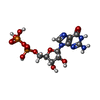
 Processing
 Electron microscopy
 FIELD EMISSION GUN
