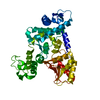
Movie
Movie Controller


+ Open data

- Basic information
| Entry | Database: PDB / ID: 9z5q | ||||||||||||||||||||||||
|---|---|---|---|---|---|---|---|---|---|---|---|---|---|---|---|---|---|---|---|---|---|---|---|---|---|
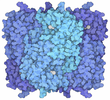
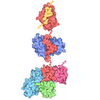
| Title | HECT domain of NEDD4-2 complex with a targeted nanobody, nb.C11 | ||||||||||||||||||||||||
 Components Components |
| ||||||||||||||||||||||||
 Keywords Keywords | LIGASE / Ubiquitin / targeted protein degradation / E3 ligase / Nanobody | ||||||||||||||||||||||||
| Function / homology |  Function and homology information Function and homology informationpositive regulation of caveolin-mediated endocytosis / RING-type E3 ubiquitin transferase (cysteine targeting) / negative regulation of sodium ion transmembrane transport / negative regulation of sodium ion import across plasma membrane / negative regulation of potassium ion transmembrane transport / negative regulation of potassium ion export across plasma membrane / negative regulation of protein localization to cell surface / regulation of membrane repolarization / positive regulation of dendrite extension / receptor catabolic process ...positive regulation of caveolin-mediated endocytosis / RING-type E3 ubiquitin transferase (cysteine targeting) / negative regulation of sodium ion transmembrane transport / negative regulation of sodium ion import across plasma membrane / negative regulation of potassium ion transmembrane transport / negative regulation of potassium ion export across plasma membrane / negative regulation of protein localization to cell surface / regulation of membrane repolarization / positive regulation of dendrite extension / receptor catabolic process / regulation of sodium ion transmembrane transport / ventricular cardiac muscle cell action potential / HECT-type E3 ubiquitin transferase / sodium channel inhibitor activity / potassium channel inhibitor activity / regulation of dendrite morphogenesis / regulation of membrane depolarization / regulation of synapse organization / neuromuscular junction development / sodium channel regulator activity / multivesicular body / protein K48-linked ubiquitination / Downregulation of TGF-beta receptor signaling / regulation of protein stability / receptor internalization / Downregulation of SMAD2/3:SMAD4 transcriptional activity / regulation of membrane potential / Budding and maturation of HIV virion / neuron projection development / Stimuli-sensing channels / ubiquitin-protein transferase activity / ubiquitin protein ligase activity / Antigen processing: Ubiquitination & Proteasome degradation / ubiquitin-dependent protein catabolic process / monoatomic ion transmembrane transport / proteasome-mediated ubiquitin-dependent protein catabolic process / transmembrane transporter binding / apical plasma membrane / protein ubiquitination / Golgi apparatus / extracellular exosome / nucleoplasm / cytosol / cytoplasm Similarity search - Function | ||||||||||||||||||||||||
| Biological species |   Lama glama (llama) Lama glama (llama) Homo sapiens (human) Homo sapiens (human) | ||||||||||||||||||||||||
| Method | ELECTRON MICROSCOPY / single particle reconstruction / cryo EM / Resolution: 3.06 Å | ||||||||||||||||||||||||
 Authors Authors | Afriyie, E. / Clarke, O.B. | ||||||||||||||||||||||||
| Funding support |  United States, 7items United States, 7items
| ||||||||||||||||||||||||
 Citation Citation | Journal: Nat Commun / Year: 2025 Title: Ion channel inhibition by targeted recruitment of NEDD4-2 with divalent nanobodies. Authors: Arden Darko-Boateng / Emmanuel Afriyie / Travis J Morgenstern / Sri Karthika Shanmugam / Xinle Zou / Yianni D Laloudakis / Papiya Choudhury / Meera Desai / Robert S Kass / Francesca Vallese ...Authors: Arden Darko-Boateng / Emmanuel Afriyie / Travis J Morgenstern / Sri Karthika Shanmugam / Xinle Zou / Yianni D Laloudakis / Papiya Choudhury / Meera Desai / Robert S Kass / Francesca Vallese / Oliver B Clarke / Henry M Colecraft / Abstract: Targeted protein degradation/downregulation (TPD/TPDR) is a disruptive paradigm for developing therapeutics. <2% of ~600 E3 ligases have been exploited for this modality, and efficacy for multi-subunit ion channels has not been demonstrated. NEDD4-2 E3 ligase regulates myriad ion channels, but its utility for TPD/TPDR is uncertain due to complex regulatory mechanisms. Here, we identify a nanobody that binds NEDD4-2 HECT domain without disrupting catalysis sites as revealed by cryo-electron microscopy and in vitro ubiquitination assays. Recruiting NEDD4-2 to diverse ion channels (Ca2.2; KCNQ1; and epithelial Na channel, ENaC, with a Liddle syndrome mutation) using divalent nanobodies (DiVas) strongly suppresses their surface density and function. Global proteomics indicates DiVa recruitment of endogenous NEDD4-2 to KCNQ1-YFP yields dramatically lower off-target effects compared to NEDD4-2 overexpression. The results establish utility of NEDD4-2 recruitment for TPD/TPDR, validate ion channels as susceptible to this modality, and introduce a general method to generate ion channel inhibitors. | ||||||||||||||||||||||||
| History |
|
- Structure visualization
| Structure viewer | Molecule: MolmilJmol/JSmol |
|---|
- Downloads & links
-Download
| PDBx/mmCIF format | 9z5q.cif.gz | 219 KB | Display | PDBx/mmCIF format |
|---|---|---|---|---|
| PDB format | pdb9z5q.ent.gz | 175.1 KB | Display | PDB format |
| PDBx/mmJSON format | 9z5q.json.gz | Tree view | PDBx/mmJSON format | |
| Others |  Other downloads Other downloads |
-Validation report
| Arichive directory | https://data.pdbj.org/pub/pdb/validation_reports/z5/9z5qftp://data.pdbj.org/pub/pdb/validation_reports/z5/9z5q | HTTPS FTP |
|---|
-Related structure data
| Related structure data |  73821MC M: map data used to model this data C: citing same article ( |
|---|---|
| Similar structure data |
-Links
 PDBj
PDBj

- Assembly
| Deposited unit | 
|
|---|---|
| 1 |
|
-Components
| #1: Antibody | Mass: 17817.080 Da / Num. of mol.: 1 Source method: isolated from a genetically manipulated source Source: (gene. exp.) Lama glama (llama) / Plasmid: pET24 / Details (production host): NYCOMPS expression plasmid / Production host:   Escherichia coli BL21(DE3) (bacteria) / Variant (production host): pLysS Escherichia coli BL21(DE3) (bacteria) / Variant (production host): pLysS |
|---|---|
| #2: Protein | Mass: 52598.484 Da / Num. of mol.: 1 Source method: isolated from a genetically manipulated source Details: HECT domain of NEDD4-2 / Source: (gene. exp.) Homo sapiens (human) / Gene: NEDD4L, KIAA0439, NEDL3 / Plasmid: pET24 / Details (production host): NYCOMPS expression plasmid / Production host: Escherichia coli BL21(DE3) (bacteria) / Variant (production host): pLysSReferences: UniProt: Q96PU5, HECT-type E3 ubiquitin transferase, RING-type E3 ubiquitin transferase (cysteine targeting) |
| Has protein modification | Y |
-Experimental details
-Experiment
| Experiment | Method: ELECTRON MICROSCOPY |
|---|---|
| EM experiment | Aggregation state: PARTICLE / 3D reconstruction method: single particle reconstruction |
- Sample preparation
| Component | Name: HECT domain of NEDD4-2 / Type: COMPLEX / Entity ID: all / Source: RECOMBINANT | ||||||||||||||||||||||||||||||
|---|---|---|---|---|---|---|---|---|---|---|---|---|---|---|---|---|---|---|---|---|---|---|---|---|---|---|---|---|---|---|---|
| Molecular weight | Value: 0.07 MDa / Experimental value: NO | ||||||||||||||||||||||||||||||
| Source (natural) | Organism: Homo sapiens (human) | ||||||||||||||||||||||||||||||
| Source (recombinant) | Organism: Escherichia coli (E. coli) / Plasmid: pET24 | ||||||||||||||||||||||||||||||
| Buffer solution | pH: 7.5 Details: 20 mM HEPES pH 7.5, 150 mM NaCl, 1 mM TCEP, and 1 mM EDTA, 0.043% CHAPS | ||||||||||||||||||||||||||||||
| Buffer component |
| ||||||||||||||||||||||||||||||
| Specimen | Conc.: 11 mg/ml / Embedding applied: NO / Shadowing applied: NO / Staining applied: NO / Vitrification applied: YES / Details: The sample was monodisperse and of high purifty | ||||||||||||||||||||||||||||||
| Specimen support | Details: The grid was only glow discharged / Grid material: GOLD / Grid mesh size: 300 divisions/in. / Grid type: Quantifoil R0.6/1 | ||||||||||||||||||||||||||||||
| Vitrification | Instrument: FEI VITROBOT MARK IV / Cryogen name: ETHANE / Humidity: 100 % / Chamber temperature: 277.15 K / Details: Vitrification carried out at Argon atmosphere |
- Electron microscopy imaging
| Experimental equipment |  Model: Titan Krios / Image courtesy: FEI Company |
|---|---|
| Microscopy | Model: TFS KRIOS / Details: Preliminary grid screening was performed manually |
| Electron gun | Electron source:  FIELD EMISSION GUN / Accelerating voltage: 300 kV / Illumination mode: SPOT SCAN FIELD EMISSION GUN / Accelerating voltage: 300 kV / Illumination mode: SPOT SCAN |
| Electron lens | Mode: BRIGHT FIELD / Nominal magnification: 165000 X / Nominal defocus max: 2500 nm / Nominal defocus min: 2500 nm / Calibrated defocus min: 1000 nm / Cs: 2.7 mm / C2 aperture diameter: 100 µm / Alignment procedure: COMA FREE |
| Specimen holder | Cryogen: NITROGEN / Specimen holder model: FEI TITAN KRIOS AUTOGRID HOLDER |
| Image recording | Electron dose: 1.092 e/Å2 / Detector mode: COUNTING / Film or detector model: GATAN K3 BIOQUANTUM (6k x 4k) / Num. of grids imaged: 1 / Num. of real images: 7790 Details: Images were collected in movie-mode at 100 frames per second |
| EM imaging optics | Energyfilter name: GIF Bioquantum / Energyfilter slit width: 20 eV |
- Processing
| EM software |
| ||||||||||||||||||||||||||||||||||||||||||||
|---|---|---|---|---|---|---|---|---|---|---|---|---|---|---|---|---|---|---|---|---|---|---|---|---|---|---|---|---|---|---|---|---|---|---|---|---|---|---|---|---|---|---|---|---|---|
| CTF correction | Details: We generated ab initio reconstruction model in CryoSPARC and use it in our pipeline Type: NONE | ||||||||||||||||||||||||||||||||||||||||||||
| Particle selection | Num. of particles selected: 1631714 | ||||||||||||||||||||||||||||||||||||||||||||
| Symmetry | Point symmetry: C1 (asymmetric) | ||||||||||||||||||||||||||||||||||||||||||||
| 3D reconstruction | Resolution: 3.06 Å / Resolution method: FSC 0.143 CUT-OFF / Num. of particles: 90979 / Algorithm: BACK PROJECTION / Num. of class averages: 1 / Symmetry type: POINT | ||||||||||||||||||||||||||||||||||||||||||||
| Atomic model building | Protocol: AB INITIO MODEL / Space: REAL Details: The initial local fitting was done using UCSF Chimera and proceed to use real space fitting to complete the whole assembly in Coot | ||||||||||||||||||||||||||||||||||||||||||||
| Atomic model building | 3D fitting-ID: 1
| ||||||||||||||||||||||||||||||||||||||||||||
| Refinement | Highest resolution: 3.06 Å Stereochemistry target values: REAL-SPACE (WEIGHTED MAP SUM AT ATOM CENTERS) | ||||||||||||||||||||||||||||||||||||||||||||
| Refine LS restraints |
|