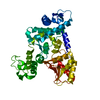
positive regulation of caveolin-mediated endocytosis / RING-type E3 ubiquitin transferase (cysteine targeting) / negative regulation of sodium ion transmembrane transport / negative regulation of potassium ion transmembrane transport / negative regulation of sodium ion import across plasma membrane / negative regulation of potassium ion export across plasma membrane / negative regulation of protein localization to cell surface / regulation of membrane repolarization / positive regulation of dendrite extension / receptor catabolic process ...positive regulation of caveolin-mediated endocytosis / RING-type E3 ubiquitin transferase (cysteine targeting) / negative regulation of sodium ion transmembrane transport / negative regulation of potassium ion transmembrane transport / negative regulation of sodium ion import across plasma membrane / negative regulation of potassium ion export across plasma membrane / negative regulation of protein localization to cell surface / regulation of membrane repolarization / positive regulation of dendrite extension / receptor catabolic process / regulation of sodium ion transmembrane transport / ventricular cardiac muscle cell action potential / HECT-type E3 ubiquitin transferase / sodium channel inhibitor activity / potassium channel inhibitor activity / regulation of dendrite morphogenesis / regulation of membrane depolarization / regulation of synapse organization / neuromuscular junction development / sodium channel regulator activity / protein monoubiquitination / multivesicular body / protein K48-linked ubiquitination / Downregulation of TGF-beta receptor signaling / regulation of protein stability / receptor internalization / Downregulation of SMAD2/3:SMAD4 transcriptional activity / regulation of membrane potential / Budding and maturation of HIV virion / neuron projection development / Stimuli-sensing channels / ubiquitin-protein transferase activity / positive regulation of protein catabolic process / ubiquitin protein ligase activity / Antigen processing: Ubiquitination & Proteasome degradation / ubiquitin-dependent protein catabolic process / monoatomic ion transmembrane transport / proteasome-mediated ubiquitin-dependent protein catabolic process / transmembrane transporter binding / apical plasma membrane / protein ubiquitination / Golgi apparatus / extracellular exosome / nucleoplasm / cytosol / cytoplasm Similarity search - Function
E3 ubiquitin-protein ligase, SMURF1 type / : / HECT domain / HECT, E3 ligase catalytic domain / HECT-domain (ubiquitin-transferase) / HECT domain profile. / Domain Homologous to E6-AP Carboxyl Terminus with / Protein kinase C conserved region 2 (CalB) / C2 domain / WW domain ...E3 ubiquitin-protein ligase, SMURF1 type / : / HECT domain / HECT, E3 ligase catalytic domain / HECT-domain (ubiquitin-transferase) / HECT domain profile. / Domain Homologous to E6-AP Carboxyl Terminus with / Protein kinase C conserved region 2 (CalB) / C2 domain / WW domain / C2 domain / C2 domain profile. / WW/rsp5/WWP domain signature. / WW domain superfamily / WW/rsp5/WWP domain profile. / Domain with 2 conserved Trp (W) residues / WW domain / C2 domain superfamily Similarity search - Domain/homology
National Institutes of Health/National Heart, Lung, and Blood Institute (NIH/NHLBI)
RO1-HL121253
United States
National Institutes of Health/National Heart, Lung, and Blood Institute (NIH/NHLBI)
RO1-HL142111
United States
National Institutes of Health/National Heart, Lung, and Blood Institute (NIH/NHLBI)
R01-NS126850
United States
National Institutes of Health/National Heart, Lung, and Blood Institute (NIH/NHLBI)
P01-HL164319
United States
American Heart Association
20PRE35210815
United States
National Institutes of Health/National Institute of Diabetes and Digestive and Kidney Disease (NIH/NIDDK)
F31 DK118866
United States
American Heart Association
POST1019343
United States
Citation
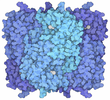
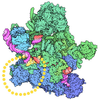
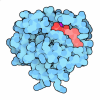
Journal: Nat Commun / Year: 2025 Title: Ion channel inhibition by targeted recruitment of NEDD4-2 with divalent nanobodies. Authors: Arden Darko-Boateng / Emmanuel Afriyie / Travis J Morgenstern / Sri Karthika Shanmugam / Xinle Zou / Yianni D Laloudakis / Papiya Choudhury / Meera Desai / Robert S Kass / Francesca Vallese ...Authors: Arden Darko-Boateng / Emmanuel Afriyie / Travis J Morgenstern / Sri Karthika Shanmugam / Xinle Zou / Yianni D Laloudakis / Papiya Choudhury / Meera Desai / Robert S Kass / Francesca Vallese / Oliver B Clarke / Henry M Colecraft / Abstract: Targeted protein degradation/downregulation (TPD/TPDR) is a disruptive paradigm for developing therapeutics. <2% of ~600 E3 ligases have been exploited for this modality, and efficacy for multi-subunit ion channels has not been demonstrated. NEDD4-2 E3 ligase regulates myriad ion channels, but its utility for TPD/TPDR is uncertain due to complex regulatory mechanisms. Here, we identify a nanobody that binds NEDD4-2 HECT domain without disrupting catalysis sites as revealed by cryo-electron microscopy and in vitro ubiquitination assays. Recruiting NEDD4-2 to diverse ion channels (Ca2.2; KCNQ1; and epithelial Na channel, ENaC, with a Liddle syndrome mutation) using divalent nanobodies (DiVas) strongly suppresses their surface density and function. Global proteomics indicates DiVa recruitment of endogenous NEDD4-2 to KCNQ1-YFP yields dramatically lower off-target effects compared to NEDD4-2 overexpression. The results establish utility of NEDD4-2 recruitment for TPD/TPDR, validate ion channels as susceptible to this modality, and introduce a general method to generate ion channel inhibitors.
Details: 20 mM HEPES pH 7.5, 150 mM NaCl, 1 mM TCEP, and 1 mM EDTA, 0.043% CHAPS
Grid
Model: Quantifoil R0.6/1 / Material: GOLD / Mesh: 300 / Support film - Material: GOLD / Support film - topology: HOLEY / Support film - Film thickness: 40 / Pretreatment - Type: GLOW DISCHARGE / Pretreatment - Time: 25 sec. / Pretreatment - Atmosphere: OTHER / Pretreatment - Pressure: 260.0 kPa / Details: The grid was only glow discharged
Vitrification
Cryogen name: ETHANE / Chamber humidity: 100 % / Chamber temperature: 277.15 K / Instrument: FEI VITROBOT MARK IV / Details: Vitrification carried out at Argon atmosphere.
Details
The sample was monodisperse and of high purifty
-
Electron microscopy
Microscope
TFS KRIOS
Specialist optics
Energy filter - Name: GIF Bioquantum / Energy filter - Slit width: 20 eV
Details
Preliminary grid screening was performed manually
Image recording
Film or detector model: GATAN K3 BIOQUANTUM (6k x 4k) / Detector mode: COUNTING / Number grids imaged: 1 / Number real images: 7790 / Average electron dose: 1.092 e/Å2 Details: Images were collected in movie-mode at 100 frames per second
Electron beam
Acceleration voltage: 300 kV / Electron source: FIELD EMISSION GUN
In the structure databanks used in Yorodumi, some data are registered as the other names, "COVID-19 virus" and "2019-nCoV". Here are the details of the virus and the list of structure data.
Jan 31, 2019. EMDB accession codes are about to change! (news from PDBe EMDB page)
EMDB accession codes are about to change! (news from PDBe EMDB page)
The allocation of 4 digits for EMDB accession codes will soon come to an end. Whilst these codes will remain in use, new EMDB accession codes will include an additional digit and will expand incrementally as the available range of codes is exhausted. The current 4-digit format prefixed with “EMD-” (i.e. EMD-XXXX) will advance to a 5-digit format (i.e. EMD-XXXXX), and so on. It is currently estimated that the 4-digit codes will be depleted around Spring 2019, at which point the 5-digit format will come into force.
The EM Navigator/Yorodumi systems omit the EMD- prefix.
Related info.:Q: What is EMD? / ID/Accession-code notation in Yorodumi/EM Navigator
Yorodumi is a browser for structure data from EMDB, PDB, SASBDB, etc.
This page is also the successor to EM Navigator detail page, and also detail information page/front-end page for Omokage search.
The word "yorodu" (or yorozu) is an old Japanese word meaning "ten thousand". "mi" (miru) is to see.
Related info.:EMDB / PDB / SASBDB / Comparison of 3 databanks / Yorodumi Search / Aug 31, 2016. New EM Navigator & Yorodumi / Yorodumi Papers / Jmol/JSmol / Function and homology information / Changes in new EM Navigator and Yorodumi
 Movie
Movie Controller

 Yorodumi
 Open data
 Basic information
 Map data
 Sample
 Keywords
 Function and homology information
 Homo sapiens (human) /
 Lama glama (llama)
 Authors
 United States, 7 items
  Citation
 Structure visualization
 Downloads & links
 emd_73821.png
 https://data.pdbj.org/pub/emdb/structures/EMD-73821
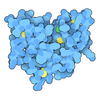

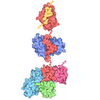
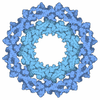
 Z (Sec.)
 Y (Row.)
 X (Col.)


 Sample components
 Escherichia coli BL21(DE3) (bacteria)
 Processing
 Electron microscopy
 FIELD EMISSION GUN