 Movie
Movie Controller

[English] 日本語
 Yorodumi
- PDB-9z2d: Mitochondrial Creatine Kinase in complex with ADP, creatine, and ... -
+ Open data

- Basic information
| Entry | Database: PDB / ID: 9z2d | ||||||||||||||||||||||||
|---|---|---|---|---|---|---|---|---|---|---|---|---|---|---|---|---|---|---|---|---|---|---|---|---|---|
| Title | Mitochondrial Creatine Kinase in complex with ADP, creatine, and uncompetitive inhibitor uci | ||||||||||||||||||||||||
 Components Components | Creatine kinase U-type, mitochondrial | ||||||||||||||||||||||||
 Keywords Keywords | TRANSFERASE/INHIBITOR / Kinase / inhibitor / TRANSFERASE-INHIBITOR complex / transition state analog | ||||||||||||||||||||||||
| Function / homology |  Function and homology information Function and homology informationcreatine kinase / phosphocreatine biosynthetic process / Creatine metabolism / creatine kinase activity / mitochondrial inner membrane / mitochondrion / ATP binding Similarity search - Function | ||||||||||||||||||||||||
| Biological species |  Homo sapiens (human) Homo sapiens (human) | ||||||||||||||||||||||||
| Method | ELECTRON MICROSCOPY / single particle reconstruction / cryo EM / Resolution: 2.6 Å | ||||||||||||||||||||||||
 Authors Authors | Demir, M. / Zhao, J. / Sergienko, E. | ||||||||||||||||||||||||
| Funding support |  United States, 1items United States, 1items
| ||||||||||||||||||||||||
 Citation Citation | Journal: bioRxiv / Year: 2026 Title: Uncompetitive Allosteric Inhibitor of Mitochondrial Creatine Kinase Prevents Binding and Release of Creatine by Stabilization of Loop Closure. Abstract: Mitochondrial creatine kinase (MtCK) is a key enzyme in energy buffering and homeostasis in cells. It catalyzes transfer of phosphoryl group from ATP to creatine. Overexpression of MtCK occurs in ...Mitochondrial creatine kinase (MtCK) is a key enzyme in energy buffering and homeostasis in cells. It catalyzes transfer of phosphoryl group from ATP to creatine. Overexpression of MtCK occurs in many cancer cells to meet elevated energy demands, which is associated with poor prognosis. This suggests that MtCK may be a promising target for cancer therapeutics. We sought to discover first-in-class selective inhibitors of MtCK with diverse mechanisms of action using high-throughput screening, biochemical characterization and cryo-EM studies. Through these studies, we identified diverse types of compounds that modulate activity of MtCK , including fast-equilibrium and time-dependent orthosteric and allosteric inhibitors. Select hits were subjected to enzymatic and binding assays to assess MtCK inhibition and binding. A subset of inhibitors was advanced into structural studies using cryo-EM resulting in the molecular structure of MtCK with and without bound substrates in complex with an allosteric uncompetitive inhibitor that we discovered. These studies identified compound's unique binding pocket on MtCK and established the molecular steps manifesting in the apparent uncompetitive mode of inhibition. We demonstrate that the compound stabilizes an active site loop in a closed conformation restricting access of the creatine substrate to and the release of phosphocreatine product from its binding pocket. These findings establish chemical tools suitable for validation of MtCK as a promising breast cancer target with high therapeutic potential and build a foundation for future structure-guided optimization of the hit compounds of MtCK we identified and de novo rational design of novel MtCK inhibitors. | ||||||||||||||||||||||||
| History |
|
- Structure visualization
| Structure viewer | Molecule: MolmilJmol/JSmol |
|---|
- Downloads & links
-Download
| PDBx/mmCIF format | 9z2d.cif.gz | 1 MB | Display | PDBx/mmCIF format |
|---|---|---|---|---|
| PDB format | pdb9z2d.ent.gz | Display | PDB format | |
| PDBx/mmJSON format | 9z2d.json.gz | Tree view | PDBx/mmJSON format | |
| Others |  Other downloads Other downloads |
-Validation report
| Arichive directory | https://data.pdbj.org/pub/pdb/validation_reports/z2/9z2dftp://data.pdbj.org/pub/pdb/validation_reports/z2/9z2d | HTTPS FTP |
|---|
-Related structure data
| Related structure data |  73766MC  9z2fC M: map data used to model this data C: citing same article ( |
|---|---|
| Similar structure data |

-Links
 PDBj
PDBj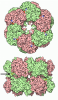
- Assembly
| Deposited unit | 
|
|---|---|
| 1 |
|
-Components
| #1: Protein | Mass: 47598.719 Da / Num. of mol.: 8 Source method: isolated from a genetically manipulated source Source: (gene. exp.) Homo sapiens (human) / Gene: CKMT1A, CKMT, CKMT1B, CKMT / Production host:   Escherichia coli BL21(DE3) (bacteria) / References: UniProt: P12532, creatine kinase Escherichia coli BL21(DE3) (bacteria) / References: UniProt: P12532, creatine kinase#2: Chemical | ChemComp-ADP / 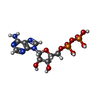 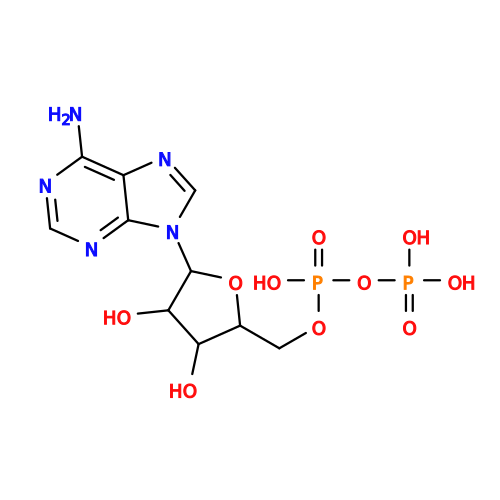 Mass: 427.201 Da / Num. of mol.: 8 / Source method: obtained synthetically / Formula: C10H15N5O10P2 / Feature type: SUBJECT OF INVESTIGATION / Comment: ADP, energy-carrying molecule*YM Mass: 427.201 Da / Num. of mol.: 8 / Source method: obtained synthetically / Formula: C10H15N5O10P2 / Feature type: SUBJECT OF INVESTIGATION / Comment: ADP, energy-carrying molecule*YM#3: Chemical | ChemComp-CRN / 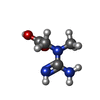 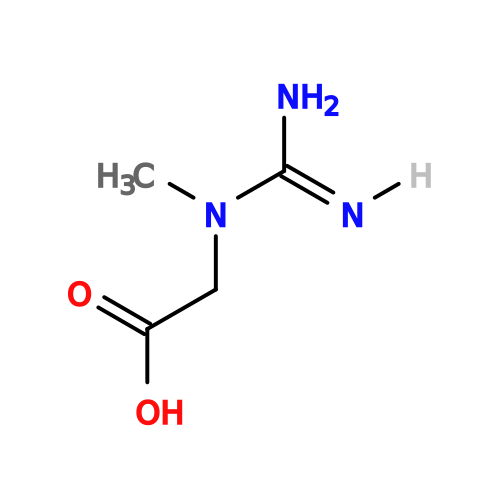 Mass: 131.133 Da / Num. of mol.: 8 / Source method: obtained synthetically / Formula: C4H9N3O2 / Feature type: SUBJECT OF INVESTIGATION Mass: 131.133 Da / Num. of mol.: 8 / Source method: obtained synthetically / Formula: C4H9N3O2 / Feature type: SUBJECT OF INVESTIGATION#4: Chemical | ChemComp-A1CZQ / [ Mass: 378.471 Da / Num. of mol.: 8 / Source method: obtained synthetically / Formula: C21H26N6O / Feature type: SUBJECT OF INVESTIGATION #5: Chemical | ChemComp-MG /   Mass: 24.305 Da / Num. of mol.: 8 / Source method: obtained synthetically / Formula: Mg / Feature type: SUBJECT OF INVESTIGATION Mass: 24.305 Da / Num. of mol.: 8 / Source method: obtained synthetically / Formula: Mg / Feature type: SUBJECT OF INVESTIGATIONHas ligand of interest | Y | Has protein modification | N | |
|---|
-Experimental details
-Experiment
| Experiment | Method: ELECTRON MICROSCOPY |
|---|---|
| EM experiment | Aggregation state: PARTICLE / 3D reconstruction method: single particle reconstruction |
- Sample preparation
| Component | Name: Mitochondrial Creatine Kinase / Type: COMPLEX / Entity ID: #1 / Source: RECOMBINANT |
|---|---|
| Source (natural) | Organism: Homo sapiens (human) |
| Source (recombinant) | Organism: Escherichia coli BL21(DE3) (bacteria) |
| Buffer solution | pH: 8 |
| Specimen | Embedding applied: NO / Shadowing applied: NO / Staining applied: NO / Vitrification applied: YES |
| Specimen support | Grid type: Quantifoil R2/2 |
| Vitrification | Cryogen name: ETHANE |
- Electron microscopy imaging
| Experimental equipment |  Model: Titan Krios / Image courtesy: FEI Company |
|---|---|
| Microscopy | Model: TFS KRIOS |
| Electron gun | Electron source:  FIELD EMISSION GUN / Accelerating voltage: 300 kV / Illumination mode: FLOOD BEAM FIELD EMISSION GUN / Accelerating voltage: 300 kV / Illumination mode: FLOOD BEAM |
| Electron lens | Mode: BRIGHT FIELD / Nominal defocus max: 2100 nm / Nominal defocus min: 900 nm |
| Image recording | Electron dose: 34 e/Å2 / Film or detector model: GATAN K3 (6k x 4k) |
- Processing
| EM software |
| ||||||||||||||||||||||||
|---|---|---|---|---|---|---|---|---|---|---|---|---|---|---|---|---|---|---|---|---|---|---|---|---|---|
| CTF correction | Type: PHASE FLIPPING AND AMPLITUDE CORRECTION | ||||||||||||||||||||||||
| 3D reconstruction | Resolution: 2.6 Å / Resolution method: FSC 0.143 CUT-OFF / Num. of particles: 1083440 / Symmetry type: POINT | ||||||||||||||||||||||||
| Refinement | Highest resolution: 2.6 Å Stereochemistry target values: REAL-SPACE (WEIGHTED MAP SUM AT ATOM CENTERS) | ||||||||||||||||||||||||
| Refine LS restraints |
|
