- PDB-9yxy: Crystal structure of EEPD1 EEP domain dimer at pH 5.5 -
+
Open data
ID or keywords:
Loading...
-
Basic information
Entry
Database: PDB / ID: 9yxy
Title
Crystal structure of EEPD1 EEP domain dimer at pH 5.5
Components
Endonuclease/exonuclease/phosphatase family domain-containing protein 1
Keywords
DNA BINDING PROTEIN / Endonuclease/Exonuclease/Phosphatase Fold / Dimerization / Replication stress response
Function / homology
Function and homology information
catalytic activity / positive regulation of cholesterol efflux / NR1H3 & NR1H2 regulate gene expression linked to cholesterol transport and efflux / DNA repair / DNA binding / plasma membrane Similarity search - Function
Competence protein ComEA, helix-hairpin-helix domain / : / : / Helix-hairpin-helix motif / Endonuclease/exonuclease/phosphatase / Endonuclease/Exonuclease/phosphatase family / RuvA domain 2-like / Endonuclease/exonuclease/phosphatase superfamily / Helix-hairpin-helix DNA-binding motif, class 1 / Helix-hairpin-helix DNA-binding motif class 1 Similarity search - Domain/homology
National Institutes of Health/National Cancer Institute (NIH/NCI)
P01 CA092584
United States
National Institutes of Health/National Cancer Institute (NIH/NCI)
R35 CA220430
United States
Citation
Journal: Nucleic Acids Res / Year: 2026 Title: EEPD1 evolved a unique DNA clamping dimer protecting reversed replication forks. Authors: Runze Shen / Altaf H Sarker / Yue Chen / Min Liu / Sunetra Roy / Andrew S Arvai / Albino Bacolla / Zamal Ahmed / Panagiotis Katsonis / Michal Hammel / Isao Kuraoka / Miaw-Sheue Tsai / ...Authors: Runze Shen / Altaf H Sarker / Yue Chen / Min Liu / Sunetra Roy / Andrew S Arvai / Albino Bacolla / Zamal Ahmed / Panagiotis Katsonis / Michal Hammel / Isao Kuraoka / Miaw-Sheue Tsai / Corydon Irie / Lukas Webb / Olivier Lichtarge / Chi-Lin Tsai / Susan E Tsutakawa / Katharina Schlacher / John A Tainer / Abstract: Exonuclease/endonuclease/phosphatase (EEP)-fold hydrolases are canonically monomeric phosphodiesterases exemplified by APE1, DNase I, and TDP2 nucleases. While EEP family domain containing protein 1 ...Exonuclease/endonuclease/phosphatase (EEP)-fold hydrolases are canonically monomeric phosphodiesterases exemplified by APE1, DNase I, and TDP2 nucleases. While EEP family domain containing protein 1 (EEPD1) acts in DNA stress responses, its proposed nuclease activities are enigmatic. Here, we integrate hybrid structural methods, evolution, biochemistry, cancer genomics, plus molecular and cell biology to define EEPD1 structure, assembly, and function at stalled DNA replication forks. Results imply EEPD1 surprisingly requires both unique EEP domain dimer and distinctive tandem Helix-hairpin-Helix [(HhH)2] domains to clamp double-stranded (ds) DNA at reversed DNA replication forks for fork protection. Small-angle X-ray Scattering (SAXS), crystal, and cryo-EM structures unveil an unprecedented tryptophan handshake dimer, conserved interface di-Trp-Pro pocket, and adjustable "wrist" enabling an open-closed conformational switch. EEPD1 dimer cooperatively binds complex dsDNA replication fork intermediates but alone lacks nuclease activity due to loss of key EEP catalytic residues during Metazoan evolution and atmospheric oxygen buildup. Instead, EEPD1 prevents nucleolytic degradation of reversed replication forks by MRE11. Furthermore, cancer bioinformatics support oxidative damage-dependent EEPD1 association as a significant modulator of overall patient survival. Collective findings uncover unexpected EEP dimer and fork protection function in clamping, not cleaving, reversed replication forks for metazoan oxidative stress responses controlling genome stability and cancer outcomes.
#259 - Jul 2021 Designed Proteins and Citizen Science similarity (1)
-
Assembly
Deposited unit
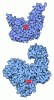
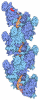
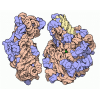
A: Endonuclease/exonuclease/phosphatase family domain-containing protein 1 B: Endonuclease/exonuclease/phosphatase family domain-containing protein 1 hetero molecules
In the structure databanks used in Yorodumi, some data are registered as the other names, "COVID-19 virus" and "2019-nCoV". Here are the details of the virus and the list of structure data.
Jan 31, 2019. EMDB accession codes are about to change! (news from PDBe EMDB page)
EMDB accession codes are about to change! (news from PDBe EMDB page)
The allocation of 4 digits for EMDB accession codes will soon come to an end. Whilst these codes will remain in use, new EMDB accession codes will include an additional digit and will expand incrementally as the available range of codes is exhausted. The current 4-digit format prefixed with “EMD-” (i.e. EMD-XXXX) will advance to a 5-digit format (i.e. EMD-XXXXX), and so on. It is currently estimated that the 4-digit codes will be depleted around Spring 2019, at which point the 5-digit format will come into force.
The EM Navigator/Yorodumi systems omit the EMD- prefix.
Related info.:Q: What is EMD? / ID/Accession-code notation in Yorodumi/EM Navigator
Yorodumi is a browser for structure data from EMDB, PDB, SASBDB, etc.
This page is also the successor to EM Navigator detail page, and also detail information page/front-end page for Omokage search.
The word "yorodu" (or yorozu) is an old Japanese word meaning "ten thousand". "mi" (miru) is to see.
Related info.:EMDB / PDB / SASBDB / Comparison of 3 databanks / Yorodumi Search / Aug 31, 2016. New EM Navigator & Yorodumi / Yorodumi Papers / Jmol/JSmol / Function and homology information / Changes in new EM Navigator and Yorodumi
 Movie
Movie Controller


 Open data
 Basic information
 Components
 Keywords
 Function and homology information
 Homo sapiens (human)
 X-RAY DIFFRACTION /
  Authors
 United States, 2items
  Citation
 Structure visualization
 Downloads & links
 Other downloads


 PDBj
PDBj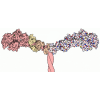
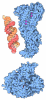
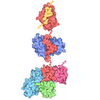
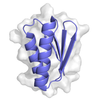
 Assembly

 Escherichia coli BL21(DE3) (bacteria) / Strain (production host): Rosetta2 / References: UniProt: Q7L9B9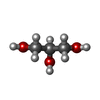
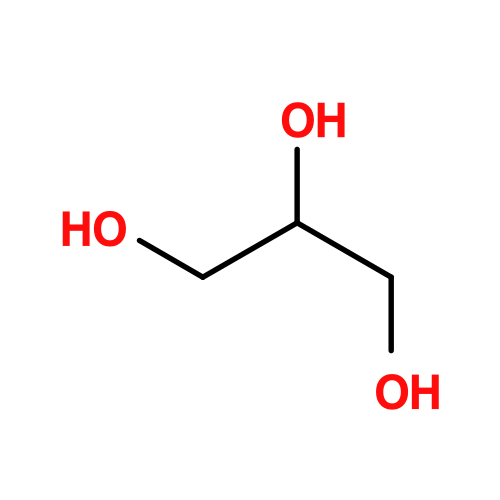 Mass: 92.094 Da / Num. of mol.: 1 / Source method: obtained synthetically / Formula: C3H8O3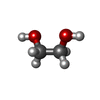
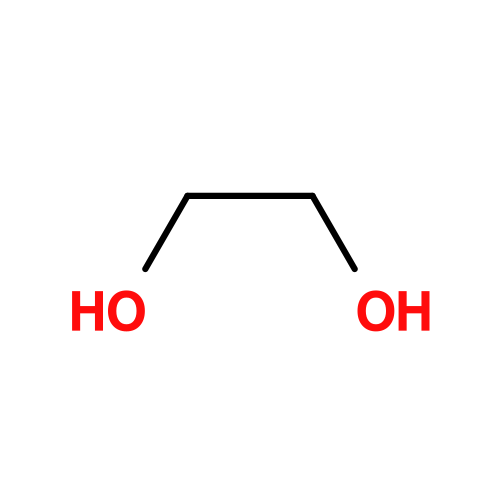 Mass: 62.068 Da / Num. of mol.: 1 / Source method: obtained synthetically / Formula: C2H6O2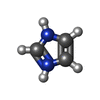
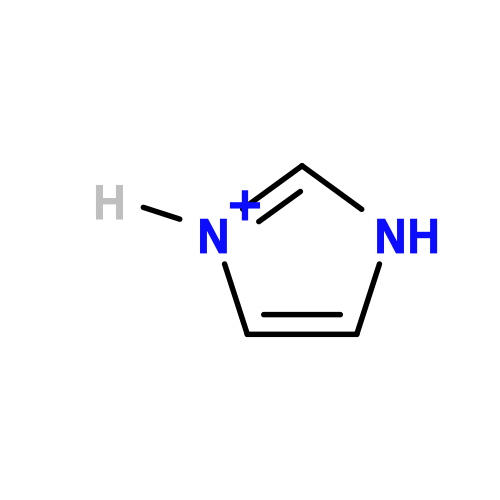 Mass: 69.085 Da / Num. of mol.: 1 / Source method: obtained synthetically / Formula: C3H5N2
 Mass: 18.015 Da / Num. of mol.: 188 / Source method: isolated from a natural source / Formula: H2O
 Sample preparation
 Processing