 Movie
Movie Controller


+ Open data

- Basic information
| Entry | Database: PDB / ID: 9yi2 | |||||||||||||||||||||||||||
|---|---|---|---|---|---|---|---|---|---|---|---|---|---|---|---|---|---|---|---|---|---|---|---|---|---|---|---|---|
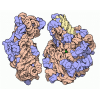
| Title | Human EEPD1 EEP domain dimer | |||||||||||||||||||||||||||
 Components Components | Endonuclease/exonuclease/phosphatase family domain-containing protein 1 | |||||||||||||||||||||||||||
 Keywords Keywords | DNA BINDING PROTEIN / Endonuclease/Exonuclease/Phosphatase Fold / dimerization / helix-hairpin-helix domains / replication stress response | |||||||||||||||||||||||||||
| Function / homology |  Function and homology information Function and homology informationcatalytic activity / positive regulation of cholesterol efflux / NR1H3 & NR1H2 regulate gene expression linked to cholesterol transport and efflux / DNA repair / DNA binding / plasma membrane Similarity search - Function | |||||||||||||||||||||||||||
| Biological species |  Homo sapiens (human) Homo sapiens (human) | |||||||||||||||||||||||||||
| Method | ELECTRON MICROSCOPY / single particle reconstruction / cryo EM / Resolution: 3.6 Å | |||||||||||||||||||||||||||
 Authors Authors | Liu, M. / Shen, R. / Tainer, J. | |||||||||||||||||||||||||||
| Funding support |  United States, 2items United States, 2items
| |||||||||||||||||||||||||||
 Citation Citation | Journal: Nucleic Acids Res / Year: 2026 Title: EEPD1 evolved a unique DNA clamping dimer protecting reversed replication forks. Authors: Runze Shen / Altaf H Sarker / Yue Chen / Min Liu / Sunetra Roy / Andrew S Arvai / Albino Bacolla / Zamal Ahmed / Panagiotis Katsonis / Michal Hammel / Isao Kuraoka / Miaw-Sheue Tsai / ...Authors: Runze Shen / Altaf H Sarker / Yue Chen / Min Liu / Sunetra Roy / Andrew S Arvai / Albino Bacolla / Zamal Ahmed / Panagiotis Katsonis / Michal Hammel / Isao Kuraoka / Miaw-Sheue Tsai / Corydon Irie / Lukas Webb / Olivier Lichtarge / Chi-Lin Tsai / Susan E Tsutakawa / Katharina Schlacher / John A Tainer /  Abstract: Exonuclease/endonuclease/phosphatase (EEP)-fold hydrolases are canonically monomeric phosphodiesterases exemplified by APE1, DNase I, and TDP2 nucleases. While EEP family domain containing protein 1 ...Exonuclease/endonuclease/phosphatase (EEP)-fold hydrolases are canonically monomeric phosphodiesterases exemplified by APE1, DNase I, and TDP2 nucleases. While EEP family domain containing protein 1 (EEPD1) acts in DNA stress responses, its proposed nuclease activities are enigmatic. Here, we integrate hybrid structural methods, evolution, biochemistry, cancer genomics, plus molecular and cell biology to define EEPD1 structure, assembly, and function at stalled DNA replication forks. Results imply EEPD1 surprisingly requires both unique EEP domain dimer and distinctive tandem Helix-hairpin-Helix [(HhH)2] domains to clamp double-stranded (ds) DNA at reversed DNA replication forks for fork protection. Small-angle X-ray Scattering (SAXS), crystal, and cryo-EM structures unveil an unprecedented tryptophan handshake dimer, conserved interface di-Trp-Pro pocket, and adjustable "wrist" enabling an open-closed conformational switch. EEPD1 dimer cooperatively binds complex dsDNA replication fork intermediates but alone lacks nuclease activity due to loss of key EEP catalytic residues during Metazoan evolution and atmospheric oxygen buildup. Instead, EEPD1 prevents nucleolytic degradation of reversed replication forks by MRE11. Furthermore, cancer bioinformatics support oxidative damage-dependent EEPD1 association as a significant modulator of overall patient survival. Collective findings uncover unexpected EEP dimer and fork protection function in clamping, not cleaving, reversed replication forks for metazoan oxidative stress responses controlling genome stability and cancer outcomes. | |||||||||||||||||||||||||||
| History |
|
- Structure visualization
| Structure viewer | Molecule: MolmilJmol/JSmol |
|---|
- Downloads & links
-Download
| PDBx/mmCIF format | 9yi2.cif.gz | 135.6 KB | Display | PDBx/mmCIF format |
|---|---|---|---|---|
| PDB format | pdb9yi2.ent.gz | 83.3 KB | Display | PDB format |
| PDBx/mmJSON format | 9yi2.json.gz | Tree view | PDBx/mmJSON format | |
| Others |  Other downloads Other downloads |
-Validation report
| Arichive directory | https://data.pdbj.org/pub/pdb/validation_reports/yi/9yi2ftp://data.pdbj.org/pub/pdb/validation_reports/yi/9yi2 | HTTPS FTP |
|---|
-Related structure data
| Related structure data |  72976MC  9ysfC  9yxyC M: map data used to model this data C: citing same article ( |
|---|---|
| Similar structure data |
-Links
 PDBj
PDBj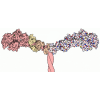
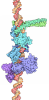
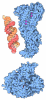
- Assembly
| Deposited unit | 
|
|---|---|
| 1 |
|
-Components
| #1: Protein | Mass: 64912.172 Da / Num. of mol.: 2 Source method: isolated from a genetically manipulated source Source: (gene. exp.) Homo sapiens (human) / Gene: EEPD1, KIAA1706 / Production host:   Escherichia coli (E. coli) / References: UniProt: Q7L9B9 Escherichia coli (E. coli) / References: UniProt: Q7L9B9Has protein modification | N | |
|---|
-Experimental details
-Experiment
| Experiment | Method: ELECTRON MICROSCOPY |
|---|---|
| EM experiment | Aggregation state: PARTICLE / 3D reconstruction method: single particle reconstruction |
- Sample preparation
| Component | Name: Human endonuclease/exonuclease/phosphatase family domain-containing protein 1 Type: COMPLEX / Entity ID: all / Source: RECOMBINANT |
|---|---|
| Molecular weight | Value: 0.065 MDa / Experimental value: NO |
| Source (natural) | Organism: Homo sapiens (human) |
| Source (recombinant) | Organism: Escherichia coli BL21(DE3) (bacteria) / Strain: Rosetta2 |
| Buffer solution | pH: 9 |
| Specimen | Embedding applied: NO / Shadowing applied: NO / Staining applied: NO / Vitrification applied: YES |
| Specimen support | Grid material: GOLD / Grid mesh size: 300 divisions/in. / Grid type: Quantifoil R1.2/1.3 |
| Vitrification | Instrument: FEI VITROBOT MARK IV / Cryogen name: ETHANE / Humidity: 100 % / Chamber temperature: 277.15 K |
- Electron microscopy imaging
| Experimental equipment |  Model: Titan Krios / Image courtesy: FEI Company |
|---|---|
| Microscopy | Model: TFS KRIOS |
| Electron gun | Electron source:  FIELD EMISSION GUN / Accelerating voltage: 300 kV / Illumination mode: FLOOD BEAM FIELD EMISSION GUN / Accelerating voltage: 300 kV / Illumination mode: FLOOD BEAM |
| Electron lens | Mode: BRIGHT FIELD / Nominal defocus max: 2000 nm / Nominal defocus min: 800 nm / Cs: 2.7 mm |
| Image recording | Electron dose: 50 e/Å2 / Film or detector model: GATAN K3 (6k x 4k) / Num. of grids imaged: 1 / Num. of real images: 2745 |
- Processing
| EM software |
| ||||||||||||||||||||||||
|---|---|---|---|---|---|---|---|---|---|---|---|---|---|---|---|---|---|---|---|---|---|---|---|---|---|
| CTF correction | Type: PHASE FLIPPING AND AMPLITUDE CORRECTION | ||||||||||||||||||||||||
| Symmetry | Point symmetry: C2 (2 fold cyclic) | ||||||||||||||||||||||||
| 3D reconstruction | Resolution: 3.6 Å / Resolution method: FSC 0.143 CUT-OFF / Num. of particles: 46575 / Symmetry type: POINT | ||||||||||||||||||||||||
| Atomic model building | Protocol: RIGID BODY FIT / Space: REAL | ||||||||||||||||||||||||
| Refinement | Cross valid method: NONE Stereochemistry target values: GeoStd + Monomer Library + CDL v1.2 | ||||||||||||||||||||||||
| Displacement parameters | Biso mean: 90.42 Å2 | ||||||||||||||||||||||||
| Refine LS restraints |
|
