 Movie
Movie Controller

[English] 日本語
 Yorodumi
- PDB-9ya9: Cryo-EM structure of ternary complex BCL6-CRBN-DDB1 with BMS-9864... -
+ Open data

- Basic information
| Entry | Database: PDB / ID: 9ya9 | ||||||||||||||||||||||||||||||
|---|---|---|---|---|---|---|---|---|---|---|---|---|---|---|---|---|---|---|---|---|---|---|---|---|---|---|---|---|---|---|---|
| Title | Cryo-EM structure of ternary complex BCL6-CRBN-DDB1 with BMS-986458 (local refined), a potent and selective BCL6 ligand directed degrader (LDD) | ||||||||||||||||||||||||||||||
 Components Components |
| ||||||||||||||||||||||||||||||
 Keywords Keywords | LIGASE / Cereblon / BCL6 / LDD / degrader / E3 | ||||||||||||||||||||||||||||||
| Function / homology |  Function and homology information Function and homology informationnegative regulation of monoatomic ion transmembrane transport / negative regulation of mitotic cell cycle DNA replication / intronic transcription regulatory region sequence-specific DNA binding / regulation of germinal center formation / paraspeckles / negative regulation of B cell apoptotic process / regulation of immune system process / type 2 immune response / positive regulation of regulatory T cell differentiation / FOXO-mediated transcription of cell death genes ...negative regulation of monoatomic ion transmembrane transport / negative regulation of mitotic cell cycle DNA replication / intronic transcription regulatory region sequence-specific DNA binding / regulation of germinal center formation / paraspeckles / negative regulation of B cell apoptotic process / regulation of immune system process / type 2 immune response / positive regulation of regulatory T cell differentiation / FOXO-mediated transcription of cell death genes / locomotory exploration behavior / TP53 regulates transcription of several additional cell death genes whose specific roles in p53-dependent apoptosis remain uncertain / Cul4A-RING E3 ubiquitin ligase complex / regulation of cell differentiation / Cul4B-RING E3 ubiquitin ligase complex / limb development / regulation of immune response / positive regulation of Wnt signaling pathway / negative regulation of protein-containing complex assembly / regulation of cytokine production / transcription corepressor binding / positive regulation of protein-containing complex assembly / chromatin DNA binding / negative regulation of cell growth / DNA-binding transcription repressor activity, RNA polymerase II-specific / sequence-specific double-stranded DNA binding / regulation of inflammatory response / regulation of cell population proliferation / Interleukin-4 and Interleukin-13 signaling / DNA-binding transcription factor binding / sequence-specific DNA binding / Potential therapeutics for SARS / proteasome-mediated ubiquitin-dependent protein catabolic process / transmembrane transporter binding / protein ubiquitination / RNA polymerase II cis-regulatory region sequence-specific DNA binding / positive regulation of apoptotic process / DNA-binding transcription factor activity / negative regulation of DNA-templated transcription / chromatin binding / DNA damage response / negative regulation of transcription by RNA polymerase II / perinuclear region of cytoplasm / nucleoplasm / membrane / identical protein binding / nucleus / cytosol / cytoplasm Similarity search - Function | ||||||||||||||||||||||||||||||
| Biological species |  Homo sapiens (human) Homo sapiens (human) | ||||||||||||||||||||||||||||||
| Method | ELECTRON MICROSCOPY / single particle reconstruction / cryo EM / Resolution: 3.09 Å | ||||||||||||||||||||||||||||||
 Authors Authors | Zhu, J. / Fang, W. / Pagarigan, B. | ||||||||||||||||||||||||||||||
| Funding support | 1items
| ||||||||||||||||||||||||||||||
 Citation Citation | Journal: J Med Chem / Year: 2026 Title: Discovery of BMS-986458, a Potent and Selective B-Cell Lymphoma 6 Protein Ligand-Directed Degrader, for the Treatment of B-Cell Non-Hodgkin Lymphoma. Authors: Deborah S Mortensen / Hunter P Shunatona / Natalie Holmberg-Douglas / Jayce Rhodes / Diogo Da Silva / Jim Gamez / Matt Groza / Jinyi Zhu / Andy Christoforou / Scott A Johnson / Godrej ...Authors: Deborah S Mortensen / Hunter P Shunatona / Natalie Holmberg-Douglas / Jayce Rhodes / Diogo Da Silva / Jim Gamez / Matt Groza / Jinyi Zhu / Andy Christoforou / Scott A Johnson / Godrej Khambatta / Rama Krishna Narla / Roshan Y Nimje / Dehua Huang / Dharmpal S Dodd / Jennifer Griffin / Giulianna Miseo / Brandon Whitefield / Dahlia R Weiss / James Rader / Elif Kuzu / Jim Leisten / Chon Lai / Lihong Shi / Joselyn Del Rosario / Deepak Dalvie / Mark Rolfe / Christoph W Zapf / Peter Belmont / Matt Alexander / Neil Bence / Lynda Groocock /   Abstract: B-cell lymphoma 6 protein (BCL6) is an oncogenic driver dysregulated and overexpressed in subtypes of high-risk non-Hodgkin lymphoma (NHL). Development of agents that induce the targeted degradation ...B-cell lymphoma 6 protein (BCL6) is an oncogenic driver dysregulated and overexpressed in subtypes of high-risk non-Hodgkin lymphoma (NHL). Development of agents that induce the targeted degradation of BCL6 would offer a promising novel therapeutic approach. For this purpose, we employed ligand-directed degraders, heterobifunctional molecules linking a BCL6-binding ligand to a cereblon recruiter, enabling cereblon-mediated BCL6 degradation. Through a focused optimization effort, we identified highly potent BCL6 degraders, culminating in the selection of BMS-986458 for clinical development. BMS-986458 induces rapid cereblon-dependent BCL6 degradation while sparing known CRBN neosubstrates such as CK1α, GSPT1, Aiolos, Ikaros, or SALL4. Oral administration of BMS-986458 results in dose-dependent pharmacokinetics, pharmacodynamics, and significant antitumor efficacy in mouse models of lymphoma. A potential first-in-class agent, BMS-986458, is currently being evaluated in a phase 1/2 clinical trial (NCT06090539) for patients with relapsed/refractory NHL. | ||||||||||||||||||||||||||||||
| History |
|
- Structure visualization
| Structure viewer | Molecule: MolmilJmol/JSmol |
|---|
- Downloads & links
-Download
| PDBx/mmCIF format | 9ya9.cif.gz | 228.2 KB | Display | PDBx/mmCIF format |
|---|---|---|---|---|
| PDB format | pdb9ya9.ent.gz | Display | PDB format | |
| PDBx/mmJSON format | 9ya9.json.gz | Tree view | PDBx/mmJSON format | |
| Others |  Other downloads Other downloads |
-Validation report
| Arichive directory | https://data.pdbj.org/pub/pdb/validation_reports/ya/9ya9ftp://data.pdbj.org/pub/pdb/validation_reports/ya/9ya9 | HTTPS FTP |
|---|
-Related structure data
| Related structure data |  72725MC M: map data used to model this data C: citing same article ( |
|---|---|
| Similar structure data |
-Links
 PDBj
PDBj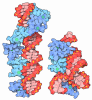
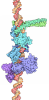
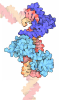
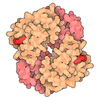
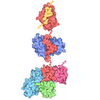

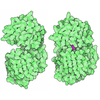
- Assembly
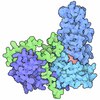
| Deposited unit | 
|
|---|---|
| 1 |
|
-Components
| #1: Protein | Mass: 16431.863 Da / Num. of mol.: 2 Source method: isolated from a genetically manipulated source Source: (gene. exp.) Homo sapiens (human) / Gene: BCL6, BCL5, LAZ3, ZBTB27, ZNF51 / Plasmid: pMAL-c5x / Cell (production host): BL21 DE3 / Production host:   Escherichia coli (E. coli) / References: UniProt: P41182 Escherichia coli (E. coli) / References: UniProt: P41182#2: Protein | | Mass: 53581.984 Da / Num. of mol.: 1 Source method: isolated from a genetically manipulated source Source: (gene. exp.) Homo sapiens (human) / Gene: CRBN, AD-006 / Cell (production host): sf9 / Production host:   Spodoptera frugiperda (fall armyworm) / References: UniProt: Q96SW2 Spodoptera frugiperda (fall armyworm) / References: UniProt: Q96SW2#3: Chemical | ChemComp-A1CTU / ( | Mass: 628.124 Da / Num. of mol.: 1 / Source method: obtained synthetically / Formula: C32H34ClN9O3 / Feature type: SUBJECT OF INVESTIGATION #4: Chemical | ChemComp-ZN / |   Mass: 65.409 Da / Num. of mol.: 1 / Source method: obtained synthetically / Formula: Zn Mass: 65.409 Da / Num. of mol.: 1 / Source method: obtained synthetically / Formula: ZnHas ligand of interest | Y | Has protein modification | N | |
|---|
-Experimental details
-Experiment
| Experiment | Method: ELECTRON MICROSCOPY |
|---|---|
| EM experiment | Aggregation state: PARTICLE / 3D reconstruction method: single particle reconstruction |
- Sample preparation
| Component | Name: ternary complex of BCL6-CRBN-DDB1 with an LDD BMS-986458 Type: COMPLEX Details: BCL6 BTB domain and CRBN/DDB1 was mixed with BMS-986458 in 1:1:2 ratio Entity ID: #1-#2 / Source: MULTIPLE SOURCES | ||||||||||||||||||||||||||||||
|---|---|---|---|---|---|---|---|---|---|---|---|---|---|---|---|---|---|---|---|---|---|---|---|---|---|---|---|---|---|---|---|
| Molecular weight | Value: 0.162 MDa / Experimental value: NO | ||||||||||||||||||||||||||||||
| Source (natural) | Organism: Homo sapiens (human) | ||||||||||||||||||||||||||||||
| Source (recombinant) | Organism: Spodoptera frugiperda (fall armyworm) | ||||||||||||||||||||||||||||||
| Buffer solution | pH: 7 | ||||||||||||||||||||||||||||||
| Buffer component |
| ||||||||||||||||||||||||||||||
| Specimen | Conc.: 4 mg/ml / Embedding applied: NO / Shadowing applied: NO / Staining applied: NO / Vitrification applied: YES | ||||||||||||||||||||||||||||||
| Specimen support | Grid material: GOLD / Grid mesh size: 300 divisions/in. / Grid type: Quantifoil R1.2/1.3 | ||||||||||||||||||||||||||||||
| Vitrification | Instrument: FEI VITROBOT MARK IV / Cryogen name: ETHANE / Humidity: 100 % / Chamber temperature: 278 K |
- Electron microscopy imaging
| Experimental equipment |  Model: Titan Krios / Image courtesy: FEI Company |
|---|---|
| Microscopy | Model: TFS KRIOS |
| Electron gun | Electron source:  FIELD EMISSION GUN / Accelerating voltage: 300 kV / Illumination mode: FLOOD BEAM FIELD EMISSION GUN / Accelerating voltage: 300 kV / Illumination mode: FLOOD BEAM |
| Electron lens | Mode: BRIGHT FIELD / Nominal magnification: 130000 X / Nominal defocus max: 1900 nm / Nominal defocus min: 1300 nm / Cs: 2.7 mm / Alignment procedure: COMA FREE |
| Specimen holder | Cryogen: NITROGEN / Specimen holder model: FEI TITAN KRIOS AUTOGRID HOLDER |
| Image recording | Average exposure time: 3.66 sec. / Electron dose: 40 e/Å2 / Film or detector model: TFS FALCON 4i (4k x 4k) / Num. of grids imaged: 1 / Num. of real images: 11500 |
- Processing
| EM software |
| |||||||||||||||||||||||||||
|---|---|---|---|---|---|---|---|---|---|---|---|---|---|---|---|---|---|---|---|---|---|---|---|---|---|---|---|---|
| CTF correction | Type: PHASE FLIPPING AND AMPLITUDE CORRECTION | |||||||||||||||||||||||||||
| Particle selection | Num. of particles selected: 19671274 | |||||||||||||||||||||||||||
| Symmetry | Point symmetry: C1 (asymmetric) | |||||||||||||||||||||||||||
| 3D reconstruction | Resolution: 3.09 Å / Resolution method: FSC 0.143 CUT-OFF / Num. of particles: 202942 / Algorithm: FOURIER SPACE / Num. of class averages: 2 / Symmetry type: POINT | |||||||||||||||||||||||||||
| Atomic model building | Protocol: RIGID BODY FIT / Space: REAL | |||||||||||||||||||||||||||
| Atomic model building | PDB-ID: pdb_00009q03 Accession code: pdb_00009q03 / Source name: PDB / Type: experimental model | |||||||||||||||||||||||||||
| Refinement | Highest resolution: 3.09 Å Stereochemistry target values: REAL-SPACE (WEIGHTED MAP SUM AT ATOM CENTERS) | |||||||||||||||||||||||||||
| Refine LS restraints |
|
