negative regulation of monoatomic ion transmembrane transport / negative regulation of mitotic cell cycle DNA replication / intronic transcription regulatory region sequence-specific DNA binding / regulation of germinal center formation / paraspeckles / negative regulation of B cell apoptotic process / regulation of immune system process / type 2 immune response / positive regulation of regulatory T cell differentiation / FOXO-mediated transcription of cell death genes ...negative regulation of monoatomic ion transmembrane transport / negative regulation of mitotic cell cycle DNA replication / intronic transcription regulatory region sequence-specific DNA binding / regulation of germinal center formation / paraspeckles / negative regulation of B cell apoptotic process / regulation of immune system process / type 2 immune response / positive regulation of regulatory T cell differentiation / FOXO-mediated transcription of cell death genes / locomotory exploration behavior / TP53 regulates transcription of several additional cell death genes whose specific roles in p53-dependent apoptosis remain uncertain / Cul4A-RING E3 ubiquitin ligase complex / regulation of cell differentiation / Cul4B-RING E3 ubiquitin ligase complex / limb development / regulation of immune response / positive regulation of Wnt signaling pathway / negative regulation of protein-containing complex assembly / regulation of cytokine production / transcription corepressor binding / positive regulation of protein-containing complex assembly / chromatin DNA binding / negative regulation of cell growth / DNA-binding transcription repressor activity, RNA polymerase II-specific / sequence-specific double-stranded DNA binding / regulation of inflammatory response / regulation of cell population proliferation / Interleukin-4 and Interleukin-13 signaling / DNA-binding transcription factor binding / sequence-specific DNA binding / Potential therapeutics for SARS / proteasome-mediated ubiquitin-dependent protein catabolic process / transmembrane transporter binding / protein ubiquitination / RNA polymerase II cis-regulatory region sequence-specific DNA binding / positive regulation of apoptotic process / DNA-binding transcription factor activity / negative regulation of DNA-templated transcription / chromatin binding / DNA damage response / negative regulation of transcription by RNA polymerase II / perinuclear region of cytoplasm / nucleoplasm / membrane / identical protein binding / nucleus / cytosol / cytoplasm Similarity search - Function
Journal: J Med Chem / Year: 2026 Title: Discovery of BMS-986458, a Potent and Selective B-Cell Lymphoma 6 Protein Ligand-Directed Degrader, for the Treatment of B-Cell Non-Hodgkin Lymphoma. Authors: Deborah S Mortensen / Hunter P Shunatona / Natalie Holmberg-Douglas / Jayce Rhodes / Diogo Da Silva / Jim Gamez / Matt Groza / Jinyi Zhu / Andy Christoforou / Scott A Johnson / Godrej ...Authors: Deborah S Mortensen / Hunter P Shunatona / Natalie Holmberg-Douglas / Jayce Rhodes / Diogo Da Silva / Jim Gamez / Matt Groza / Jinyi Zhu / Andy Christoforou / Scott A Johnson / Godrej Khambatta / Rama Krishna Narla / Roshan Y Nimje / Dehua Huang / Dharmpal S Dodd / Jennifer Griffin / Giulianna Miseo / Brandon Whitefield / Dahlia R Weiss / James Rader / Elif Kuzu / Jim Leisten / Chon Lai / Lihong Shi / Joselyn Del Rosario / Deepak Dalvie / Mark Rolfe / Christoph W Zapf / Peter Belmont / Matt Alexander / Neil Bence / Lynda Groocock / Abstract: B-cell lymphoma 6 protein (BCL6) is an oncogenic driver dysregulated and overexpressed in subtypes of high-risk non-Hodgkin lymphoma (NHL). Development of agents that induce the targeted degradation ...B-cell lymphoma 6 protein (BCL6) is an oncogenic driver dysregulated and overexpressed in subtypes of high-risk non-Hodgkin lymphoma (NHL). Development of agents that induce the targeted degradation of BCL6 would offer a promising novel therapeutic approach. For this purpose, we employed ligand-directed degraders, heterobifunctional molecules linking a BCL6-binding ligand to a cereblon recruiter, enabling cereblon-mediated BCL6 degradation. Through a focused optimization effort, we identified highly potent BCL6 degraders, culminating in the selection of BMS-986458 for clinical development. BMS-986458 induces rapid cereblon-dependent BCL6 degradation while sparing known CRBN neosubstrates such as CK1α, GSPT1, Aiolos, Ikaros, or SALL4. Oral administration of BMS-986458 results in dose-dependent pharmacokinetics, pharmacodynamics, and significant antitumor efficacy in mouse models of lymphoma. A potential first-in-class agent, BMS-986458, is currently being evaluated in a phase 1/2 clinical trial (NCT06090539) for patients with relapsed/refractory NHL.
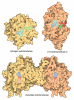
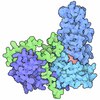
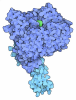
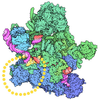
Supramolecule #1: ternary complex of BCL6-CRBN-DDB1 with an LDD BMS-986458
Supramolecule
Name: ternary complex of BCL6-CRBN-DDB1 with an LDD BMS-986458 type: complex / ID: 1 / Parent: 0 / Macromolecule list: #1-#2 Details: BCL6 BTB domain and CRBN/DDB1 was mixed with BMS-986458 in 1:1:2 ratio
Source (natural)
Organism: Homo sapiens (human)
Molecular weight
Theoretical: 162 KDa
-
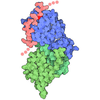
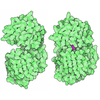
Macromolecule #1: B-cell lymphoma 6 protein
Macromolecule
Name: B-cell lymphoma 6 protein / type: protein_or_peptide / ID: 1 / Number of copies: 2 / Enantiomer: LEVO
Model: Quantifoil R1.2/1.3 / Material: GOLD / Mesh: 300 / Support film - Material: GOLD / Support film - topology: HOLEY / Pretreatment - Type: GLOW DISCHARGE / Pretreatment - Time: 30 sec.
Vitrification
Cryogen name: ETHANE / Chamber humidity: 100 % / Chamber temperature: 278 K / Instrument: FEI VITROBOT MARK IV
-
Electron microscopy
Microscope
TFS KRIOS
Image recording
Film or detector model: TFS FALCON 4i (4k x 4k) / Number grids imaged: 1 / Number real images: 11500 / Average exposure time: 3.66 sec. / Average electron dose: 40.0 e/Å2
Electron beam
Acceleration voltage: 300 kV / Electron source: FIELD EMISSION GUN
Chain - Source name: PDB / Chain - Initial model type: experimental model
Refinement
Space: REAL / Protocol: RIGID BODY FIT
Output model
PDB-9ya9: Cryo-EM structure of ternary complex BCL6-CRBN-DDB1 with BMS-986458 (local refined), a potent and selective BCL6 ligand directed degrader (LDD)
+
About Yorodumi
-
News
-
Feb 9, 2022. New format data for meta-information of EMDB entries
New format data for meta-information of EMDB entries
Version 3 of the EMDB header file is now the official format.
The previous official version 1.9 will be removed from the archive.
In the structure databanks used in Yorodumi, some data are registered as the other names, "COVID-19 virus" and "2019-nCoV". Here are the details of the virus and the list of structure data.
Jan 31, 2019. EMDB accession codes are about to change! (news from PDBe EMDB page)
EMDB accession codes are about to change! (news from PDBe EMDB page)
The allocation of 4 digits for EMDB accession codes will soon come to an end. Whilst these codes will remain in use, new EMDB accession codes will include an additional digit and will expand incrementally as the available range of codes is exhausted. The current 4-digit format prefixed with “EMD-” (i.e. EMD-XXXX) will advance to a 5-digit format (i.e. EMD-XXXXX), and so on. It is currently estimated that the 4-digit codes will be depleted around Spring 2019, at which point the 5-digit format will come into force.
The EM Navigator/Yorodumi systems omit the EMD- prefix.
Related info.:Q: What is EMD? / ID/Accession-code notation in Yorodumi/EM Navigator
Yorodumi is a browser for structure data from EMDB, PDB, SASBDB, etc.
This page is also the successor to EM Navigator detail page, and also detail information page/front-end page for Omokage search.
The word "yorodu" (or yorozu) is an old Japanese word meaning "ten thousand". "mi" (miru) is to see.
Related info.:EMDB / PDB / SASBDB / Comparison of 3 databanks / Yorodumi Search / Aug 31, 2016. New EM Navigator & Yorodumi / Yorodumi Papers / Jmol/JSmol / Function and homology information / Changes in new EM Navigator and Yorodumi
 Movie
Movie Controller

 Yorodumi
 Open data
 Basic information
 Map data
 Sample
 Keywords
 Function and homology information
 Homo sapiens (human)
 Authors
 Citation

 Structure visualization
 Downloads & links
 emd_72725.png
 https://data.pdbj.org/pub/emdb/structures/EMD-72725
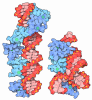

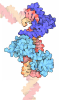
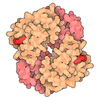

 Z (Sec.)
 Y (Row.)
 X (Col.)


 Sample components
 Escherichia coli (E. coli)
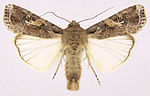 Spodoptera frugiperda (fall armyworm)
 Processing
 Electron microscopy
 FIELD EMISSION GUN


