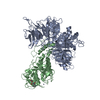
Movie
Movie Controller

[English] 日本語
 Yorodumi
- PDB-9y61: Cryo-EM structure of ternary complex NSD2-PWWP1:CRBN:DDB1 in comp... -
+ Open data

- Basic information
| Entry | Database: PDB / ID: 9y61 | |||||||||||||||||||||||||||
|---|---|---|---|---|---|---|---|---|---|---|---|---|---|---|---|---|---|---|---|---|---|---|---|---|---|---|---|---|
| Title | Cryo-EM structure of ternary complex NSD2-PWWP1:CRBN:DDB1 in complex with NSD2-LDD, an LDD degrader | |||||||||||||||||||||||||||
 Components Components |
| |||||||||||||||||||||||||||
 Keywords Keywords | LIGASE / Cereblon / degrader / DDB1 / NSD2 / PWWP1 / LDD | |||||||||||||||||||||||||||
| Function / homology |  Function and homology information Function and homology information[histone H3]-lysine36 N-dimethyltransferase / histone H4K20 methyltransferase activity / histone H3K36 dimethyltransferase activity / histone H3K36 trimethyltransferase activity / histone H3K36 methyltransferase activity / negative regulation of monoatomic ion transmembrane transport / histone H3 methyltransferase activity / locomotory exploration behavior / Cul4A-RING E3 ubiquitin ligase complex / limb development ...[histone H3]-lysine36 N-dimethyltransferase / histone H4K20 methyltransferase activity / histone H3K36 dimethyltransferase activity / histone H3K36 trimethyltransferase activity / histone H3K36 methyltransferase activity / negative regulation of monoatomic ion transmembrane transport / histone H3 methyltransferase activity / locomotory exploration behavior / Cul4A-RING E3 ubiquitin ligase complex / limb development / positive regulation of Wnt signaling pathway / negative regulation of protein-containing complex assembly / Nonhomologous End-Joining (NHEJ) / positive regulation of protein-containing complex assembly / PKMTs methylate histone lysines / G2/M DNA damage checkpoint / double-strand break repair / Recruitment and ATM-mediated phosphorylation of repair and signaling proteins at DNA double strand breaks / Processing of DNA double-strand break ends / methylation / sequence-specific DNA binding / Potential therapeutics for SARS / proteasome-mediated ubiquitin-dependent protein catabolic process / transmembrane transporter binding / protein ubiquitination / chromatin binding / nucleolus / regulation of DNA-templated transcription / chromatin / perinuclear region of cytoplasm / DNA-templated transcription / nucleoplasm / zinc ion binding / membrane / metal ion binding / nucleus / cytosol / cytoplasm Similarity search - Function | |||||||||||||||||||||||||||
| Biological species |  Homo sapiens (human) Homo sapiens (human) | |||||||||||||||||||||||||||
| Method | ELECTRON MICROSCOPY / single particle reconstruction / cryo EM / Resolution: 3.1 Å | |||||||||||||||||||||||||||
 Authors Authors | Zhu, J. / Pagarigan, B.E. / Fang, W. | |||||||||||||||||||||||||||
| Funding support | 1items
| |||||||||||||||||||||||||||
 Citation Citation | Journal: Blood / Year: 2026 Title: NSD2 Degradation Remediates the Oncogenic Cistrome in t(4;14) Multiple Myeloma. Authors: Bo Hu / Jacob Edwards / Hardik Modi / Jim Gamez / Oscar Enrique Echeagaray / Kyle Hess / Yue Ren / Diana Anderson / Marta Larrayoz / Jinyi Zhu / Scott Arne Johnson / Gauri Deb / Diana ...Authors: Bo Hu / Jacob Edwards / Hardik Modi / Jim Gamez / Oscar Enrique Echeagaray / Kyle Hess / Yue Ren / Diana Anderson / Marta Larrayoz / Jinyi Zhu / Scott Arne Johnson / Gauri Deb / Diana Jankeel / Preethi Janardhanan / Jim Leisten / Sophie Peng / Andy Christoforou / Nicholas Stong / Celia Fontanillo / Chad C Bjorklund / Patrick Ryan Hagner / Anita Krithivas Gandhi / Jose A Martínez-Climent / Rama Krishna Narla / Antonia Lopez-Girona / Mark Rolfe / Neil Bence / Deborah S Mortensen / Lynda Groocock /   Abstract: The t(4;14) chromosomal translocation drives overexpression of the histone methyltransferase NSD2 and defines a high-risk segment of multiple myeloma (MM) patients. Herein, we report the discovery of ...The t(4;14) chromosomal translocation drives overexpression of the histone methyltransferase NSD2 and defines a high-risk segment of multiple myeloma (MM) patients. Herein, we report the discovery of NSD2-LDD, a cereblon-recruiting and PWWP1-mediated ligand directed degrader (LDD) that selectively and potently eliminates full length and PWWP1 domain containing NSD2 protein isoforms. NSD2-LDD treatment induces global loss of H3K36me2 leading to promoter-proximal spreading of H3K27me3 and re-wiring of cis-regulatory interactions that reverse t(4;14) transcriptional programs. These effects suppress MM disease-associated phenotypes including stromal adhesion, three-dimensional colony growth and paracrine signaling. By integrating patient single cell profiles with model 3D epigenomic and spatial transcriptomics, we delineate t(4;14) disease state together with the tumor-intrinsic reprogramming and resultant remodeling of the bone marrow microenvironment upon NSD2 degradation. In cell line derived xenografts and genetically engineered mouse models of t(4;14), NSD2-LDD extends median survival accompanied by tumoral H3K36me2 loss and niche re-modelling. Although the NSD2-LDD response is restricted to PWWP1-containining models, collectively this work validates NSD2 as a tractable dependency and supports clinical development of NSD2 degradation as a novel, targeted therapeutic strategy in high-risk MM. | |||||||||||||||||||||||||||
| History |
|
- Structure visualization
| Structure viewer | Molecule: MolmilJmol/JSmol |
|---|
- Downloads & links
-Download
| PDBx/mmCIF format | 9y61.cif.gz | 100.7 KB | Display | PDBx/mmCIF format |
|---|---|---|---|---|
| PDB format | pdb9y61.ent.gz | Display | PDB format | |
| PDBx/mmJSON format | 9y61.json.gz | Tree view | PDBx/mmJSON format | |
| Others |  Other downloads Other downloads |
-Validation report
| Arichive directory | https://data.pdbj.org/pub/pdb/validation_reports/y6/9y61ftp://data.pdbj.org/pub/pdb/validation_reports/y6/9y61 | HTTPS FTP |
|---|
-Related structure data
| Related structure data |  72526MC  9y60C M: map data used to model this data C: citing same article ( |
|---|---|
| Similar structure data |
-Links
 PDBj
PDBj
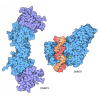
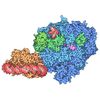
- Assembly
| Deposited unit | 
|
|---|---|
| 1 |
|
-Components
| #1: Protein | Mass: 19818.707 Da / Num. of mol.: 1 / Fragment: UNP residues 202-368 Source method: isolated from a genetically manipulated source Source: (gene. exp.) Homo sapiens (human) / Gene: NSD2, KIAA1090, MMSET, TRX5, WHSC1 / Production host:   Escherichia coli BL21(DE3) (bacteria) Escherichia coli BL21(DE3) (bacteria)References: UniProt: O96028, [histone H3]-lysine36 N-dimethyltransferase |
|---|---|
| #2: Protein | Mass: 53581.984 Da / Num. of mol.: 1 Source method: isolated from a genetically manipulated source Source: (gene. exp.) Homo sapiens (human) / Gene: CRBN, AD-006 / Cell (production host): sf9 / Production host:   Spodoptera frugiperda (fall armyworm) / References: UniProt: Q96SW2 Spodoptera frugiperda (fall armyworm) / References: UniProt: Q96SW2 |
| #3: Chemical | ChemComp-A1CSQ / Mass: 771.748 Da / Num. of mol.: 1 / Source method: obtained synthetically / Formula: C39H49Cl2FN6O5 / Feature type: SUBJECT OF INVESTIGATION |
| #4: Chemical | ChemComp-ZN /  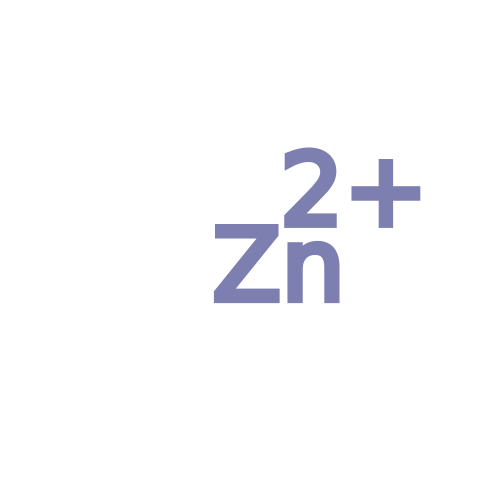 Mass: 65.409 Da / Num. of mol.: 1 / Source method: obtained synthetically / Formula: Zn Mass: 65.409 Da / Num. of mol.: 1 / Source method: obtained synthetically / Formula: Zn |
| Has ligand of interest | Y |
| Has protein modification | N |
-Experimental details
-Experiment
| Experiment | Method: ELECTRON MICROSCOPY |
|---|---|
| EM experiment | Aggregation state: PARTICLE / 3D reconstruction method: single particle reconstruction |
- Sample preparation
| Component | Name: Ternary complex NSD2-PWWP1:NSD2-LDD:CRBN:DDB1 / Type: COMPLEX Details: NSD2 PWWP1 domain, CRBN/DDB1 complex, and NSD2-LDD in 1:1:3 ratio Entity ID: #1-#2 / Source: MULTIPLE SOURCES | ||||||||||||||||||||||||||||||
|---|---|---|---|---|---|---|---|---|---|---|---|---|---|---|---|---|---|---|---|---|---|---|---|---|---|---|---|---|---|---|---|
| Molecular weight | Value: 0.166 MDa / Experimental value: NO | ||||||||||||||||||||||||||||||
| Source (natural) | Organism: Homo sapiens (human) | ||||||||||||||||||||||||||||||
| Source (recombinant) | Organism: Spodoptera frugiperda (fall armyworm) | ||||||||||||||||||||||||||||||
| Buffer solution | pH: 7 | ||||||||||||||||||||||||||||||
| Buffer component |
| ||||||||||||||||||||||||||||||
| Specimen | Conc.: 3.5 mg/ml / Embedding applied: NO / Shadowing applied: NO / Staining applied: NO / Vitrification applied: YES | ||||||||||||||||||||||||||||||
| Specimen support | Grid material: GOLD / Grid mesh size: 300 divisions/in. / Grid type: Quantifoil R0.6/1 | ||||||||||||||||||||||||||||||
| Vitrification | Instrument: FEI VITROBOT MARK IV / Cryogen name: ETHANE / Humidity: 100 % / Chamber temperature: 278 K / Details: blot time 4 sec blot force 4 |
- Electron microscopy imaging
| Experimental equipment |  Model: Titan Krios / Image courtesy: FEI Company |
|---|---|
| Microscopy | Model: TFS KRIOS |
| Electron gun | Electron source:  FIELD EMISSION GUN / Accelerating voltage: 300 kV / Illumination mode: FLOOD BEAM FIELD EMISSION GUN / Accelerating voltage: 300 kV / Illumination mode: FLOOD BEAM |
| Electron lens | Mode: BRIGHT FIELD / Nominal magnification: 75000 X / Nominal defocus max: 2500 nm / Nominal defocus min: 1500 nm / Cs: 2.7 mm / Alignment procedure: COMA FREE |
| Specimen holder | Cryogen: NITROGEN / Specimen holder model: FEI TITAN KRIOS AUTOGRID HOLDER |
| Image recording | Average exposure time: 3.49 sec. / Electron dose: 33.85 e/Å2 / Film or detector model: FEI FALCON IV (4k x 4k) / Num. of grids imaged: 1 / Num. of real images: 14049 |
- Processing
| EM software |
| ||||||||||||||||||||||||
|---|---|---|---|---|---|---|---|---|---|---|---|---|---|---|---|---|---|---|---|---|---|---|---|---|---|
| CTF correction | Type: PHASE FLIPPING AND AMPLITUDE CORRECTION | ||||||||||||||||||||||||
| Particle selection | Num. of particles selected: 14824032 | ||||||||||||||||||||||||
| Symmetry | Point symmetry: C1 (asymmetric) | ||||||||||||||||||||||||
| 3D reconstruction | Resolution: 3.1 Å / Resolution method: FSC 0.143 CUT-OFF / Num. of particles: 127545 / Algorithm: FOURIER SPACE / Num. of class averages: 1 / Symmetry type: POINT | ||||||||||||||||||||||||
| Atomic model building | Protocol: RIGID BODY FIT / Space: REAL | ||||||||||||||||||||||||
| Atomic model building | PDB-ID: 8D81 Accession code: 8D81 / Source name: PDB / Type: experimental model | ||||||||||||||||||||||||
| Refinement | Highest resolution: 3.1 Å Stereochemistry target values: REAL-SPACE (WEIGHTED MAP SUM AT ATOM CENTERS) | ||||||||||||||||||||||||
| Refine LS restraints |
|