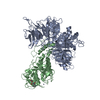
Journal: Blood / Year: 2026 Title: NSD2 Degradation Remediates the Oncogenic Cistrome in t(4;14) Multiple Myeloma. Authors: Bo Hu / Jacob Edwards / Hardik Modi / Jim Gamez / Oscar Enrique Echeagaray / Kyle Hess / Yue Ren / Diana Anderson / Marta Larrayoz / Jinyi Zhu / Scott Arne Johnson / Gauri Deb / Diana ...Authors: Bo Hu / Jacob Edwards / Hardik Modi / Jim Gamez / Oscar Enrique Echeagaray / Kyle Hess / Yue Ren / Diana Anderson / Marta Larrayoz / Jinyi Zhu / Scott Arne Johnson / Gauri Deb / Diana Jankeel / Preethi Janardhanan / Jim Leisten / Sophie Peng / Andy Christoforou / Nicholas Stong / Celia Fontanillo / Chad C Bjorklund / Patrick Ryan Hagner / Anita Krithivas Gandhi / Jose A Martínez-Climent / Rama Krishna Narla / Antonia Lopez-Girona / Mark Rolfe / Neil Bence / Deborah S Mortensen / Lynda Groocock / Abstract: The t(4;14) chromosomal translocation drives overexpression of the histone methyltransferase NSD2 and defines a high-risk segment of multiple myeloma (MM) patients. Herein, we report the discovery of ...The t(4;14) chromosomal translocation drives overexpression of the histone methyltransferase NSD2 and defines a high-risk segment of multiple myeloma (MM) patients. Herein, we report the discovery of NSD2-LDD, a cereblon-recruiting and PWWP1-mediated ligand directed degrader (LDD) that selectively and potently eliminates full length and PWWP1 domain containing NSD2 protein isoforms. NSD2-LDD treatment induces global loss of H3K36me2 leading to promoter-proximal spreading of H3K27me3 and re-wiring of cis-regulatory interactions that reverse t(4;14) transcriptional programs. These effects suppress MM disease-associated phenotypes including stromal adhesion, three-dimensional colony growth and paracrine signaling. By integrating patient single cell profiles with model 3D epigenomic and spatial transcriptomics, we delineate t(4;14) disease state together with the tumor-intrinsic reprogramming and resultant remodeling of the bone marrow microenvironment upon NSD2 degradation. In cell line derived xenografts and genetically engineered mouse models of t(4;14), NSD2-LDD extends median survival accompanied by tumoral H3K36me2 loss and niche re-modelling. Although the NSD2-LDD response is restricted to PWWP1-containining models, collectively this work validates NSD2 as a tractable dependency and supports clinical development of NSD2 degradation as a novel, targeted therapeutic strategy in high-risk MM.
Model: Quantifoil R0.6/1 / Material: GOLD / Mesh: 300 / Support film - Material: GOLD / Support film - topology: HOLEY / Pretreatment - Type: GLOW DISCHARGE / Pretreatment - Time: 30 sec.
Vitrification
Cryogen name: ETHANE / Chamber humidity: 100 % / Chamber temperature: 278 K / Instrument: FEI VITROBOT MARK IV / Details: blot time 4 sec blot force 4.
-
Electron microscopy
Microscope
TFS KRIOS
Image recording
Film or detector model: FEI FALCON IV (4k x 4k) / Number grids imaged: 1 / Number real images: 14049 / Average exposure time: 3.49 sec. / Average electron dose: 33.85 e/Å2
Electron beam
Acceleration voltage: 300 kV / Electron source: FIELD EMISSION GUN
In the structure databanks used in Yorodumi, some data are registered as the other names, "COVID-19 virus" and "2019-nCoV". Here are the details of the virus and the list of structure data.
Jan 31, 2019. EMDB accession codes are about to change! (news from PDBe EMDB page)
EMDB accession codes are about to change! (news from PDBe EMDB page)
The allocation of 4 digits for EMDB accession codes will soon come to an end. Whilst these codes will remain in use, new EMDB accession codes will include an additional digit and will expand incrementally as the available range of codes is exhausted. The current 4-digit format prefixed with “EMD-” (i.e. EMD-XXXX) will advance to a 5-digit format (i.e. EMD-XXXXX), and so on. It is currently estimated that the 4-digit codes will be depleted around Spring 2019, at which point the 5-digit format will come into force.
The EM Navigator/Yorodumi systems omit the EMD- prefix.
Related info.:Q: What is EMD? / ID/Accession-code notation in Yorodumi/EM Navigator
Yorodumi is a browser for structure data from EMDB, PDB, SASBDB, etc.
This page is also the successor to EM Navigator detail page, and also detail information page/front-end page for Omokage search.
The word "yorodu" (or yorozu) is an old Japanese word meaning "ten thousand". "mi" (miru) is to see.
Related info.:EMDB / PDB / SASBDB / Comparison of 3 databanks / Yorodumi Search / Aug 31, 2016. New EM Navigator & Yorodumi / Yorodumi Papers / Jmol/JSmol / Function and homology information / Changes in new EM Navigator and Yorodumi
 Movie
Movie Controller

 Yorodumi
 Open data
 Basic information
 Map data
 Sample
 Keywords
 Function and homology information
 Homo sapiens (human)
 Authors
 Citation

 Structure visualization
 Downloads & links
 emd_72526.png
 https://data.pdbj.org/pub/emdb/structures/EMD-72526

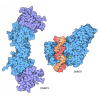
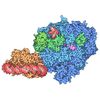
 Z (Sec.)
 Y (Row.)
 X (Col.)


 Sample components
 Escherichia coli BL21(DE3) (bacteria)
 Spodoptera frugiperda (fall armyworm)
 Processing
 Electron microscopy
 FIELD EMISSION GUN