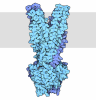
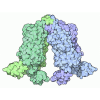
Journal: PLoS Biol / Year: 2026 Title: Structures of the human glucose-6-phosphate transporter provide insights into its transport cycle and substrate recognition. Authors: Wanqin Zhang / Haizhan Jiao / Jingchuan Xue / Jiao Zhou / Yuye Wang / Qi Pan / Yuting Guo / Geshu Zhang / Hongli Hu / Xue Guo / Abstract: The human glucose-6-phosphate transporter (G6PT/SLC37A4) mediates the translocation of glucose-6-phosphate (G6P) from the cytoplasm into the endoplasmic reticulum, a process essential for glucose ...The human glucose-6-phosphate transporter (G6PT/SLC37A4) mediates the translocation of glucose-6-phosphate (G6P) from the cytoplasm into the endoplasmic reticulum, a process essential for glucose production and the maintenance of blood glucose homeostasis between meals. Dysfunction of G6PT causes glycogen storage disease type Ib (GSD-Ib), a severe metabolic disorder characterized by hypoglycemia, hepatomegaly, and neutropenia. Despite its physiological and clinical significance, the structural basis of G6P recognition and the molecular mechanisms underlying GSD-Ib have remained elusive. Here, we present cryo-electron microscopy structures of human G6PT, revealing a monomer in an outward-open state at 3.1 Å and a homodimeric assembly in a face-to-face topology at 3.3 Å. By combining computational modeling of the G6P-G6PT complexes with functional characterization, we have uncovered the key molecular elements that govern the alternating-access mechanism: an electropositive substrate-binding pocket tailored for phosphorylated sugars; conserved aromatic residues that seal the cytosolic gate; and a dynamic inter-domain salt bridge that regulates the conformational transition. Our work provides fundamental insights into the transport cycle of the organophosphate:phosphate antiporter (OPA) family, offers a framework for interpreting GSD-Ib pathology at the molecular level, and establishes a foundation for advancing the mechanistic understanding of the human SLC37 family.
History
Deposition
Oct 25, 2025
Deposition site: PDBJ / Processing site: PDBC
Revision 1.0
Mar 18, 2026
Provider: repository / Type: Initial release
Revision 1.0
Mar 18, 2026
Data content type: EM metadata / Data content type: EM metadata / Provider: repository / Type: Initial release
Revision 1.0
Mar 18, 2026
Data content type: Additional map / Part number: 1 / Data content type: Additional map / Provider: repository / Type: Initial release
Revision 1.0
Mar 18, 2026
Data content type: FSC / Data content type: FSC / Provider: repository / Type: Initial release
Revision 1.0
Mar 18, 2026
Data content type: Half map / Part number: 1 / Data content type: Half map / Provider: repository / Type: Initial release
Revision 1.0
Mar 18, 2026
Data content type: Half map / Part number: 2 / Data content type: Half map / Provider: repository / Type: Initial release
Revision 1.0
Mar 18, 2026
Data content type: Image / Data content type: Image / Provider: repository / Type: Initial release
Revision 1.0
Mar 18, 2026
Data content type: Primary map / Data content type: Primary map / Provider: repository / Type: Initial release
Data content type: EM metadata / Data content type: EM metadata / EM metadata / Group: Database references / Experimental summary / Data content type: EM metadata / EM metadata / EM metadata / Category: citation / citation_author / em_admin Data content type: EM metadata / EM metadata ...EM metadata / EM metadata / EM metadata / EM metadata / EM metadata / EM metadata / EM metadata / EM metadata / EM metadata / EM metadata / EM metadata / EM metadata Item: _citation.country / _citation.journal_abbrev ..._citation.country / _citation.journal_abbrev / _citation.journal_id_CSD / _citation.journal_id_ISSN / _citation.journal_volume / _citation.page_first / _citation.page_last / _citation.pdbx_database_id_DOI / _citation.pdbx_database_id_PubMed / _citation.title / _citation.year / _em_admin.last_update
In the structure databanks used in Yorodumi, some data are registered as the other names, "COVID-19 virus" and "2019-nCoV". Here are the details of the virus and the list of structure data.
Jan 31, 2019. EMDB accession codes are about to change! (news from PDBe EMDB page)
EMDB accession codes are about to change! (news from PDBe EMDB page)
The allocation of 4 digits for EMDB accession codes will soon come to an end. Whilst these codes will remain in use, new EMDB accession codes will include an additional digit and will expand incrementally as the available range of codes is exhausted. The current 4-digit format prefixed with “EMD-” (i.e. EMD-XXXX) will advance to a 5-digit format (i.e. EMD-XXXXX), and so on. It is currently estimated that the 4-digit codes will be depleted around Spring 2019, at which point the 5-digit format will come into force.
The EM Navigator/Yorodumi systems omit the EMD- prefix.
Related info.:Q: What is EMD? / ID/Accession-code notation in Yorodumi/EM Navigator
Yorodumi is a browser for structure data from EMDB, PDB, SASBDB, etc.
This page is also the successor to EM Navigator detail page, and also detail information page/front-end page for Omokage search.
The word "yorodu" (or yorozu) is an old Japanese word meaning "ten thousand". "mi" (miru) is to see.
Related info.:EMDB / PDB / SASBDB / Comparison of 3 databanks / Yorodumi Search / Aug 31, 2016. New EM Navigator & Yorodumi / Yorodumi Papers / Jmol/JSmol / Function and homology information / Changes in new EM Navigator and Yorodumi
 Movie
Movie Controller


 Open data
 Basic information
 Components
 Keywords
 Function and homology information
 Homo sapiens (human)
 Authors
 Citation
 Structure visualization
 Downloads & links
 Other downloads


 PDBj
PDBj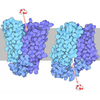
 Assembly
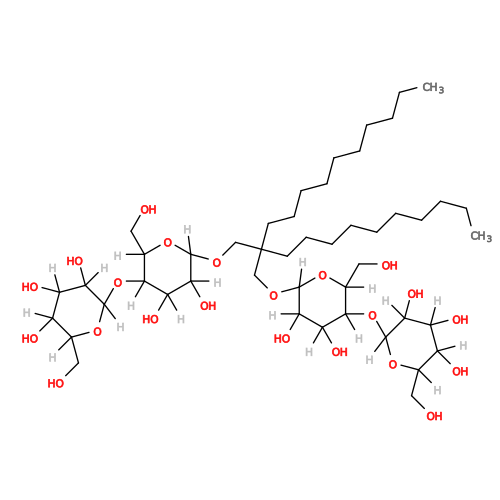 Mass: 1005.188 Da / Num. of mol.: 2 / Source method: obtained synthetically / Formula: C47H88O22 / Comment: detergent*YM
 Sample preparation
 Aequorea victoria (jellyfish)
 Electron microscopy imaging
 FIELD EMISSION GUN / Accelerating voltage: 300 kV / Illumination mode: FLOOD BEAM
 Processing