 ムービー
ムービー コントローラー


+ データを開く

- 基本情報
基本情報
| 登録情報 | データベース: PDB / ID: 9wp9 | ||||||
|---|---|---|---|---|---|---|---|
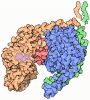
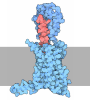
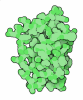
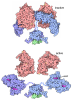
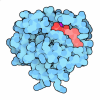
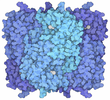
| タイトル | Cryo-EM structure of the d18:1 S1P-bound S1PR3 and Gq complex | ||||||
 要素 要素 |
| ||||||
 キーワード キーワード | MEMBRANE PROTEIN / GPCR / SBDD / lipid | ||||||
| 機能・相同性 |  機能・相同性情報 機能・相同性情報negative regulation of establishment of endothelial barrier / sphingosine-1-phosphate receptor activity / Lysosphingolipid and LPA receptors / regulation of interleukin-1 beta production / regulation of metabolic process / anatomical structure morphogenesis / Notch signaling pathway / G protein-coupled receptor activity / adenylate cyclase-inhibiting G protein-coupled receptor signaling pathway / integrin binding ...negative regulation of establishment of endothelial barrier / sphingosine-1-phosphate receptor activity / Lysosphingolipid and LPA receptors / regulation of interleukin-1 beta production / regulation of metabolic process / anatomical structure morphogenesis / Notch signaling pathway / G protein-coupled receptor activity / adenylate cyclase-inhibiting G protein-coupled receptor signaling pathway / integrin binding / adenylate cyclase-activating G protein-coupled receptor signaling pathway / Olfactory Signaling Pathway / Activation of the phototransduction cascade / G beta:gamma signalling through PLC beta / Presynaptic function of Kainate receptors / Thromboxane signalling through TP receptor / G protein-coupled acetylcholine receptor signaling pathway / Activation of G protein gated Potassium channels / Inhibition of voltage gated Ca2+ channels via Gbeta/gamma subunits / G-protein activation / Prostacyclin signalling through prostacyclin receptor / G beta:gamma signalling through CDC42 / Glucagon signaling in metabolic regulation / G beta:gamma signalling through BTK / Synthesis, secretion, and inactivation of Glucagon-like Peptide-1 (GLP-1) / ADP signalling through P2Y purinoceptor 12 / photoreceptor disc membrane / Sensory perception of sweet, bitter, and umami (glutamate) taste / Glucagon-type ligand receptors / Adrenaline,noradrenaline inhibits insulin secretion / Vasopressin regulates renal water homeostasis via Aquaporins / Glucagon-like Peptide-1 (GLP1) regulates insulin secretion / G alpha (z) signalling events / cellular response to catecholamine stimulus / ADORA2B mediated anti-inflammatory cytokines production / ADP signalling through P2Y purinoceptor 1 / G beta:gamma signalling through PI3Kgamma / Cooperation of PDCL (PhLP1) and TRiC/CCT in G-protein beta folding / adenylate cyclase-activating dopamine receptor signaling pathway / GPER1 signaling / Inactivation, recovery and regulation of the phototransduction cascade / cellular response to prostaglandin E stimulus / G-protein beta-subunit binding / heterotrimeric G-protein complex / G alpha (12/13) signalling events / presynapse / sensory perception of taste / extracellular vesicle / signaling receptor complex adaptor activity / Thrombin signalling through proteinase activated receptors (PARs) / retina development in camera-type eye / positive regulation of cytosolic calcium ion concentration / GTPase binding / Ca2+ pathway / fibroblast proliferation / High laminar flow shear stress activates signaling by PIEZO1 and PECAM1:CDH5:KDR in endothelial cells / G alpha (i) signalling events / G alpha (s) signalling events / phospholipase C-activating G protein-coupled receptor signaling pathway / G alpha (q) signalling events / Ras protein signal transduction / Extra-nuclear estrogen signaling / cell population proliferation / G protein-coupled receptor signaling pathway / inflammatory response / lysosomal membrane / GTPase activity / positive regulation of cell population proliferation / synapse / lipid binding / protein-containing complex binding / signal transduction / extracellular exosome / membrane / plasma membrane / cytosol / cytoplasm 類似検索 - 分子機能 | ||||||
| 生物種 |  Homo sapiens (ヒト) Homo sapiens (ヒト) | ||||||
| 手法 | 電子顕微鏡法 / 単粒子再構成法 / クライオ電子顕微鏡法 / 解像度: 3.25 Å | ||||||
 データ登録者 データ登録者 | Im, D. / Asada, H. / Iwata, S. / Yamauchi, M. / Hagiwara, M. | ||||||
| 資金援助 | 1件
| ||||||
 引用 引用 | ジャーナル: Proc Natl Acad Sci U S A / 年: 2025 タイトル: Structural insights into the G-protein subtype selectivity revealed by human sphingosine-1-phosphate receptor 3-G complexes. 著者: Momono Yamauchi / Dohyun Im / Shintaro Maeda / Tatsuya Ikuta / Masayasu Toyomoto / Hidetsugu Asada / Yukihiko Sugita / Jun-Ichi Kishikawa / Takeshi Noda / Takayuki Kato / Asuka Inoue / So ...著者: Momono Yamauchi / Dohyun Im / Shintaro Maeda / Tatsuya Ikuta / Masayasu Toyomoto / Hidetsugu Asada / Yukihiko Sugita / Jun-Ichi Kishikawa / Takeshi Noda / Takayuki Kato / Asuka Inoue / So Iwata / Masatoshi Hagiwara /  要旨: Sphingosine-1-phosphate (S1P) is one of the most extensively studied bioactive lipids that transduces signals via the S1P receptor (S1PR) family (S1PR1-5), a class of G-protein-coupled receptors ...Sphingosine-1-phosphate (S1P) is one of the most extensively studied bioactive lipids that transduces signals via the S1P receptor (S1PR) family (S1PR1-5), a class of G-protein-coupled receptors (GPCRs), to regulate immune cell migration, vascular permeability, and pain modulation. However, the mechanism for achieving specificity in downstream signaling remains poorly understood. Here, we present cryogenic electron microscopic structures of the S1PR3-G complex bound to endogenous agonists: d18:1 S1P or d16:1 S1P. Both agonists shared the same binding pocket and binding mode despite the different signaling intensities of the S1PR3-G signal pathway. By comparing the structures of two agonist-bound complexes, combined with mutagenesis studies, we identified key amino acids, Phe119 and Arg136, that play crucial roles in differential agonist recognition and receptor activation. Furthermore, structural comparisons with previously determined S1PR3-G complex or G-protein-free S1PR3 structures, along with mutagenesis analysis, revealed dynamic intracellular loop 2 conformations and specific amino acid interactions that contribute to G-protein selectivity. Notably, we identified amino acids at the 34.50 and 34.53 positions within ICL2 as critical for specific interactions with G proteins. These findings provide better understanding of the mechanism of GPCR activation and unique perspectives that can be applied to other class A GPCRs, leading to the possibility of optimized drug development. | ||||||
| 履歴 |
|
- 構造の表示
構造の表示
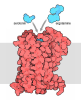
| 構造ビューア | 分子: MolmilJmol/JSmol |
|---|
- ダウンロードとリンク
-ダウンロード
| PDBx/mmCIF形式 | 9wp9.cif.gz | 259 KB | 表示 | PDBx/mmCIF形式 |
|---|---|---|---|---|
| PDB形式 | pdb9wp9.ent.gz | 201.1 KB | 表示 | PDB形式 |
| PDBx/mmJSON形式 | 9wp9.json.gz | ツリー表示 | PDBx/mmJSON形式 | |
| その他 |  その他のダウンロード その他のダウンロード |
-検証レポート
| 文書・要旨 | 9wp9_validation.pdf.gz | 1.3 MB | 表示 | wwPDB検証レポート |
|---|---|---|---|---|
| 文書・詳細版 | 9wp9_full_validation.pdf.gz | 1.3 MB | 表示 | |
| XML形式データ | 9wp9_validation.xml.gz | 45.7 KB | 表示 | |
| CIF形式データ | 9wp9_validation.cif.gz | 67.8 KB | 表示 | |
| アーカイブディレクトリ | https://data.pdbj.org/pub/pdb/validation_reports/wp/9wp9ftp://data.pdbj.org/pub/pdb/validation_reports/wp/9wp9 | HTTPS FTP |
-関連構造データ


-リンク
 PDBj
PDBj

- 集合体
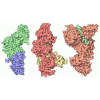
集合体
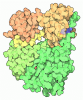
| 登録構造単位 | 
|
|---|---|
| 1 |
|
-要素
-タンパク質 , 3種, 3分子 ANR
| #1: タンパク質 | 分子量: 27680.387 Da / 分子数: 1 / 由来タイプ: 組換発現 / 由来: (組換発現) Homo sapiens (ヒト)発現宿主:   Spodoptera frugiperda (ツマジロクサヨトウ) Spodoptera frugiperda (ツマジロクサヨトウ) |
|---|---|
| #5: タンパク質 | 分子量: 14016.636 Da / 分子数: 1 / 由来タイプ: 組換発現 / 由来: (組換発現) Homo sapiens (ヒト)発現宿主: Spodoptera frugiperda (ツマジロクサヨトウ) |
| #6: タンパク質 | 分子量: 38829.141 Da / 分子数: 1 / 由来タイプ: 組換発現 / 由来: (組換発現) Homo sapiens (ヒト) / 遺伝子: S1PR3, C9orf108, C9orf47, EDG3発現宿主: Spodoptera frugiperda (ツマジロクサヨトウ)参照: UniProt: Q99500 |
-Guanine nucleotide-binding protein ... , 2種, 2分子 BG
| #2: タンパク質 | 分子量: 39418.086 Da / 分子数: 1 / 由来タイプ: 組換発現 / 由来: (組換発現) Homo sapiens (ヒト) / 遺伝子: GNB1発現宿主: Spodoptera frugiperda (ツマジロクサヨトウ)参照: UniProt: P62873 |
|---|---|
| #4: タンパク質 | 分子量: 7861.143 Da / 分子数: 1 / 由来タイプ: 組換発現 / 由来: (組換発現) Homo sapiens (ヒト) / 遺伝子: GNG2発現宿主: Spodoptera frugiperda (ツマジロクサヨトウ)参照: UniProt: P59768 |
-抗体 / 非ポリマー , 2種, 2分子 C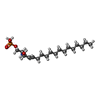
| #3: 抗体 | 分子量: 27784.896 Da / 分子数: 1 / 由来タイプ: 組換発現 / 由来: (組換発現) Homo sapiens (ヒト)発現宿主: Spodoptera frugiperda (ツマジロクサヨトウ) |
|---|---|
| #7: 化合物 | ChemComp-S1P / (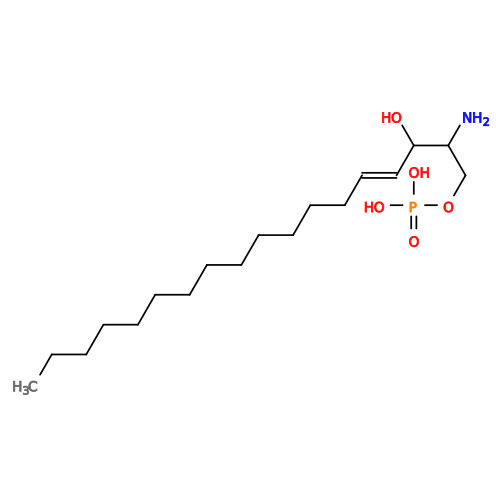 分子量: 379.472 Da / 分子数: 1 / 由来タイプ: 合成 / 式: C18H38NO5P / タイプ: SUBJECT OF INVESTIGATION 分子量: 379.472 Da / 分子数: 1 / 由来タイプ: 合成 / 式: C18H38NO5P / タイプ: SUBJECT OF INVESTIGATION |
-詳細
| 研究の焦点であるリガンドがあるか | Y |
|---|---|
| Has protein modification | Y |
-実験情報
-実験
| 実験 | 手法: 電子顕微鏡法 |
|---|---|
| EM実験 | 試料の集合状態: PARTICLE / 3次元再構成法: 単粒子再構成法 |
- 試料調製
試料調製
| 構成要素 | 名称: d18:1 S1P-bound S1PR3 in complex with Gq / タイプ: COMPLEX / Entity ID: #1-#6 / 由来: RECOMBINANT |
|---|---|
| 分子量 | 値: 0.19 MDa / 実験値: YES |
| 由来(天然) | 生物種: Homo sapiens (ヒト) |
| 由来(組換発現) | 生物種: Spodoptera frugiperda (ツマジロクサヨトウ) |
| 緩衝液 | pH: 7.5 |
| 試料 | 濃度: 10 mg/ml / 包埋: NO / シャドウイング: NO / 染色: NO / 凍結: YES |
| 急速凍結 | 凍結剤: ETHANE / 湿度: 100 % / 凍結前の試料温度: 281.15 K |
- 電子顕微鏡撮影
| 実験機器 |  モデル: Titan Krios / 画像提供: FEI Company |
|---|---|
| 顕微鏡 | モデル: TFS KRIOS |
| 電子銃 | 電子線源:  FIELD EMISSION GUN / 加速電圧: 300 kV / 照射モード: FLOOD BEAM FIELD EMISSION GUN / 加速電圧: 300 kV / 照射モード: FLOOD BEAM |
| 電子レンズ | モード: BRIGHT FIELD / 最大 デフォーカス(公称値): 1800 nm / 最小 デフォーカス(公称値): 800 nm |
| 試料ホルダ | 試料ホルダーモデル: FEI TITAN KRIOS AUTOGRID HOLDER |
| 撮影 | 電子線照射量: 50 e/Å2 フィルム・検出器のモデル: GATAN K3 BIOQUANTUM (6k x 4k) |
- 解析
解析
| EMソフトウェア |
| ||||||||||||||||||||||||
|---|---|---|---|---|---|---|---|---|---|---|---|---|---|---|---|---|---|---|---|---|---|---|---|---|---|
| CTF補正 | タイプ: NONE | ||||||||||||||||||||||||
| 3次元再構成 | 解像度: 3.25 Å / 解像度の算出法: FSC 0.143 CUT-OFF / 粒子像の数: 366554 / 対称性のタイプ: POINT | ||||||||||||||||||||||||
| 精密化 | 最高解像度: 3.25 Å 立体化学のターゲット値: REAL-SPACE (WEIGHTED MAP SUM AT ATOM CENTERS) | ||||||||||||||||||||||||
| 拘束条件 |
|
