 Movie
Movie Controller


+ Open data

- Basic information
| Entry | Database: PDB / ID: 9vlg | ||||||||||||||||||||||||||||||
|---|---|---|---|---|---|---|---|---|---|---|---|---|---|---|---|---|---|---|---|---|---|---|---|---|---|---|---|---|---|---|---|
| Title | Structure of human alpha-2/delta-1 with crisugabalin | ||||||||||||||||||||||||||||||
 Components Components | Isoform 2 of Voltage-dependent calcium channel subunit alpha-2/delta-1 | ||||||||||||||||||||||||||||||
 Keywords Keywords | MEMBRANE PROTEIN / Complex / Alpha-2/delta-1 / Crisugabalin | ||||||||||||||||||||||||||||||
| Function / homology |  Function and homology information Function and homology informationregulation of membrane repolarization during action potential / calcium ion transmembrane transport via high voltage-gated calcium channel / L-type voltage-gated calcium channel complex / calcium ion transport into cytosol / membrane depolarization during bundle of His cell action potential / regulation of ventricular cardiac muscle cell membrane repolarization / cardiac muscle cell action potential involved in contraction / regulation of calcium ion transmembrane transport via high voltage-gated calcium channel / voltage-gated calcium channel complex / Mechanical load activates signaling by PIEZO1 and integrins in osteocytes ...regulation of membrane repolarization during action potential / calcium ion transmembrane transport via high voltage-gated calcium channel / L-type voltage-gated calcium channel complex / calcium ion transport into cytosol / membrane depolarization during bundle of His cell action potential / regulation of ventricular cardiac muscle cell membrane repolarization / cardiac muscle cell action potential involved in contraction / regulation of calcium ion transmembrane transport via high voltage-gated calcium channel / voltage-gated calcium channel complex / Mechanical load activates signaling by PIEZO1 and integrins in osteocytes / regulation of calcium ion transport / regulation of heart rate by cardiac conduction / calcium ion import across plasma membrane / neuronal dense core vesicle / voltage-gated calcium channel activity / presynaptic active zone membrane / positive regulation of insulin secretion involved in cellular response to glucose stimulus / sarcoplasmic reticulum / GABA-ergic synapse / cellular response to amyloid-beta / calcium ion transport / extracellular exosome / metal ion binding / plasma membrane Similarity search - Function | ||||||||||||||||||||||||||||||
| Biological species |  Homo sapiens (human) Homo sapiens (human) | ||||||||||||||||||||||||||||||
| Method | ELECTRON MICROSCOPY / single particle reconstruction / cryo EM / Resolution: 3.01 Å | ||||||||||||||||||||||||||||||
 Authors Authors | Wang, J. / Chen, Z. / Gou, X. | ||||||||||||||||||||||||||||||
| Funding support | 1items
| ||||||||||||||||||||||||||||||
 Citation Citation | Journal: J Chem Inf Model / Year: 2026 Title: Structural and Computational Insights into the Mechanism of the Superior Pharmacological Activity of Crisugabalin: A Third-Generation Cavαδ1 Ligand. Authors: Zhaoqiang Chen / Xiaoli Gou / Qingyuan Meng / He Li / Yao Li / Zongjun Shi / Xinxin Li / Ju Wang /  Abstract: Crisugabalin, a recently approved third-generation GABA analogue with a unique cage-like tricyclic scaffold, shows superior efficacy and safety over pregabalin and mirogabalin for treating ...Crisugabalin, a recently approved third-generation GABA analogue with a unique cage-like tricyclic scaffold, shows superior efficacy and safety over pregabalin and mirogabalin for treating neuropathic pain. Through integrated biophysical, structural, and computational approaches, we elucidate the molecular basis of its enhanced pharmacological profile. Dissociation kinetic studies revealed that crisugabalin exhibited the slowest dissociation kinetics from the αδ1 subunit (τ = 32.05, 80.00, 111.11 min for pregabalin, mirogabalin, and crisugabalin) but the fastest dissociation from the αδ2 subunit (τ = 8.70, 16.39, 5.78 min for pregabalin, mirogabalin, and crisugabalin). Cryo-EM structures demonstrated crisugabalin's superior binding affinity for αδ1 over gabapentin and l-leucine, driven by enhanced hydrogen bonding and hydrophobic contacts, alongside volumetric expansion of the l-leucine binding pocket. Molecular dynamics (MD) simulations identified significantly more persistent hydrogen bonding by crisugabalin (66.3% average occupancy) relative to pregabalin (28.3%). Random Acceleration Molecular Dynamics (RAMD) simulations revealed that ligand dissociation primarily proceeds via Pathway A (along the β2, β3, and β1 segments), and τRAMD calculations correctly ranked the ligand residence times, yielding values of 0.18 ns for pregabalin and 2.88 ns for crisugabalin. Furthermore, the binding free energies for pregabalin, mirogabalin, and crisugabalin were -21.64, -31.30, and -34.99 kcal/mol, calculated by MM/GBSA. The decomposition of the binding free energy components revealed that crisugabalin exhibits a dual-action mechanism characterized by enhanced hydrophobic interactions (-28.46 kcal/mol) and favorable entropic contributions (3.03 kcal/mol). This unique binding behavior stems from its cage-like tricyclic scaffold, an unprecedented substructure in drug molecules. These findings establish the cage-like tricyclic motif as a novel pharmacophore that simultaneously optimizes binding entropy and enthalpy, providing a blueprint for next-generation voltage-gated calcium channel modulators. MD, τRAMD, and MM-GBSA used in this study are powerful computational tools for rational drug design, particularly for optimizing compounds with prolonged target residence times. | ||||||||||||||||||||||||||||||
| History |
|
- Structure visualization
| Structure viewer | Molecule: MolmilJmol/JSmol |
|---|
- Downloads & links
-Download
| PDBx/mmCIF format | 9vlg.cif.gz | 183.1 KB | Display | PDBx/mmCIF format |
|---|---|---|---|---|
| PDB format | pdb9vlg.ent.gz | Display | PDB format | |
| PDBx/mmJSON format | 9vlg.json.gz | Tree view | PDBx/mmJSON format | |
| Others |  Other downloads Other downloads |
-Validation report
| Arichive directory | https://data.pdbj.org/pub/pdb/validation_reports/vl/9vlgftp://data.pdbj.org/pub/pdb/validation_reports/vl/9vlg | HTTPS FTP |
|---|
-Related structure data
| Related structure data |  65160MC M: map data used to model this data C: citing same article ( |
|---|---|
| Similar structure data |
-Links
 PDBj
PDBj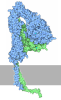
- Assembly
| Deposited unit | 
|
|---|---|
| 1 |
|
-Components
| #1: Protein | Mass: 120990.766 Da / Num. of mol.: 1 Source method: isolated from a genetically manipulated source Source: (gene. exp.) Homo sapiens (human) / Gene: CACNA2D1, CACNL2A, CCHL2A, MHS3 / Production host: Homo sapiens (human) / References: UniProt: P54289 | ||||||||||
|---|---|---|---|---|---|---|---|---|---|---|---|
| #2: Polysaccharide | Source method: isolated from a genetically manipulated source #3: Polysaccharide | 2-acetamido-2-deoxy-beta-D-glucopyranose-(1-4)-2-acetamido-2-deoxy-beta-D-glucopyranose | Source method: isolated from a genetically manipulated source #4: Sugar | 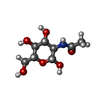 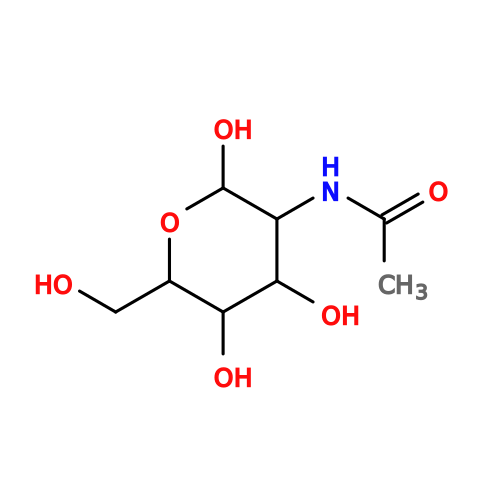 Type: D-saccharide, beta linking / Mass: 221.208 Da / Num. of mol.: 2 / Source method: obtained synthetically / Formula: C8H15NO6 / Feature type: SUBJECT OF INVESTIGATION Type: D-saccharide, beta linking / Mass: 221.208 Da / Num. of mol.: 2 / Source method: obtained synthetically / Formula: C8H15NO6 / Feature type: SUBJECT OF INVESTIGATION#5: Chemical | ChemComp-A1ESQ / | Mass: 209.285 Da / Num. of mol.: 1 / Source method: obtained synthetically / Formula: C12H19NO2 / Feature type: SUBJECT OF INVESTIGATION Has ligand of interest | Y | Has protein modification | Y | |
-Experimental details
-Experiment
| Experiment | Method: ELECTRON MICROSCOPY |
|---|---|
| EM experiment | Aggregation state: PARTICLE / 3D reconstruction method: single particle reconstruction |
- Sample preparation
| Component | Name: Structure of human alpha-2/delta-1 with crisugabalin / Type: COMPLEX / Entity ID: #1 / Source: RECOMBINANT |
|---|---|
| Source (natural) | Organism: Homo sapiens (human) |
| Source (recombinant) | Organism: Homo sapiens (human) |
| Buffer solution | pH: 7.5 |
| Specimen | Embedding applied: NO / Shadowing applied: NO / Staining applied: NO / Vitrification applied: YES |
| Vitrification | Cryogen name: ETHANE / Humidity: 100 % |
- Electron microscopy imaging
| Microscopy | Model: FEI/PHILIPS CM300FEG/HE |
|---|---|
| Electron gun | Electron source:  FIELD EMISSION GUN / Accelerating voltage: 300 kV / Illumination mode: FLOOD BEAM FIELD EMISSION GUN / Accelerating voltage: 300 kV / Illumination mode: FLOOD BEAM |
| Electron lens | Mode: BRIGHT FIELD / Nominal defocus max: 1800 nm / Nominal defocus min: 1100 nm |
| Image recording | Electron dose: 55 e/Å2 / Film or detector model: GATAN K3 BIOCONTINUUM (6k x 4k) |
- Processing
| EM software |
| |||||||||
|---|---|---|---|---|---|---|---|---|---|---|
| CTF correction | Type: NONE | |||||||||
| 3D reconstruction | Resolution: 3.01 Å / Resolution method: FSC 0.143 CUT-OFF / Num. of particles: 226483 / Symmetry type: POINT |
