 Movie
Movie Controller

[English] 日本語
 Yorodumi
- PDB-9vbw: Lectin FRIL from Lablab purpureus complexed to Lewis X tetrasaccharide -
+ Open data

- Basic information
| Entry | Database: PDB / ID: 9vbw | |||||||||
|---|---|---|---|---|---|---|---|---|---|---|
| Title | Lectin FRIL from Lablab purpureus complexed to Lewis X tetrasaccharide | |||||||||
 Components Components | Flt3 receptor-interacting lectin | |||||||||
 Keywords Keywords | PLANT PROTEIN / Flt3 receptor-interacting lectin / carbohydrate binding protein / lectin / glycoprotein / complex type glycan / FRIL | |||||||||
| Function / homology |  Function and homology information Function and homology information | |||||||||
| Biological species |  Lablab purpureus (hyacinth bean) Lablab purpureus (hyacinth bean) | |||||||||
| Method |  X-RAY DIFFRACTION / SYNCHROTRON / MOLECULAR REPLACEMENT / Resolution: 2.49 Å X-RAY DIFFRACTION / SYNCHROTRON / MOLECULAR REPLACEMENT / Resolution: 2.49 Å | |||||||||
 Authors Authors | Nguyen, V.H.T. / Chen, T.H. / Chen, X. / Liu, Y.M. / Ma, C. | |||||||||
| Funding support |  Taiwan, 2items Taiwan, 2items
| |||||||||
 Citation Citation | Journal: Nat Commun / Year: 2026 Title: Altering the carbohydrate-binding specificity of the legume lectin FRIL through structure-guided engineering. Authors: Yo-Min Liu / Hong Thuy Vy Nguyen / Xiaorui Chen / Md Shahed-Al-Mahmud / Ting-Hua Chen / Kuo-Shiang Liao / Jennifer M Lo / Tzu-Chun Kan / Chien-Tai Ren / Che Ma /  Abstract: FRIL is a legume lectin from the hyacinth bean that has broad-spectrum antiviral activity. A distinctive trait of FRIL among similar mannose/glucose-specific legume lectins is that FRIL shows ...FRIL is a legume lectin from the hyacinth bean that has broad-spectrum antiviral activity. A distinctive trait of FRIL among similar mannose/glucose-specific legume lectins is that FRIL shows specificity for complex type N-glycans. We postulate that an extended binding site on FRIL facilitates this ligand selectivity. Here, we show legume lectin carbohydrate recognition domain (CRD) loop B is the main determinant of complex versus high-mannose N-glycan specificity in FRIL and Concanavalin A (ConA), respectively. First, we find that the inactive precursors of recombinant FRIL (rFRIL) and proConA (rproConA) can be activated via deglycosylation. Secondly, the cryo-EM structures of inactive apo rFRIL, active FRIL in complex with Galβ1,4-(Fucα1,3-)GlcNAcβ1,2-Man tetrasaccharide, and active rFRIL in complex with MannoseGlcNAc (Man9) N-glycan are determined, and residues H102 and Y101 on loop B are identified as crucial for complex glycan recognition. Finally, we swapped loop B residues 101 and 102 alongside loop C residue 145 on FRIL to their structural equivalent on ConA, resulting in a FRIL mutant that binds exclusively to high mannose N-glycans. Taken together, we have established a process of activating recombinant FRIL and related lectins through deglycosylation, and demonstrated the crucial role that loop B residues play in establishing oligosaccharide specificity. | |||||||||
| History |
|
- Structure visualization
| Structure viewer | Molecule: MolmilJmol/JSmol |
|---|
- Downloads & links
-Download
| PDBx/mmCIF format | 9vbw.cif.gz | 1.4 MB | Display | PDBx/mmCIF format |
|---|---|---|---|---|
| PDB format | pdb9vbw.ent.gz | 1.2 MB | Display | PDB format |
| PDBx/mmJSON format | 9vbw.json.gz | Tree view | PDBx/mmJSON format | |
| Others |  Other downloads Other downloads |
-Validation report
| Arichive directory | https://data.pdbj.org/pub/pdb/validation_reports/vb/9vbwftp://data.pdbj.org/pub/pdb/validation_reports/vb/9vbw | HTTPS FTP |
|---|
-Related structure data
| Related structure data |  9vbxC  9vbyC  9vbzC  9vc0C  1qmoS C: citing same article ( S: Starting model for refinement |
|---|---|
| Similar structure data |


-Links
 PDBj
PDBj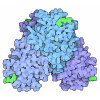
- Assembly
| Deposited unit | 
| ||||||||
|---|---|---|---|---|---|---|---|---|---|
| 1 | 
| ||||||||
| 2 | 
| ||||||||
| 3 | 
| ||||||||
| 4 | 
| ||||||||
| Unit cell |
|
-Components
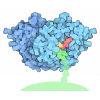
| #1: Protein | Mass: 29075.068 Da / Num. of mol.: 16 / Source method: isolated from a natural source / Source: (natural) Lablab purpureus (hyacinth bean) / References: UniProt: Q9ZTA9#2: Polysaccharide | alpha-L-fucopyranose-(1-3)-[beta-D-galactopyranose-(1-4)]2-acetamido-2-deoxy-beta-D-glucopyranose- ...alpha-L-fucopyranose-(1-3)-[beta-D-galactopyranose-(1-4)]2-acetamido-2-deoxy-beta-D-glucopyranose-(1-2)-alpha-D-mannopyranose Type: oligosaccharide / Mass: 691.630 Da / Num. of mol.: 16 / Source method: obtained synthetically #3: Chemical | ChemComp-CA /   Mass: 40.078 Da / Num. of mol.: 16 / Source method: obtained synthetically / Formula: Ca / Feature type: SUBJECT OF INVESTIGATION Mass: 40.078 Da / Num. of mol.: 16 / Source method: obtained synthetically / Formula: Ca / Feature type: SUBJECT OF INVESTIGATION#4: Chemical | ChemComp-MN /   Mass: 54.938 Da / Num. of mol.: 16 / Source method: obtained synthetically / Formula: Mn / Feature type: SUBJECT OF INVESTIGATION Mass: 54.938 Da / Num. of mol.: 16 / Source method: obtained synthetically / Formula: Mn / Feature type: SUBJECT OF INVESTIGATION#5: Water | ChemComp-HOH / |  Mass: 18.015 Da / Num. of mol.: 858 / Source method: isolated from a natural source / Formula: H2O Mass: 18.015 Da / Num. of mol.: 858 / Source method: isolated from a natural source / Formula: H2OHas ligand of interest | Y | Has protein modification | N | |
|---|
-Experimental details
-Experiment
| Experiment | Method: X-RAY DIFFRACTION / Number of used crystals: 1 |
|---|
- Sample preparation
| Crystal | Density Matthews: 2.51 Å3/Da / Density % sol: 50.97 % |
|---|---|
| Crystal grow | Temperature: 293 K / Method: vapor diffusion, hanging drop / pH: 6.2 / Details: 0.2 M ammonium fluoride, pH 6.2, 20% PEG 3350 |
-Data collection
| Diffraction | Mean temperature: 100 K / Serial crystal experiment: N |
|---|---|
| Diffraction source | Source: SYNCHROTRON / Site: NSRRC / Beamline: TPS 05A / Wavelength: 1 Å |
| Detector | Type: RAYONIX MX300HE / Detector: CCD / Date: Aug 29, 2020 |
| Radiation | Protocol: SINGLE WAVELENGTH / Monochromatic (M) / Laue (L): M / Scattering type: x-ray |
| Radiation wavelength | Wavelength: 1 Å / Relative weight: 1 |
| Reflection | Resolution: 2.49→29.14 Å / Num. obs: 128114 / % possible obs: 83.5 % / Redundancy: 2.8 % / CC1/2: 0.961 / Rmerge(I) obs: 0.083 / Net I/σ(I): 7.3 |
| Reflection shell | Resolution: 2.49→2.58 Å / Redundancy: 2.7 % / Rmerge(I) obs: 0.402 / Num. unique obs: 11275 / CC1/2: 0.805 / % possible all: 74.3 |
- Processing
| Software |
| |||||||||||||||||||||||||||||||||||||||||||||||||||||||||||||||||||||||||||||||||||||||||||||||||||||||||
|---|---|---|---|---|---|---|---|---|---|---|---|---|---|---|---|---|---|---|---|---|---|---|---|---|---|---|---|---|---|---|---|---|---|---|---|---|---|---|---|---|---|---|---|---|---|---|---|---|---|---|---|---|---|---|---|---|---|---|---|---|---|---|---|---|---|---|---|---|---|---|---|---|---|---|---|---|---|---|---|---|---|---|---|---|---|---|---|---|---|---|---|---|---|---|---|---|---|---|---|---|---|---|---|---|---|---|
| Refinement | Method to determine structure: MOLECULAR REPLACEMENT Starting model: 1QMO Resolution: 2.49→29.14 Å / SU ML: 0.31 / Cross valid method: FREE R-VALUE / σ(F): 1.35 / Phase error: 28.49 / Stereochemistry target values: ML
| |||||||||||||||||||||||||||||||||||||||||||||||||||||||||||||||||||||||||||||||||||||||||||||||||||||||||
| Solvent computation | Shrinkage radii: 0.9 Å / VDW probe radii: 1.11 Å / Solvent model: FLAT BULK SOLVENT MODEL | |||||||||||||||||||||||||||||||||||||||||||||||||||||||||||||||||||||||||||||||||||||||||||||||||||||||||
| Refinement step | Cycle: LAST / Resolution: 2.49→29.14 Å
| |||||||||||||||||||||||||||||||||||||||||||||||||||||||||||||||||||||||||||||||||||||||||||||||||||||||||
| Refine LS restraints |
| |||||||||||||||||||||||||||||||||||||||||||||||||||||||||||||||||||||||||||||||||||||||||||||||||||||||||
| LS refinement shell |
| |||||||||||||||||||||||||||||||||||||||||||||||||||||||||||||||||||||||||||||||||||||||||||||||||||||||||
| Refinement TLS params. | Method: refined / Origin x: -29.9832 Å / Origin y: -4.9006 Å / Origin z: -59.7072 Å
| |||||||||||||||||||||||||||||||||||||||||||||||||||||||||||||||||||||||||||||||||||||||||||||||||||||||||
| Refinement TLS group | Selection details: all |
