 Movie
Movie Controller


+ Open data

- Basic information
| Entry | Database: PDB / ID: 9v9c | |||||||||||||||||||||||||||
|---|---|---|---|---|---|---|---|---|---|---|---|---|---|---|---|---|---|---|---|---|---|---|---|---|---|---|---|---|
| Title | Cryo-EM structure of human TNFR1 DD filament | |||||||||||||||||||||||||||
 Components Components | Tumor necrosis factor receptor superfamily member 1A, membrane form | |||||||||||||||||||||||||||
 Keywords Keywords | PROTEIN FIBRIL / Death doamin | |||||||||||||||||||||||||||
| Function / homology |  Function and homology information Function and homology informationpulmonary valve development / establishment of blood-brain barrier / aortic valve development / tumor necrosis factor receptor activity / negative regulation of extracellular matrix constituent secretion / positive regulation of apoptotic process involved in morphogenesis / TNFs bind their physiological receptors / tumor necrosis factor binding / tumor necrosis factor receptor superfamily complex / activation of NF-kappaB-inducing kinase activity ...pulmonary valve development / establishment of blood-brain barrier / aortic valve development / tumor necrosis factor receptor activity / negative regulation of extracellular matrix constituent secretion / positive regulation of apoptotic process involved in morphogenesis / TNFs bind their physiological receptors / tumor necrosis factor binding / tumor necrosis factor receptor superfamily complex / activation of NF-kappaB-inducing kinase activity / TNF signaling / negative regulation of cardiac muscle hypertrophy / regulation of establishment of endothelial barrier / TNFR1-induced proapoptotic signaling / prostaglandin metabolic process / TNFR1-mediated ceramide production / extrinsic apoptotic signaling pathway via death domain receptors / Interleukin-10 signaling / positive regulation of execution phase of apoptosis / cell surface receptor signaling pathway via JAK-STAT / tumor necrosis factor-mediated signaling pathway / astrocyte activation / protein localization to plasma membrane / gene expression / TNFR1-induced NF-kappa-B signaling pathway / Regulation of TNFR1 signaling / negative regulation of inflammatory response / cellular response to mechanical stimulus / cytokine-mediated signaling pathway / positive regulation of inflammatory response / signaling receptor activity / cellular response to lipopolysaccharide / inflammatory response / positive regulation of canonical NF-kappaB signal transduction / signaling receptor complex / membrane raft / Golgi membrane / cell surface / positive regulation of transcription by RNA polymerase II / extracellular region / membrane / plasma membrane Similarity search - Function | |||||||||||||||||||||||||||
| Biological species |  Homo sapiens (human) Homo sapiens (human) | |||||||||||||||||||||||||||
| Method | ELECTRON MICROSCOPY / helical reconstruction / cryo EM / Resolution: 2.62 Å | |||||||||||||||||||||||||||
 Authors Authors | Zhao, K. / Liu, J.P. / Liu, C. / Yuan, J.Y. | |||||||||||||||||||||||||||
| Funding support | 1items
| |||||||||||||||||||||||||||
 Citation Citation | Journal: Nature / Year: 2026 Title: Electric dipole moment drives the dynamics of the TNFR1 complex I signalosome. Authors: Jianping Liu / Jing Zhao / Jiayang Gao / Kun Zhao / Yaoyao Han / Jing Yang / Zefei Li / Jianyu Ye / Ziyu Sun / Fengyi Wang / Xinyi Liu / Zekai Li / Siyu Ji / Bo Liu / Cong Liu / Yixiao Zhang ...Authors: Jianping Liu / Jing Zhao / Jiayang Gao / Kun Zhao / Yaoyao Han / Jing Yang / Zefei Li / Jianyu Ye / Ziyu Sun / Fengyi Wang / Xinyi Liu / Zekai Li / Siyu Ji / Bo Liu / Cong Liu / Yixiao Zhang / Junying Yuan / James J Chou /  Abstract: Dynamic assembly of the complex I signalosome mediated by three death domain (DD)-containing proteins-TNFR1, TRADD and RIPK1-is key for transmitting extracellular TNF stimuli to intracellular NF-κB ...Dynamic assembly of the complex I signalosome mediated by three death domain (DD)-containing proteins-TNFR1, TRADD and RIPK1-is key for transmitting extracellular TNF stimuli to intracellular NF-κB signalling in controlling 'live or die' cell fate. This signalling hub features the rapid recruitment of TRADD and RIPK1 after engagement of TNFR1 by TNF for the formation of complex I, followed by timed disassembly for transition into downstream signalling complexes, but the mechanism driving the dynamic reversibility of complex I remains unclear. Here we captured the assembly core of complex I and determined its cryo-electron microscopy structure, showing a pentameric fibre comprising 31 DDs, with a single layer of a TRADD-DD pentamer sandwiched between multiple layers of TNFR1-DD and RIPK1-DD homopentamers. Structural analysis revealed a strong opposing electric dipole moment (EDM) generated by RIPK1-DD oligomerization relative to that of TNFR1-DD and TRADD-DD. Structure-guided mutagenesis in TNFR1-TRADD-RIPK1 pentameric fibres altering the EDM without affecting DD oligomerization demonstrated the role and mechanism of EDM in driving the dynamic reversibility mediating the rapid assembly and disassembly of complex I. Our study demonstrates a role for long-range interactions mediated by protein EDMs in driving the assembly and disassembly of super-signalling complex I for promoting NF-κB signalling. | |||||||||||||||||||||||||||
| History |
|
- Structure visualization
| Structure viewer | Molecule: MolmilJmol/JSmol |
|---|
- Downloads & links
-Download
| PDBx/mmCIF format | 9v9c.cif.gz | 311.9 KB | Display | PDBx/mmCIF format |
|---|---|---|---|---|
| PDB format | pdb9v9c.ent.gz | 257.7 KB | Display | PDB format |
| PDBx/mmJSON format | 9v9c.json.gz | Tree view | PDBx/mmJSON format | |
| Others |  Other downloads Other downloads |
-Validation report
| Arichive directory | https://data.pdbj.org/pub/pdb/validation_reports/v9/9v9cftp://data.pdbj.org/pub/pdb/validation_reports/v9/9v9c | HTTPS FTP |
|---|
-Related structure data
| Related structure data |  64869MC  9v9eC  9vgdC  9vinC M: map data used to model this data C: citing same article ( |
|---|---|
| Similar structure data |


-Links
 PDBj
PDBj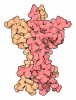

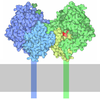
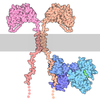
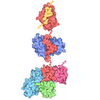
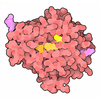
- Assembly
| Deposited unit | 
|
|---|---|
| 1 |
|
-Components
| #1: Protein | Mass: 13035.875 Da / Num. of mol.: 20 / Fragment: TNFR1 death domain Source method: isolated from a genetically manipulated source Source: (gene. exp.) Homo sapiens (human) / Gene: TNFRSF1A, TNFAR, TNFR1 / Production host:   Escherichia coli (E. coli) / References: UniProt: P19438 Escherichia coli (E. coli) / References: UniProt: P19438Has protein modification | N | |
|---|
-Experimental details
-Experiment
| Experiment | Method: ELECTRON MICROSCOPY |
|---|---|
| EM experiment | Aggregation state: FILAMENT / 3D reconstruction method: helical reconstruction |
- Sample preparation
| Component | Name: TNFR1 DD filament / Type: ORGANELLE OR CELLULAR COMPONENT / Entity ID: all / Source: RECOMBINANT |
|---|---|
| Source (natural) | Organism: Homo sapiens (human) |
| Source (recombinant) | Organism: Escherichia coli (E. coli) |
| Buffer solution | pH: 7.8 |
| Specimen | Embedding applied: NO / Shadowing applied: NO / Staining applied: NO / Vitrification applied: YES |
| Vitrification | Cryogen name: ETHANE |
- Electron microscopy imaging
| Experimental equipment |  Model: Titan Krios / Image courtesy: FEI Company |
|---|---|
| Microscopy | Model: TFS KRIOS |
| Electron gun | Electron source:  FIELD EMISSION GUN / Accelerating voltage: 300 kV / Illumination mode: FLOOD BEAM FIELD EMISSION GUN / Accelerating voltage: 300 kV / Illumination mode: FLOOD BEAM |
| Electron lens | Mode: BRIGHT FIELD / Nominal defocus max: 2200 nm / Nominal defocus min: 1200 nm |
| Image recording | Electron dose: 55 e/Å2 / Film or detector model: GATAN K3 BIOCONTINUUM (6k x 4k) |
- Processing
| EM software | Name: PHENIX / Version: 1.15.2_3472 / Category: model refinement | ||||||||||||||||||||||||
|---|---|---|---|---|---|---|---|---|---|---|---|---|---|---|---|---|---|---|---|---|---|---|---|---|---|
| CTF correction | Type: NONE | ||||||||||||||||||||||||
| Helical symmerty | Angular rotation/subunit: 138.364 ° / Axial rise/subunit: 5.30557 Å / Axial symmetry: C1 | ||||||||||||||||||||||||
| 3D reconstruction | Resolution: 2.62 Å / Resolution method: FSC 0.143 CUT-OFF / Num. of particles: 512379 / Symmetry type: HELICAL | ||||||||||||||||||||||||
| Refinement | Stereochemistry target values: REAL-SPACE (WEIGHTED MAP SUM AT ATOM CENTERS) | ||||||||||||||||||||||||
| Refine LS restraints |
|
