National Natural Science Foundation of China (NSFC)
China
Citation
Journal: Cell Rep / Year: 2025 Title: Membrane dome-based regulation mechanism of the mechanosensitive PIEZO channel. Authors: Yushuang Liu / Bowen Liu / Weiran Zhan / Lun Zhang / Anbing Shi / Long Lin / Man Jiang / Yusong R Guo / Abstract: PIEZO channels are mechanosensitive ion channels essential for various physiological processes. How activation of PIEZO channels is regulated for distinct mechanical environments remains largely ...PIEZO channels are mechanosensitive ion channels essential for various physiological processes. How activation of PIEZO channels is regulated for distinct mechanical environments remains largely unclear. Here, we use patch-clamp electrophysiology to record pressure-activated currents of natural splicing isoforms of Caenorhabditis elegans PIEZO channels that differ in sequence length. These isoforms are sensitive in different tension regimes, consistent with the quantitative prediction from the membrane dome mechanism, based on structural measurement from cryo-electron microscopy data. Furthermore, these isoforms show different localization in the worm body and are involved in different physiological functions. Therefore, inspired by the membrane dome mechanism, a distinct regulatory strategy is found for PIEZO channels to tune the mechanosensitivity by adjusting the dome area via alternative splicing to adapt to the physiological environment.
History
Deposition
Apr 27, 2025
Deposition site: PDBJ / Processing site: PDBC
Revision 1.0
Dec 24, 2025
Provider: repository / Type: Initial release
Revision 1.0
Dec 24, 2025
Data content type: EM metadata / Data content type: EM metadata / Provider: repository / Type: Initial release
Revision 1.0
Dec 24, 2025
Data content type: Additional map / Part number: 1 / Data content type: Additional map / Provider: repository / Type: Initial release
Revision 1.0
Dec 24, 2025
Data content type: FSC / Data content type: FSC / Provider: repository / Type: Initial release
Revision 1.0
Dec 24, 2025
Data content type: Half map / Part number: 1 / Data content type: Half map / Provider: repository / Type: Initial release
Revision 1.0
Dec 24, 2025
Data content type: Half map / Part number: 2 / Data content type: Half map / Provider: repository / Type: Initial release
Revision 1.0
Dec 24, 2025
Data content type: Image / Data content type: Image / Provider: repository / Type: Initial release
Revision 1.0
Dec 24, 2025
Data content type: Primary map / Data content type: Primary map / Provider: repository / Type: Initial release
Revision 1.1
Mar 4, 2026
Group: Data collection / Category: em_admin / Item: _em_admin.last_update
Revision 2.0
Mar 4, 2026
Data content type: EM metadata / Data content type: EM metadata / Group: Experimental summary / Data content type: EM metadata / Category: em_admin / Data content type: EM metadata / Item: _em_admin.last_update
In the structure databanks used in Yorodumi, some data are registered as the other names, "COVID-19 virus" and "2019-nCoV". Here are the details of the virus and the list of structure data.
Jan 31, 2019. EMDB accession codes are about to change! (news from PDBe EMDB page)
EMDB accession codes are about to change! (news from PDBe EMDB page)
The allocation of 4 digits for EMDB accession codes will soon come to an end. Whilst these codes will remain in use, new EMDB accession codes will include an additional digit and will expand incrementally as the available range of codes is exhausted. The current 4-digit format prefixed with “EMD-” (i.e. EMD-XXXX) will advance to a 5-digit format (i.e. EMD-XXXXX), and so on. It is currently estimated that the 4-digit codes will be depleted around Spring 2019, at which point the 5-digit format will come into force.
The EM Navigator/Yorodumi systems omit the EMD- prefix.
Related info.:Q: What is EMD? / ID/Accession-code notation in Yorodumi/EM Navigator
Yorodumi is a browser for structure data from EMDB, PDB, SASBDB, etc.
This page is also the successor to EM Navigator detail page, and also detail information page/front-end page for Omokage search.
The word "yorodu" (or yorozu) is an old Japanese word meaning "ten thousand". "mi" (miru) is to see.
Related info.:EMDB / PDB / SASBDB / Comparison of 3 databanks / Yorodumi Search / Aug 31, 2016. New EM Navigator & Yorodumi / Yorodumi Papers / Jmol/JSmol / Function and homology information / Changes in new EM Navigator and Yorodumi
 Movie
Movie Controller


 Open data
 Basic information
 Components
 Keywords
 Function and homology information
 Caenorhabditis elegans (invertebrata)
 Authors
 China, 1items
  Citation
 Structure visualization
 Downloads & links
 Other downloads


 PDBj
PDBj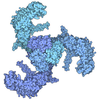
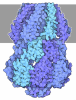
 Assembly
 Homo sapiens (human) / References: UniProt: A0A061ACU2
 Sample preparation
 Electron microscopy imaging
 FIELD EMISSION GUN / Accelerating voltage: 300 kV / Illumination mode: FLOOD BEAM
 Processing