 Movie
Movie Controller


+ Open data

- Basic information
| Entry | Database: PDB / ID: 9unw | |||||||||||||||
|---|---|---|---|---|---|---|---|---|---|---|---|---|---|---|---|---|
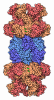
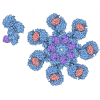
| Title | mouse PDCD5-TRiC complex | |||||||||||||||
 Components Components |
| |||||||||||||||
 Keywords Keywords | CHAPERONE / Complex / cofactor | |||||||||||||||
| Function / homology |  Function and homology information Function and homology informationAssociation of TriC/CCT with target proteins during biosynthesis / BBSome-mediated cargo-targeting to cilium / RHOBTB1 GTPase cycle / negative regulation of protein folding / RHOBTB2 GTPase cycle / Cooperation of PDCL (PhLP1) and TRiC/CCT in G-protein beta folding / binding of sperm to zona pellucida / positive regulation of establishment of protein localization to telomere / scaRNA localization to Cajal body / zona pellucida receptor complex ...Association of TriC/CCT with target proteins during biosynthesis / BBSome-mediated cargo-targeting to cilium / RHOBTB1 GTPase cycle / negative regulation of protein folding / RHOBTB2 GTPase cycle / Cooperation of PDCL (PhLP1) and TRiC/CCT in G-protein beta folding / binding of sperm to zona pellucida / positive regulation of establishment of protein localization to telomere / scaRNA localization to Cajal body / zona pellucida receptor complex / positive regulation of telomerase RNA localization to Cajal body / sperm head-tail coupling apparatus / chaperonin-containing T-complex / acetyltransferase activator activity / WD40-repeat domain binding / pericentriolar material / microtubule organizing center / cellular response to transforming growth factor beta stimulus / chaperone-mediated protein complex assembly / beta-tubulin binding / Hydrolases; Acting on acid anhydrides; In phosphorus-containing anhydrides / positive regulation of telomere maintenance via telomerase / heterochromatin / Neutrophil degranulation / protein folding chaperone / acrosomal vesicle / sperm midpiece / ATP-dependent protein folding chaperone / mRNA 3'-UTR binding / myelin sheath / response to virus / mRNA 5'-UTR binding / : / melanosome / heparin binding / G-protein beta-subunit binding / protein folding / cell body / microtubule / regulation of apoptotic process / protein stabilization / positive regulation of apoptotic process / ubiquitin protein ligase binding / apoptotic process / centrosome / positive regulation of gene expression / Golgi apparatus / ATP hydrolysis activity / mitochondrion / DNA binding / nucleoplasm / ATP binding / metal ion binding / identical protein binding / nucleus / cytosol / cytoplasm Similarity search - Function | |||||||||||||||
| Biological species |   Mus musculus (house mouse) Mus musculus (house mouse) | |||||||||||||||
| Method | ELECTRON MICROSCOPY / single particle reconstruction / cryo EM / Resolution: 3.55 Å | |||||||||||||||
 Authors Authors | Song, Q.Q. / Cong, Y. | |||||||||||||||
| Funding support |  China, 1items China, 1items
| |||||||||||||||
 Citation Citation | Journal: Mol Cell / Year: 2026 Title: PDCD5 promotes substrate release from the TRiC complex in cilia and flagella. Authors: Huafang Wei / Qianqian Song / Liying Wang / Qiong Deng / Bingbing Wu / Yinghong Chen / Tingting Han / Yueshuai Guo / Zuyang Li / Fucheng Dong / Shuang Ma / Qiaoyu Zhao / Xiangyi Shi / Chen ...Authors: Huafang Wei / Qianqian Song / Liying Wang / Qiong Deng / Bingbing Wu / Yinghong Chen / Tingting Han / Yueshuai Guo / Zuyang Li / Fucheng Dong / Shuang Ma / Qiaoyu Zhao / Xiangyi Shi / Chen Pan / Wanying Jiang / Xiaofei Liu / Yingyu Chen / Renjie Jiao / Li Yuan / Chao Liu / Xuejiang Guo / Yao Cong / Wei Li / Abstract: Approximately 10% of eukaryotic proteins are folded by the TRiC/CCT complex (TCP1-ring complex, also called CCT for cytosolic chaperonin containing TCP1), and only open-state TRiC can bind with ...Approximately 10% of eukaryotic proteins are folded by the TRiC/CCT complex (TCP1-ring complex, also called CCT for cytosolic chaperonin containing TCP1), and only open-state TRiC can bind with programmed cell death 5 (PDCD5). However, the physiological role of the PDCD5-TRiC interaction remains elusive. Here, we show that PDCD5 is required for flagellum biogenesis and ciliogenesis and present the PDCD5-TRiC structures in their open states at near-atomic resolution. Mechanically, we find that PDCD5 promotes substrates release by competing with PhLP2A to interact with TRiC, and the depletion of PDCD5 traps flagellum- and cilium-associated proteins within TRiC, finally leading to malformed flagella of spermatids and cilia in mouse ciliated cells. Moreover, we demonstrate that the function of PDCD5 in flagellum biogenesis and ciliogenesis depends on the interaction with TRiC by its C terminus. These findings identify PDCD5 as a TRiC regulator to promote a subset of proteins release. | |||||||||||||||
| History |
|
- Structure visualization
| Structure viewer | Molecule: MolmilJmol/JSmol |
|---|
- Downloads & links
-Download
| PDBx/mmCIF format | 9unw.cif.gz | 432.4 KB | Display | PDBx/mmCIF format |
|---|---|---|---|---|
| PDB format | pdb9unw.ent.gz | 321.1 KB | Display | PDB format |
| PDBx/mmJSON format | 9unw.json.gz | Tree view | PDBx/mmJSON format | |
| Others |  Other downloads Other downloads |
-Validation report
| Arichive directory | https://data.pdbj.org/pub/pdb/validation_reports/un/9unwftp://data.pdbj.org/pub/pdb/validation_reports/un/9unw | HTTPS FTP |
|---|
-Related structure data
| Related structure data |  64367MC C: citing same article ( M: map data used to model this data |
|---|---|
| Similar structure data |


-Links
 PDBj
PDBj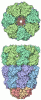
- Assembly
| Deposited unit | 
|
|---|---|
| 1 |
|
-Components
-T-complex protein 1 subunit ... , 8 types, 8 molecules CGHIFABE
| #1: Protein | Mass: 60524.516 Da / Num. of mol.: 1 / Source method: isolated from a natural source / Source: (natural) Mus musculus (house mouse)References: UniProt: P11983, Hydrolases; Acting on acid anhydrides; In phosphorus-containing anhydrides |
|---|---|
| #2: Protein | Mass: 57556.148 Da / Num. of mol.: 1 / Source method: isolated from a natural source / Source: (natural) Mus musculus (house mouse)References: UniProt: P80314, Hydrolases; Acting on acid anhydrides; In phosphorus-containing anhydrides |
| #3: Protein | Mass: 60710.934 Da / Num. of mol.: 1 / Source method: isolated from a natural source / Source: (natural) Mus musculus (house mouse)References: UniProt: P80318, Hydrolases; Acting on acid anhydrides; In phosphorus-containing anhydrides |
| #4: Protein | Mass: 58138.238 Da / Num. of mol.: 1 / Source method: isolated from a natural source / Source: (natural) Mus musculus (house mouse)References: UniProt: P80315, Hydrolases; Acting on acid anhydrides; In phosphorus-containing anhydrides |
| #5: Protein | Mass: 59704.020 Da / Num. of mol.: 1 / Source method: isolated from a natural source / Source: (natural) Mus musculus (house mouse)References: UniProt: P80316, Hydrolases; Acting on acid anhydrides; In phosphorus-containing anhydrides |
| #6: Protein | Mass: 58086.180 Da / Num. of mol.: 1 / Source method: isolated from a natural source / Source: (natural) Mus musculus (house mouse)References: UniProt: P80317, Hydrolases; Acting on acid anhydrides; In phosphorus-containing anhydrides |
| #7: Protein | Mass: 59727.059 Da / Num. of mol.: 1 / Source method: isolated from a natural source / Source: (natural) Mus musculus (house mouse)References: UniProt: P80313, Hydrolases; Acting on acid anhydrides; In phosphorus-containing anhydrides |
| #8: Protein | Mass: 59625.312 Da / Num. of mol.: 1 / Source method: isolated from a natural source / Source: (natural) Mus musculus (house mouse)References: UniProt: P42932, Hydrolases; Acting on acid anhydrides; In phosphorus-containing anhydrides |
-Protein , 1 types, 1 molecules D
| #9: Protein | Mass: 19048.205 Da / Num. of mol.: 1 Source method: isolated from a genetically manipulated source Source: (gene. exp.) Mus musculus (house mouse) / Gene: Pdcd5, Tfar19 / Production host:   Escherichia coli BL21(DE3) (bacteria) / References: UniProt: P56812 Escherichia coli BL21(DE3) (bacteria) / References: UniProt: P56812 |
|---|
-Details
| Has protein modification | N |
|---|
-Experimental details
-Experiment
| Experiment | Method: ELECTRON MICROSCOPY |
|---|---|
| EM experiment | Aggregation state: PARTICLE / 3D reconstruction method: single particle reconstruction |
- Sample preparation
| Component | Name: mouse PDCD5-TRiC complex / Type: COMPLEX / Entity ID: #9 / Source: MULTIPLE SOURCES |
|---|---|
| Source (natural) | Organism: Mus musculus (house mouse) |
| Source (recombinant) | Organism: Escherichia coli BL21(DE3) (bacteria) |
| Buffer solution | pH: 7.5 |
| Specimen | Embedding applied: NO / Shadowing applied: NO / Staining applied: NO / Vitrification applied: YES |
| Vitrification | Cryogen name: ETHANE |
- Electron microscopy imaging
| Experimental equipment |  Model: Titan Krios / Image courtesy: FEI Company |
|---|---|
| Microscopy | Model: TFS KRIOS |
| Electron gun | Electron source:  FIELD EMISSION GUN / Accelerating voltage: 300 kV / Illumination mode: FLOOD BEAM FIELD EMISSION GUN / Accelerating voltage: 300 kV / Illumination mode: FLOOD BEAM |
| Electron lens | Mode: BRIGHT FIELD / Nominal defocus max: 15000 nm / Nominal defocus min: 9000 nm |
| Image recording | Electron dose: 57 e/Å2 / Film or detector model: GATAN K3 BIOQUANTUM (6k x 4k) |
- Processing
| EM software |
| ||||||||||||
|---|---|---|---|---|---|---|---|---|---|---|---|---|---|
| CTF correction | Type: PHASE FLIPPING AND AMPLITUDE CORRECTION | ||||||||||||
| Symmetry | Point symmetry: C2 (2 fold cyclic) | ||||||||||||
| 3D reconstruction | Resolution: 3.55 Å / Resolution method: FSC 0.143 CUT-OFF / Num. of particles: 659930 / Symmetry type: POINT |
