 Movie
Movie Controller

[English] 日本語
 Yorodumi
- PDB-9ujt: RNA polymerase II elongation complex stalled at SHL(-0.5) of the ... -
+ Open data

- Basic information
| Entry | Database: PDB / ID: 9ujt | ||||||||||||||||||||||||||||||
|---|---|---|---|---|---|---|---|---|---|---|---|---|---|---|---|---|---|---|---|---|---|---|---|---|---|---|---|---|---|---|---|
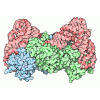
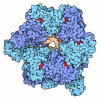
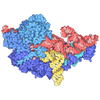
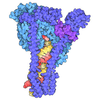
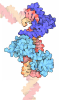
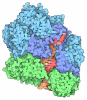
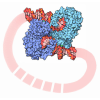
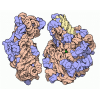
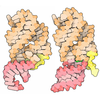
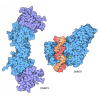
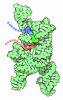
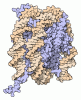
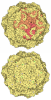
| Title | RNA polymerase II elongation complex stalled at SHL(-0.5) of the H3-H4 octasome (tetrasome) | ||||||||||||||||||||||||||||||
 Components Components |
| ||||||||||||||||||||||||||||||
 Keywords Keywords | TRANSCRIPTION/RNA/DNA / RNAPII / subnucleosome / H3-H4 tetrasome / TRANSCRIPTION / TRANSCRIPTION-RNA-DNA complex | ||||||||||||||||||||||||||||||
| Function / homology |  Function and homology information Function and homology informationregulation of septum digestion after cytokinesis / co-transcriptional lncRNA 3' end processing, cleavage and polyadenylation pathway / siRNA-mediated pericentric heterochromatin formation / intracellular phosphate ion homeostasis / chromatin-protein adaptor activity / nuclear-transcribed mRNA catabolic process, deadenylation-dependent decay / positive regulation of nuclear-transcribed mRNA poly(A) tail shortening / termination of RNA polymerase II transcription / termination of RNA polymerase I transcription / maintenance of transcriptional fidelity during transcription elongation by RNA polymerase II ...regulation of septum digestion after cytokinesis / co-transcriptional lncRNA 3' end processing, cleavage and polyadenylation pathway / siRNA-mediated pericentric heterochromatin formation / intracellular phosphate ion homeostasis / chromatin-protein adaptor activity / nuclear-transcribed mRNA catabolic process, deadenylation-dependent decay / positive regulation of nuclear-transcribed mRNA poly(A) tail shortening / termination of RNA polymerase II transcription / termination of RNA polymerase I transcription / maintenance of transcriptional fidelity during transcription elongation by RNA polymerase II / transcription initiation at RNA polymerase I promoter / positive regulation of translational initiation / nuclear-transcribed mRNA catabolic process / pericentric heterochromatin / termination of RNA polymerase III transcription / transcription initiation at RNA polymerase III promoter / RNA polymerase I complex / RNA polymerase III complex / negative regulation of megakaryocyte differentiation / RNA polymerase II, core complex / transcription elongation by RNA polymerase I / tRNA transcription by RNA polymerase III / protein localization to CENP-A containing chromatin / Chromatin modifying enzymes / transcription by RNA polymerase I / Replacement of protamines by nucleosomes in the male pronucleus / Packaging Of Telomere Ends / transcription-coupled nucleotide-excision repair / translation initiation factor binding / Recognition and association of DNA glycosylase with site containing an affected purine / Cleavage of the damaged purine / telomere organization / Interleukin-7 signaling / Deposition of new CENPA-containing nucleosomes at the centromere / Recognition and association of DNA glycosylase with site containing an affected pyrimidine / Cleavage of the damaged pyrimidine / translesion synthesis / RNA Polymerase I Promoter Opening / Inhibition of DNA recombination at telomere / Assembly of the ORC complex at the origin of replication / SUMOylation of chromatin organization proteins / Regulation of endogenous retroelements by the Human Silencing Hub (HUSH) complex / Meiotic synapsis / DNA methylation / Condensation of Prophase Chromosomes / Chromatin modifications during the maternal to zygotic transition (MZT) / SIRT1 negatively regulates rRNA expression / HCMV Late Events / ERCC6 (CSB) and EHMT2 (G9a) positively regulate rRNA expression / PRC2 methylates histones and DNA / Regulation of endogenous retroelements by KRAB-ZFP proteins / Defective pyroptosis / HDACs deacetylate histones / Transcriptional regulation by small RNAs / Regulation of endogenous retroelements by Piwi-interacting RNAs (piRNAs) / RNA Polymerase I Promoter Escape / Nonhomologous End-Joining (NHEJ) / transcription initiation at RNA polymerase II promoter / P-body / epigenetic regulation of gene expression / HDMs demethylate histones / Activated PKN1 stimulates transcription of AR (androgen receptor) regulated genes KLK2 and KLK3 / transcription elongation by RNA polymerase II / RUNX1 regulates genes involved in megakaryocyte differentiation and platelet function / Negative Regulation of CDH1 Gene Transcription / NoRC negatively regulates rRNA expression / PKMTs methylate histone lysines / G2/M DNA damage checkpoint / Formation of the beta-catenin:TCF transactivating complex / B-WICH complex positively regulates rRNA expression / DNA Damage/Telomere Stress Induced Senescence / Meiotic recombination / transcription by RNA polymerase II / Pre-NOTCH Transcription and Translation / ribonucleoside binding / Activation of anterior HOX genes in hindbrain development during early embryogenesis / Transcriptional regulation of granulopoiesis / nucleosomal DNA binding / RMTs methylate histone arginines / DNA-directed RNA polymerase / HCMV Early Events / structural constituent of chromatin / DNA-directed RNA polymerase activity / nucleosome / Regulation of PD-L1(CD274) transcription / nucleosome assembly / single-stranded DNA binding / HATs acetylate histones / Recruitment and ATM-mediated phosphorylation of repair and signaling proteins at DNA double strand breaks / Factors involved in megakaryocyte development and platelet production / MLL4 and MLL3 complexes regulate expression of PPARG target genes in adipogenesis and hepatic steatosis / RUNX1 regulates transcription of genes involved in differentiation of HSCs / Dengue Virus-Host Interactions / Processing of DNA double-strand break ends / Senescence-Associated Secretory Phenotype (SASP) / heterochromatin formation / Oxidative Stress Induced Senescence / chromatin organization / Estrogen-dependent gene expression / nucleic acid binding Similarity search - Function | ||||||||||||||||||||||||||||||
| Biological species |  Homo sapiens (human) Homo sapiens (human) Komagataella phaffii GS115 (fungus) Komagataella phaffii GS115 (fungus)synthetic construct (others) | ||||||||||||||||||||||||||||||
| Method | ELECTRON MICROSCOPY / single particle reconstruction / cryo EM / Resolution: 6.54 Å | ||||||||||||||||||||||||||||||
 Authors Authors | Ho, C.-H. / Nozawa, K. / Nishimura, M. / Oi, M. / Kujirai, T. / Ogasawara, M. / Ehara, H. / Sekine, S. / Takizawa, Y. / Kurumizaka, H. | ||||||||||||||||||||||||||||||
| Funding support |  Japan, 9items Japan, 9items
| ||||||||||||||||||||||||||||||
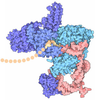
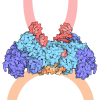
 Citation Citation | Journal: J Biol Chem / Year: 2026 Title: Structural basis of RNA polymerase II transcription on the histone H3-H4 octasome. Authors: Cheng-Han Ho / Kayo Nozawa / Masahiro Nishimura / Mayuko Oi / Tomoya Kujirai / Mitsuo Ogasawara / Haruhiko Ehara / Shun-Ichi Sekine / Yoshimasa Takizawa / Hitoshi Kurumizaka / Abstract: The histone H3-H4 octasome is a nucleosome-like particle in which two DNA gyres are wrapped around each histone (H3-H4) tetramer disk, forming a clamshell-like configuration. In the present study, we ...The histone H3-H4 octasome is a nucleosome-like particle in which two DNA gyres are wrapped around each histone (H3-H4) tetramer disk, forming a clamshell-like configuration. In the present study, we performed in vitro RNA polymerase II (RNAPII) transcription assays with the H3-H4 octasome and found that RNAPII transcribed the H3-H4 octasome more efficiently than the nucleosome. RNAPII paused at only one position, superhelical location (SHL(-4)) in the H3-H4 octasome, in contrast to pausing at the SHL(-5), SHL(-2), and SHL(-1) positions in the nucleosome. Cryo-EM analysis revealed that two (H3-H4) tetramer disks are retained when the RNAPII paused at the SHL(-4) position of the H3-H4 octasome. However, when RNAPII reached the SHL(-0.5) position, five base pairs before the dyad position of the H3-H4 octasome, the proximal (H3-H4) tetramer was disassembled, but the distal (H3-H4) tetramer still remained on the DNA. Therefore, RNAPII efficiently transcribes the H3-H4 octasome by stepwise (H3-H4) tetramer disassembly. | ||||||||||||||||||||||||||||||
| History |
|
- Structure visualization
| Structure viewer | Molecule: MolmilJmol/JSmol |
|---|
- Downloads & links
-Download
| PDBx/mmCIF format | 9ujt.cif.gz | 884.6 KB | Display | PDBx/mmCIF format |
|---|---|---|---|---|
| PDB format | pdb9ujt.ent.gz | 693.5 KB | Display | PDB format |
| PDBx/mmJSON format | 9ujt.json.gz | Tree view | PDBx/mmJSON format | |
| Others |  Other downloads Other downloads |
-Validation report
| Arichive directory | https://data.pdbj.org/pub/pdb/validation_reports/uj/9ujtftp://data.pdbj.org/pub/pdb/validation_reports/uj/9ujt | HTTPS FTP |
|---|
-Related structure data
| Related structure data |  64226MC  9ujsC M: map data used to model this data C: citing same article ( |
|---|---|
| Similar structure data |

-Links
 PDBj
PDBj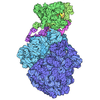



- Assembly
| Deposited unit | 
|
|---|---|
| 1 |
|
-Components
-DNA chain , 2 types, 2 molecules NT
| #1: DNA chain | Mass: 61372.891 Da / Num. of mol.: 1 / Source method: obtained synthetically / Source: (synth.) synthetic construct (others) |
|---|---|
| #2: DNA chain | Mass: 60878.992 Da / Num. of mol.: 1 / Source method: obtained synthetically / Source: (synth.) synthetic construct (others) |
-DNA-directed RNA polymerase ... , 3 types, 3 molecules ABI
| #3: Protein | Mass: 194107.422 Da / Num. of mol.: 1 / Source method: isolated from a natural source / Source: (natural) Komagataella phaffii GS115 (fungus) / References: UniProt: C4R4Y0, DNA-directed RNA polymerase |
|---|---|
| #4: Protein | Mass: 139746.094 Da / Num. of mol.: 1 / Source method: isolated from a natural source / Source: (natural) Komagataella phaffii GS115 (fungus) / References: UniProt: C4QZQ7, DNA-directed RNA polymerase |
| #11: Protein | Mass: 13612.320 Da / Num. of mol.: 1 / Source method: isolated from a natural source / Source: (natural) Komagataella phaffii GS115 (fungus) / References: UniProt: F2QPE6 |
-RNA polymerase II ... , 4 types, 4 molecules CDGK
| #5: Protein | Mass: 34216.293 Da / Num. of mol.: 1 / Source method: isolated from a natural source / Source: (natural) Komagataella phaffii GS115 (fungus) / References: UniProt: C4R7L2 |
|---|---|
| #6: Protein | Mass: 20622.980 Da / Num. of mol.: 1 / Source method: isolated from a natural source / Source: (natural) Komagataella phaffii GS115 (fungus) / References: UniProt: C4R2U9 |
| #9: Protein | Mass: 18802.625 Da / Num. of mol.: 1 / Source method: isolated from a natural source / Source: (natural) Komagataella phaffii GS115 (fungus) / References: UniProt: C4R9A1 |
| #13: Protein | Mass: 13832.896 Da / Num. of mol.: 1 / Source method: isolated from a natural source / Source: (natural) Komagataella phaffii GS115 (fungus) / References: UniProt: C4R3Z5 |
-RNA polymerase subunit ... , 4 types, 4 molecules EFJL
| #7: Protein | Mass: 24962.680 Da / Num. of mol.: 1 / Source method: isolated from a natural source / Source: (natural) Komagataella phaffii GS115 (fungus) / References: UniProt: C4R3P8 |
|---|---|
| #8: Protein | Mass: 17803.588 Da / Num. of mol.: 1 / Source method: isolated from a natural source / Source: (natural) Komagataella phaffii GS115 (fungus) / References: UniProt: C4R1V1 |
| #12: Protein | Mass: 8554.064 Da / Num. of mol.: 1 / Source method: isolated from a natural source / Source: (natural) Komagataella phaffii GS115 (fungus) / References: UniProt: C4R009 |
| #14: Protein | Mass: 7862.048 Da / Num. of mol.: 1 / Source method: isolated from a natural source / Source: (natural) Komagataella phaffii GS115 (fungus) / References: UniProt: F2QMI1 |
-Protein , 3 types, 5 molecules Hegfh
| #10: Protein | Mass: 16249.220 Da / Num. of mol.: 1 / Source method: isolated from a natural source / Source: (natural) Komagataella phaffii GS115 (fungus) / References: UniProt: C4R273 | ||
|---|---|---|---|
| #16: Protein | Mass: 15719.445 Da / Num. of mol.: 2 Source method: isolated from a genetically manipulated source Source: (gene. exp.) Homo sapiens (human)Gene: H3C1, H3FA, HIST1H3A, H3C2, H3FL, HIST1H3B, H3C3, H3FC HIST1H3C, H3C4, H3FB, HIST1H3D, H3C6, H3FD, HIST1H3E, H3C7, H3FI, HIST1H3F, H3C8, H3FH, HIST1H3G, H3C10, H3FK, HIST1H3H, H3C11, H3FF, ...Gene: H3C1, H3FA, HIST1H3A, H3C2, H3FL, HIST1H3B, H3C3, H3FC HIST1H3C, H3C4, H3FB, HIST1H3D, H3C6, H3FD, HIST1H3E, H3C7, H3FI, HIST1H3F, H3C8, H3FH, HIST1H3G, H3C10, H3FK, HIST1H3H, H3C11, H3FF, HIST1H3I, H3C12, H3FJ, HIST1H3J Production host:   Escherichia coli (E. coli) / References: UniProt: P68431 Escherichia coli (E. coli) / References: UniProt: P68431#17: Protein | Mass: 11676.703 Da / Num. of mol.: 2 Source method: isolated from a genetically manipulated source Source: (gene. exp.) Homo sapiens (human)Gene: H4C1, H4/A, H4FA, HIST1H4A, H4C2, H4/I, H4FI, HIST1H4B, H4C3, H4/G, H4FG, HIST1H4C, H4C4, H4/B, H4FB, HIST1H4D, H4C5, H4/J, H4FJ, HIST1H4E, H4C6, H4/C, H4FC, HIST1H4F, H4C8, H4/H, H4FH, ...Gene: H4C1, H4/A, H4FA, HIST1H4A, H4C2, H4/I, H4FI, HIST1H4B, H4C3, H4/G, H4FG, HIST1H4C, H4C4, H4/B, H4FB, HIST1H4D, H4C5, H4/J, H4FJ, HIST1H4E, H4C6, H4/C, H4FC, HIST1H4F, H4C8, H4/H, H4FH, HIST1H4H, H4C9, H4/M, H4FM, HIST1H4I, H4C11, H4/E, H4FE, HIST1H4J, H4C12, H4/D, H4FD, HIST1H4K, H4C13, H4/K, H4FK, HIST1H4L, H4C14, H4/N, H4F2, H4FN, HIST2H4, HIST2H4A, H4C15, H4/O, H4FO, HIST2H4B, H4C16, H4-16, HIST4H4 Production host: Escherichia coli (E. coli) / References: UniProt: P62805 |
-RNA chain , 1 types, 1 molecules P
| #15: RNA chain | Mass: 3478.042 Da / Num. of mol.: 1 / Source method: obtained synthetically / Source: (synth.) synthetic construct (others) |
|---|
-Details
| Has protein modification | N |
|---|
-Experimental details
-Experiment
| Experiment | Method: ELECTRON MICROSCOPY |
|---|---|
| EM experiment | Aggregation state: PARTICLE / 3D reconstruction method: single particle reconstruction |
- Sample preparation
| Component |
| ||||||||||||||||||||||||||||||
|---|---|---|---|---|---|---|---|---|---|---|---|---|---|---|---|---|---|---|---|---|---|---|---|---|---|---|---|---|---|---|---|
| Source (natural) |
| ||||||||||||||||||||||||||||||
| Source (recombinant) | Organism: Escherichia coli (E. coli) | ||||||||||||||||||||||||||||||
| Buffer solution | pH: 7.5 | ||||||||||||||||||||||||||||||
| Specimen | Embedding applied: NO / Shadowing applied: NO / Staining applied: NO / Vitrification applied: YES | ||||||||||||||||||||||||||||||
| Vitrification | Cryogen name: ETHANE |
- Electron microscopy imaging
| Experimental equipment |  Model: Titan Krios / Image courtesy: FEI Company |
|---|---|
| Microscopy | Model: TFS KRIOS |
| Electron gun | Electron source:  FIELD EMISSION GUN / Accelerating voltage: 300 kV / Illumination mode: FLOOD BEAM FIELD EMISSION GUN / Accelerating voltage: 300 kV / Illumination mode: FLOOD BEAM |
| Electron lens | Mode: BRIGHT FIELD / Nominal defocus max: 2500 nm / Nominal defocus min: 1000 nm |
| Specimen holder | Cryogen: NITROGEN / Specimen holder model: FEI TITAN KRIOS AUTOGRID HOLDER |
| Image recording | Electron dose: 60 e/Å2 / Film or detector model: GATAN K3 BIOQUANTUM (6k x 4k) / Num. of grids imaged: 3 / Num. of real images: 36878 |
| EM imaging optics | Energyfilter name: GIF Bioquantum / Energyfilter slit width: 20 eV |
- Processing
| EM software |
| ||||||||||||||||||||||||
|---|---|---|---|---|---|---|---|---|---|---|---|---|---|---|---|---|---|---|---|---|---|---|---|---|---|
| CTF correction | Type: PHASE FLIPPING AND AMPLITUDE CORRECTION | ||||||||||||||||||||||||
| 3D reconstruction | Resolution: 6.54 Å / Resolution method: FSC 0.143 CUT-OFF / Num. of particles: 5000 / Details: CryoSPARC 3D flex reconstruction / Symmetry type: POINT | ||||||||||||||||||||||||
| Refinement | Highest resolution: 6.54 Å Stereochemistry target values: REAL-SPACE (WEIGHTED MAP SUM AT ATOM CENTERS) | ||||||||||||||||||||||||
| Refine LS restraints |
|
